
Spoilers!
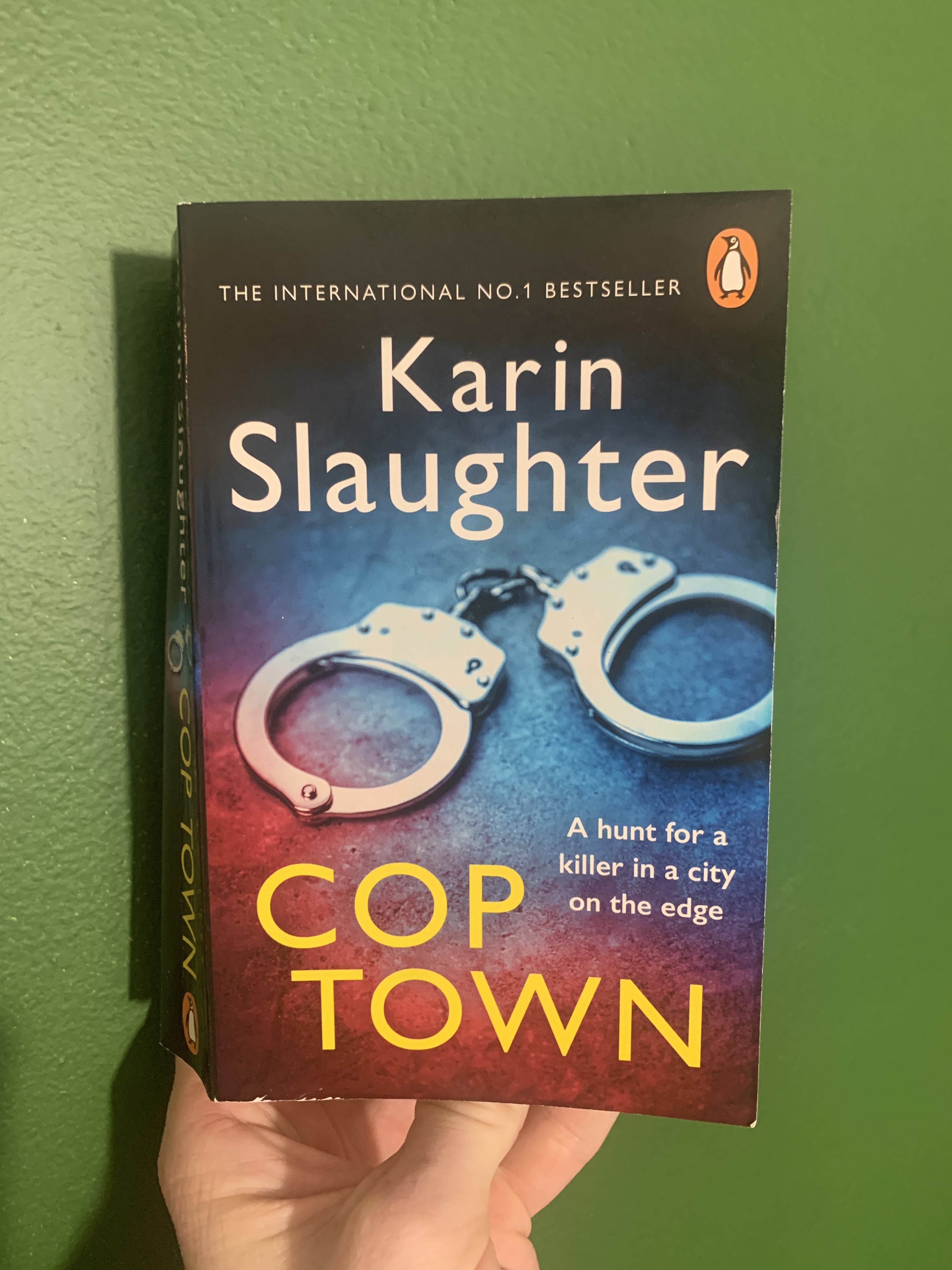
Of course, I couldn’t end the year without reading a Karin Slaughter book (last year, I read five to finish off the Will Trent series). Her standalone 2014 book, Cop Town, set in 1974 Atlanta is grimy, riveting, and heart-pounding throughout. Nobody writes crime fiction quite like Slaughter. I particularly appreciate when she takes a deep dive into researching the milieu — 1970s Atlanta, and specifically cop culture, and also, the Holocaust — to bring the story to life. Indeed, 1970s Atlanta, like many large American cities was dealing with the follow through of the Civil Rights movement and integration, but that also included integration of women into male-dominated industries, such as policing. The older guard at this point, all of whom were mostly straight, white, non-Jewish men, were often veterans of WWII, experiencing PTSD before it was named and treated as such. They self-medicated often with alcohol and violence toward others, but most certainly turned inward at home. That’s where our two main characters, Maggie, a five-year police veteran, and Kate, the FNG (or “fucking new guy”), are dealing with: the misogyny and threat of (and often perpetrated) violence (physical and sexual) from their fellow police officers and family members, much less the already-difficult task of being a police officer in 1970s Atlanta. What a captivating political and social environment in which to place a serial killer whodunit, especially when that serial killer is targeting police officers (the 1970s was also the apex of officers killed in the line of duty). Captivating and maddening in equal measure, I couldn’t read this one fast enough.
Maggie comes from a law enforcement family. Her uncle Terry, who is the patriarch of the family after her father’s mental illness-spurred death, is a police officer and WWII veteran, and so is her older brother, Jimmy. He was the star football player until he injured his knee, so, he became a cop, and Terry and all his similarly aged police brothers, took Jimmy under their collective, boozy wing. Even though Maggie’s ostensibly one of them, because she’s a woman, Terry expects her to know her place. Really, he’d prefer she quit and do “women’s work.” Indeed, she’s already expected to regularly wash Terry’s and Jimmy’s uniforms. So, yes, Terry is an arrogant loudmouth, racist, sexist, and bigoted toward the “changing of the world” with respect to the inclusion of Blacks, women, and Jews. He’s also violent, and doesn’t think twice about punching or physically accosting Maggie. And like his partners in blue, he drinks, all the time, including during the day and on-duty — heck, often at 9 a.m. They don’t think twice about getting behind a police cruiser after a round or two or three of drinking, either. Again, it’s maddening to think that such a culture was even an iota like this, and how many crimes went unsolved and/or ensnared innocent people due to their arrogance, drinking, and not doing policing by the book.
Slaughter depicts these men like Terry so well, “Same cropped haircuts. Same bushy mustaches. Same kind of anger flashing in their beady little eyes. Terry’s friends all had names like Bud and Mack and Red and talked about the good old days like preachers talked about heaven. They all had multiple ex-wives, angry mistresses, and grown children who wouldn’t talk to them. Worse, they were all the same kind of cop as Terry. They always knew better than everybody else. They never listened to anyone from the outside. They carried throwaway guns in their ankle holsters. They kept their Klan robes hanging in the back of their closets.” These are not good cops. The world needed to pass them by with more women, Blacks, Jews, and actually decent white men, too, representing the police force and reflecting the communities in which they served. Unfortunately, the Terrys of the world will always rage against the world’s attempts to pass them by. Often impotently, to be sure, but sometimes, very violently.
In walks Kate to this fray, green as goose shit, as they say, and what’s wild about such dynamics is that of course Kate’s getting sexually harassed and accosted by the men on the police force her first day, but she’s also getting bullied and pushed around by the women, too. That’s because the women by necessity need to try twice as hard and be twice as good to prove their mettle within the force, so they tend to look down even harder at new recruits who will probably wash out anyway. Why bother learning their names or being kind or helping them if they’re not going to last? That’s the thinking at least, but Kate is built different. Or at least, she will quickly realize she is after what she goes through. The reason she’s even applying to be a police officer is because a different war, the Vietnam War, took her husband. Now, she’s out to prove herself. She doesn’t need to, as she comes from a rich family who would happily take her in. But she doesn’t want that for herself. I mentioned the Holocaust research Slaughter did because Kate is Jewish and her grandmother and mother are Holocaust survivors. I think that also informs Kate’s sense of not only wanting to prove herself, but do good in the world. However, in the course of her first few days, it brings up a theme that is always present in Slaughter’s books: how do good people do bad things, and conversely, how do bad people do good things? Kate is particularly interested in the latter. She’s surrounded by these awful people — her fellow police officers, and in fact, when she’s putting this moral quandary to her grandmother, she’s actually talking about Gail, an older female police officer — and yet, if she was in a pickle, they’d think nothing of risking their life to save hers. How do you square that? Especially when the serial killer who has killed four police officers at the start of the book, and then a fifth shortly thereafter, is propelled by such animus that is casually bandied about by the officers? Indeed, one of them, a cop, stopped talking about it and decided to take action by picking cops off one by one, typically because they’re associating with one of the “others,” like a Black woman or a Jew. (The grandmother relays the story of a girl from her class, who was accompanied by a Nazi, who decided to help her instead of outing her out to the Nazi. In other words, humans are complicated.)
What kickstarts the renewed hunt for the serial killer of cops is the shooting death of Don, Jimmy’s partner. Jimmy carries his body to Grady Hospital, but he’s already dead. If the shooter’s gun hadn’t jammed, Jimmy would surely have died, too. Prior to this, the four police officers were shot in pairs, execution style after being ambushed on a bogus burglary call. Kate later learns from a doctor friend she knows at the hospital, Philip (there’s a whole side plot with Kate and Philip having raunchy sex, and I didn’t need it at all, to be honest), that he pulled shrapnel out of Jimmy’s legs. In other words, Jimmy’s injuries contradict his sworn statement about how the shooting transpired. What really happened was Jimmy and Don were engaged in oral sex when the shooter happened upon them, shooting Don in the head. Jimmy, despite his bravado and womanizing, is gay. If Terry finds out about it, he’d probably kill Jimmy outright. Before he can, though, Jimmy is kidnapped by the shooter and forced to write a confession to not only being gay but being the shooter. As predicted, Terry decides to handle this himself and is going to kill Terry on site. He nearly strangles Maggie when she tries to stop him.
Fortunately for Jimmy and for actual justice, Kate is proving herself to be a smart cop who is good at working the case, and Maggie has always been good at it, if Terry just would shut the hell up and listen. Working together, Maggie and Kate uncover proof that Jimmy was gay, sure, but also that it’s unlikely he’s the shooter. They also solidify the fact that the shooter must be a cop or at least ex-military, owing to awareness of police codes, procedure, and marksmanship.
The shooter takes out another cop, which brings Terry, Maggie, Kate, and the rest of the Atlanta Police Force to the Howell Rail Yard. But that’s part of the shooter’s plan to frame Jimmy and kidnap Kate, which has been his real desire. He’s been stalking her throughout the book. Once on site, of course Terry thinks the shooter is Jimmy still. When Maggie tries to stop him yet again, he punches her in the face. Gosh, I hated Terry! When Kate gets involved, Terry physically assaults her, too, but then the shooter shoots Terry in the stomach. Kate and Maggie take cover in a nearby building, where they are then joined by fellow cop, Chip. It dawns on Maggie, though, that Chip sure came out of nowhere and that he seems to be encouraging Kate and Maggie to escape to the roof of the building, which makes no tactical sense. It hits Maggie then: Chip is the shooter. But Chip is ahead of her; he puts a gun to her head and takes her out to the roof where Kate already is with a tied-up Jimmy.
Chip grew up with an abusive father, who was brutal to him and his mother. The mother died when Chip was young, and the father attempted suicide the day of her funeral. Chip finished the father off. After WWII, he’s blamed all the usual “others” for the ills of society, which is why he’s been killing cops. I think subconsciously he’s also been killing them for having not saved his mother from his abusive father.
The arrogant Chip underestimates Kate, though, who was counting how many bullets Chip had left. She’s able to reach Maggie’s discarded gun because Chip has no bullets left and shoots him in the shoulder. Chip would prefer to die by cop than be arrested, though. However, Kate, being the good cop she is, convinces Maggie that the right thing to do is to bring Chip in. Before they can, he jumps off the building, killing himself. Kate and Maggie then decide to lie that Chip made up the fact of Jimmy’s homosexuality to protect Jimmy (poor Jimmy wanted his sister to shoot him rather than those cops believe what Terry had said). Kate even leans into the lie in the Epilogue by pretending to be Jimmy’s girlfriend.
The sweetest comeuppance isn’t even against Chip, though, but Terry, who survived the shooting, but is paralyzed from the waist down. He summons Maggie to his hospital room to continue berating her as usual. But Maggie knows he’s powerless now, and she tells him as much. She tells him how much of a loser he is, and that his despicable words likely inspired Chip. She compels him to apologize to her, which he does. Good for Maggie. Suck it, Terry.
I’d love more stories with Maggie and Kate moving up through the ranks and becoming detectives solving crimes in the late 1970s and early 1980s. They were such interesting, compelling characters: Maggie, five years in already turned cynical, but still trying to do honest-to-goodness police work, and Kate, the newbie also trying to prove herself in a male-dominated, competitive industry. All of it wrapped up in the authenticity of Slaughter’s research into Atlanta and the dynamics at play. Even if you’ve stayed away from Slaughter’s notable two series, you have to give her standalone books, like Cop Town, a shot. No pun intended.


