
Spoilers!
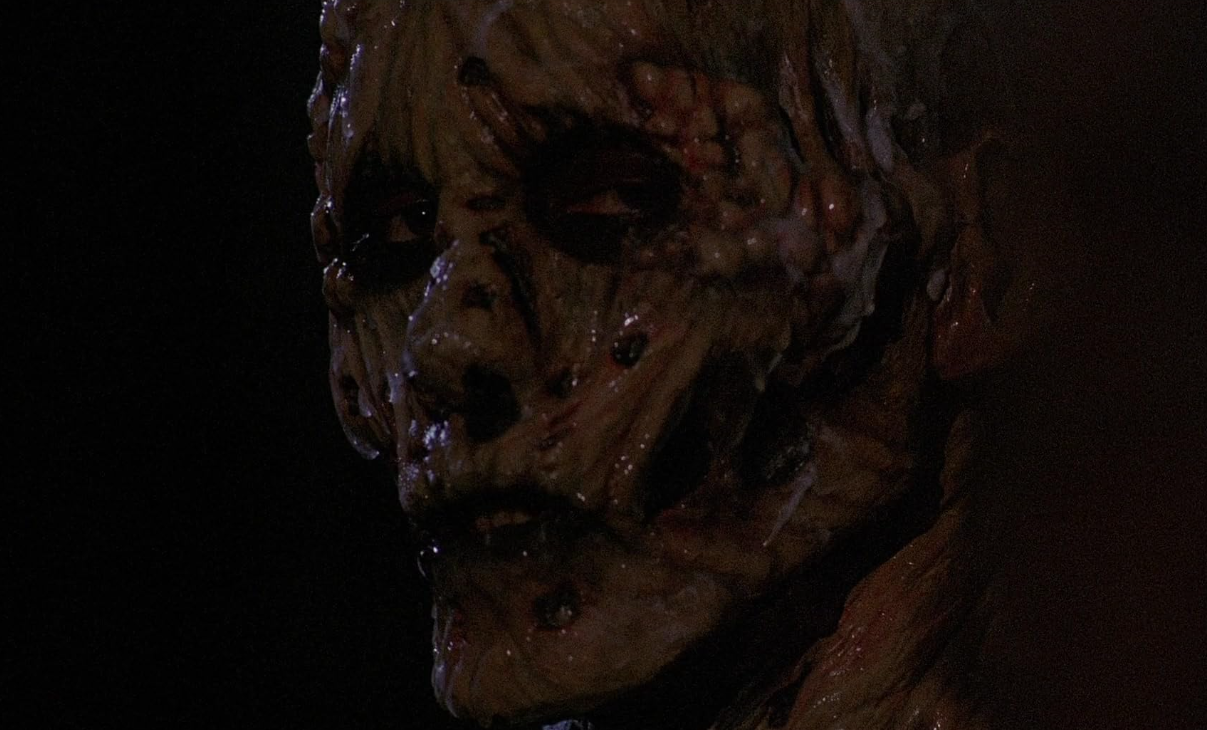
I was trying to put my finger on why I’ve never had an interest in watching the Hellraiser movies despite the reputation they have (or at least, the first two films), and of course, the popularity of Pinhead. Sure, Pinhead (and the Cenobites more broadly) isn’t necessarily top five material for slasher villains, but he’s right there. Or maybe he is in your top five! Personally, I’ve always seen Child’s Play, Leprechaun, Candyman, and Hellraiser as more of the B-level for horror films, whereas Halloween, Friday the 13th, A Nightmare on Elm Street, and Scream were the top tier. Then, as I decided to watch 1987’s Hellraiser for the first time beginning to end, it hit me what the analogy is for this movie. It’s like enjoying rock music (Halloween), but only occasionally dipping my toes into heavy metal (Hellraiser). Which is to say, as I was watching the film, Hellraiser, as weird as it is to say, is not as “grounded” as Halloween, and plays more to the extreme end of the spectrum, like heavy metal. Anyhow, I’m glad I finally gave Hellraiser a proper viewing because I thoroughly enjoyed it! Pinhead saying, “We have such sights to show you!” will stick in my head for a long time to come. What a phenomenal line!
Hellraiser is based on British author Clive Barker’s novella released a year previous, The Hellbound Heart. What I think has to be so neat for an author is that Barker himself wrote and directed this adaptation on a $1-3 million budget. Given those budget constraints, the special effects by Bob Keen are quite impressive, and some of the scenes I’ll talk about below hold up well nearly 40 years later. Also of note, is that apparently, as the story goes, the film stars British actors, but the production company wanted American accents dubbed over. Honestly, I didn’t really notice one way or another or care.
A hedonist named Frank (played by Sean Chapman) buys a puzzle box while in Morocco. Now, it wasn’t instantly clear to me what the puzzle box promised, but if one “solves it” it introduces you to otherworldly pleasures. The entire conceit being this hazy line between pleasure and pain in this “otherworld.” The film does not establish what it means or looks like to solve the puzzle, which I think is a pivotal point I’ll address more later.
Later, Frank’s brother, Larry (played appropriately stiffly by Andrew Robinson) and his new wife, Julia (played terrifyingly by Clare Higgins), move into Frank’s seemingly abandoned house. What they don’t know is that Frank opened the puzzle box and unleashed chains from the otherworld that tore him apart. His body is beneath the floorboards of one of the rooms. What Larry specifically doesn’t know is that Julia had a prior affair with Frank and still pines for him. After Larry cuts his finger and his blood drips onto those aforementioned floorboards, it’s enough to begin reconstituting Frank’s body. That reconstituting of Frank’s body is one of the great special effect sequences by Keen. Even though he’s now a ghastly creature far from wholly human, Julia still pines for Frank and is willing to do his bidding! What’s his bidding? Bringing him more blood to further advance his regrowth. So, Julia brings him men who think they are having a torrid affair with her, only for her to bash them in the head with a hammer and Frank to take their blood.
It is through Frank that we first learn about the Cenobites, the actual beings who emerge from this otherworld once the puzzle is solved to dish out pain and pleasure to the extreme.
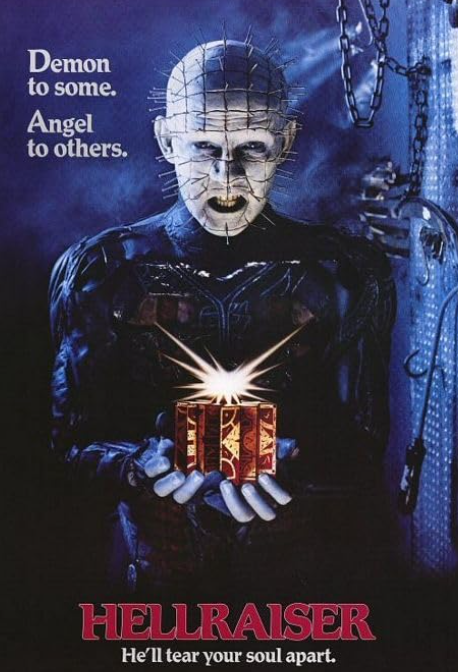
Kirsty (played by Ashley Laurence), Larry’s daughter, soon catches Julia bringing a would-be suitor to the house. While investigating further inside the house, she runs into Frank, but is able to escape, and with the puzzle box, no less. She awakens in a hospital, opens the box, as one is likely to do out of curiosity, and summons the Cenobites. Pinhead (played by Doug Bradley), ostensibly the leader of the Cenobites, explains to Kirsty that they are castigated as demons or venerated as angels, but they are merely “explorers” unable to clearly discern between pain and pleasure. To delay their encroachment upon her, Kirsty reveals that Frank survived them, which motivates the Cenobites to recapture Frank.
In a grotesque and horrifying scene, Kirsty returns home to find her “father” waiting. Instead, it’s Frank who has assumed Larry’s skin. Frank, as Larry, is even sexually harassing Kirsty. His niece! Frank’s and Julia’s goal now is to sacrifice Kirsty to Frank to complete his rejuvenation. But Frank stabs Julia in the course of this, killing her, which he doesn’t care about, and then he turns his attention to Kirsty. The Cenobites stop Frank, knowing now that he escaped them, and tear him asunder once more. Then, the Cenobites turn their attention to Kirsty. I believe it is around this time we get Pinhead’s line mentioned at the top, plus a woman Cenobite tauntingly and ominously saying to a fleeing Kirsty, “Not leaving so soon, are you?” Another memorable line!
But here is where I take issue with the puzzle box of it all. Kirsty begins fiddling with the puzzle box and because she “solved it,” she’s able to send the Cenobites back to wherever the hell (heh) they came from. But what does “solving it” mean?! How did she figure out how to solve it?!
Still, I think what’s so clever about Hellraiser is that the real villains of the movie are the very real humans, Frank (well, reconstituted as such) and Julia. The Cenobites, including Pinhead, are more of a force of nature, if you will, than anything else. Otherworldly nature, to be sure, but not villainous in the way Frank and Julia choose to be.
At the end of the film, the puzzle box returns to the Moroccan merchant, obviously teasing that more hell awaits for the next person who buys the puzzle box.
For such a limited budget and for being a gory, rather out-there film, Hellraiser made an impressive $30 million. It’s also a short and sweet (heh) 93 minutes. Hellraiser does not overstay its welcome by any means, and it’s certainly judicious with the Pinhead character, which was hauntingly acted by Bradley. It leaves you wanting more, along with more explanation of the box, for sure.
Overall, Hellraiser is well-worth the attention of any horror movie fan — and it’s to my shame that I dismissed it for so long! — because of its interesting concept, impressive special effects, and memorable Pinhead character, both the dialogue and character design. Now, I’m ready for Part II!


