
Spoilers!
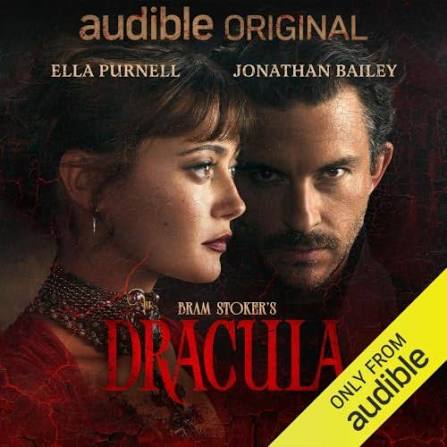
Until Audible’s full-cast audio drama adaptation of Bram Stoker’s Dracula, released on October 1, I had never listened to a fiction audiobook. I’ve certainly listened to nonfiction audiobooks, but with fiction, I’ve always had a preference for reading the material with a physical book. My aversion was more about ensuring my ability to retain what I was reading and following along than anything else. But given that Audible’s adaptation was more than a typical reading of the material, and reduced to just under 6 hours told across 6 parts — and of a book I’ve read before — this felt like a great one way to break the seal on. It was a phenomenal listening experience. It brought me back to my days listening to horror stories on Old-Time Radio, with sound effects, eerie music, impressive voice actors, and an overall immersive experience. I was also often listening on my commute to work when it was still dark and occasionally foggy, which upped the creepy aesthetic experience. Ultimately, what a great way for someone to experience a classic book. I thoroughly enjoyed it. I particularly enjoyed the ways in which a modern adaptation can still thematically resonate with respect to believing women, the demands of masculinity, and the seductive pull of all that Dracula represents.
This dramatic adaptation was done by Robyn Ahern (her first lead credit!) and directed by Mary Lambert, with an original, haunting, and unforgettable score by Illan Eshkeri. The soundscape in general is incredible throughout. Audible pulled out all the stops with its cast featuring Jonathan Bailey as Dracula, Ella Purnell as Mina, Aimee Lou Wood as Lucy, and Maggie Gyllenhaal as Professor Van Helsing. Bailey, especially getting to play a villain, Purnell, and Wood were fantastic and really helped with the immersion. Admittedly, I thought Gyllenhaal was a step-down by comparison. However, David Jonsson also deserves a shout-out for his voice work as Dr. Seward.
The story follows Mina as she tries to ascertain the whereabouts and circumstances of her husband, Jonathan’s (voiced by Louis Partridge), disappearance in Transylvania. Even as she’s trying to do so, the predator who ensnared Jonathan in his castle, Count Dracula, is already extending his evil tendrils out toward Mina’s friend, Lucy. He attacks her outright, sinking his sharp teeth into her neck, and so begins the slow, agonizing process of her turning into a vampire and coming fully under his control.
What’s compelling about the aftermath therein is that there’s a resonant modern theme: doctors not believing women. Dr. Seward is initially very skeptical of anything Mina tells him regarding what she witnessed and Lucy’s condition. Then, when the professor he looks up to for their work on blood conditions, Professor Van Helsing, arrives, he’s taken aback that the professor is a she! Biases are a helluva drug. For her part, though, Van Helsing is irritating in her opaque observations and directions, true to the source material. But still, you just want Van Helsing to tell Dr. Seward and everyone else what they know! That’s what makes for an important character arc, as Van Helsing will own up to having not been more forthright later in the story.
Mina learns that Jonathan is in Istanbul convalescing from his ordeal at Count Dracula’s house. Fortunately for Mina, he documented it in his journal. I believe it’s Part Two that details everything. The gist is that Jonathan, an assistant to a solicitor, was sent to Count Dracula’s house to help him with real estate, only to be imprisoned and psychologically accosted into doing more of Dracula’s bidding and assisting with preparations for his London machinations. Part 2 is great because it’s the most we get of Bailey’s performance and it’s spellbinding through audio alone! This section, and later when Jonathan is at first reluctant to help track down Dracula, especially if it means going back to his castle, is a great reflection of the demands put on masculinity. Which is to say, Jonathan feels so much shame around his experience with Dracula because he thinks, as a man, he ought to be braver. But it was horrific! I also think there’s something to be said for Victorian mores that even kept him at the castle in the first place, i.e., not wanting to be rude. Eventually, Jonathan does journey with everyone to hunt down Dracula, though.
Back in North London with Lucy, as Dr. Seward, Van Helsing, and a grieving Arthur (voiced by Francis Lovehall), who just buried his father, are trying to figure out how to stave off more intrusions by Dracula, not that Van Helsing has let on that that’s what she’s doing. But she is guarding against Dracula all the same with garlic and sacraments. It doesn’t work. Dracula is too powerful. He breaks into her house, kills Lucy’s poor mother, and then further drinks from Lucy’s blood ensuring she’ll fully turn. And the reason Dracula was able to gain access to Lucy is that she was unprotected. Dr. Seward had maintained a consistent vigil over her each night except for that night because Renfield (brilliantly and eerily voiced by Johnny Flynn), one of his patients, attacked him. Indeed, Renfield, who takes to consuming spiders, seems to be a willing minion of Dracula’s. The spider-eating scene made me shudder, one of a few times the audio dramatization engendered such a feeling!
Dracula is also able to attack Mina, so now she’s also on the trajectory toward being under Dracula’s control. However, Dr. Seward, Van Helsing, and Arthur, now fully knowledgeable about Dracula and his macabre ways (inasmuch as one can be), especially and mostly, thanks to Mina putting all the pieces together, know how to come after Dracula: while he’s asleep in the dirt of one of his coffins. The problem is he has a lot and they’re spread out. He’s also freaking powerful. With the help of a mental connection to Dracula, Van Helsing hypnotizes Mina, so they are able to trace Dracula back to his stomping grounds, his castle. Van Helsing, boldly, confronts him alone, this only because Mina seems too far gone and is left behind in a sacraments circle, and Jonathan, Arthur, and Dr. Seward did the proverbial split-up and came toward the castle in a different direction (honestly, I lost track of whether it was Jonathan or Arthur or both who were still with Dr. Seward at this point) Admittedly, the lead-up to this momentous confrontation between Van Helsing and Dracula is difficult to pull off on audio because there’s not a real reason for Van Helsing to verbally narrate what she’s doing all alone, as she creeps through the castle, or for Dracula to then help with explaining the action that is occurring. That said, it’s both amusing and terrifying when Dracula laughs in the face of Van Helsing, who tries to stab him with a wooden stake. He breaks her hand and ushers her into the darkness. Jonathan, Arthur, and Dr. Seward arrive, with the latter essentially sacrificing himself long enough for Arthur to finish off Dracula and turning him to ash. Conquering Dracula also means returning Mina to human form.
Years later, we aptly learn through Mina’s diary, that she and Jonathan have a child named Jack, so named after Dr. Seward. Mina also reveals what keeps her up at night, the dying words Dr. Seward whispered to her: “Truly, there is no such thing as finality.” Dun-dun-dun! Ominous. Which is to say, I think, that the seductive nature of what Dracula represented — power, control, violent hedonism, greed (in more ways than one), and immortality — are always seductive to humans. And it’s the seductiveness that makes this such a thrilling and enthralling adaptation of Dracula. Dracula is monstrous and frightening here, yes, but it’s all more so conveyed, and accentuated by the score and soundscape, through an insidious hypnosis than anything else. Indeed, a lot of what the characters face is psychological horror, even in a story well-noted for its body horror. Perhaps most horrific is that by the nature of something being seductive and hypnotic is that, despite Dracula being so abhorrent, there’s a certain sensualness to it all. For him to take over your mind, body, and spirit, he has to ultimately imbibe upon your blood with a “kiss” to your neck. Refuting such a powerful force rather than acquiescing takes the fortitude and mettle that Mina possesses, which isn’t a knock on Lucy since she had no clue what she was up against, and that is what makes Mina such a memorable and important character opposite Dracula, even more so, arguably, than Van Helsing.
Overall, if you love Dracula and vampire stories in general, you owe yourself the experience of listening to this exquisitely evil audio dramatization and adaptation of the classic book. It will linger because, well, there is no finality to things.


