
Spoilers!
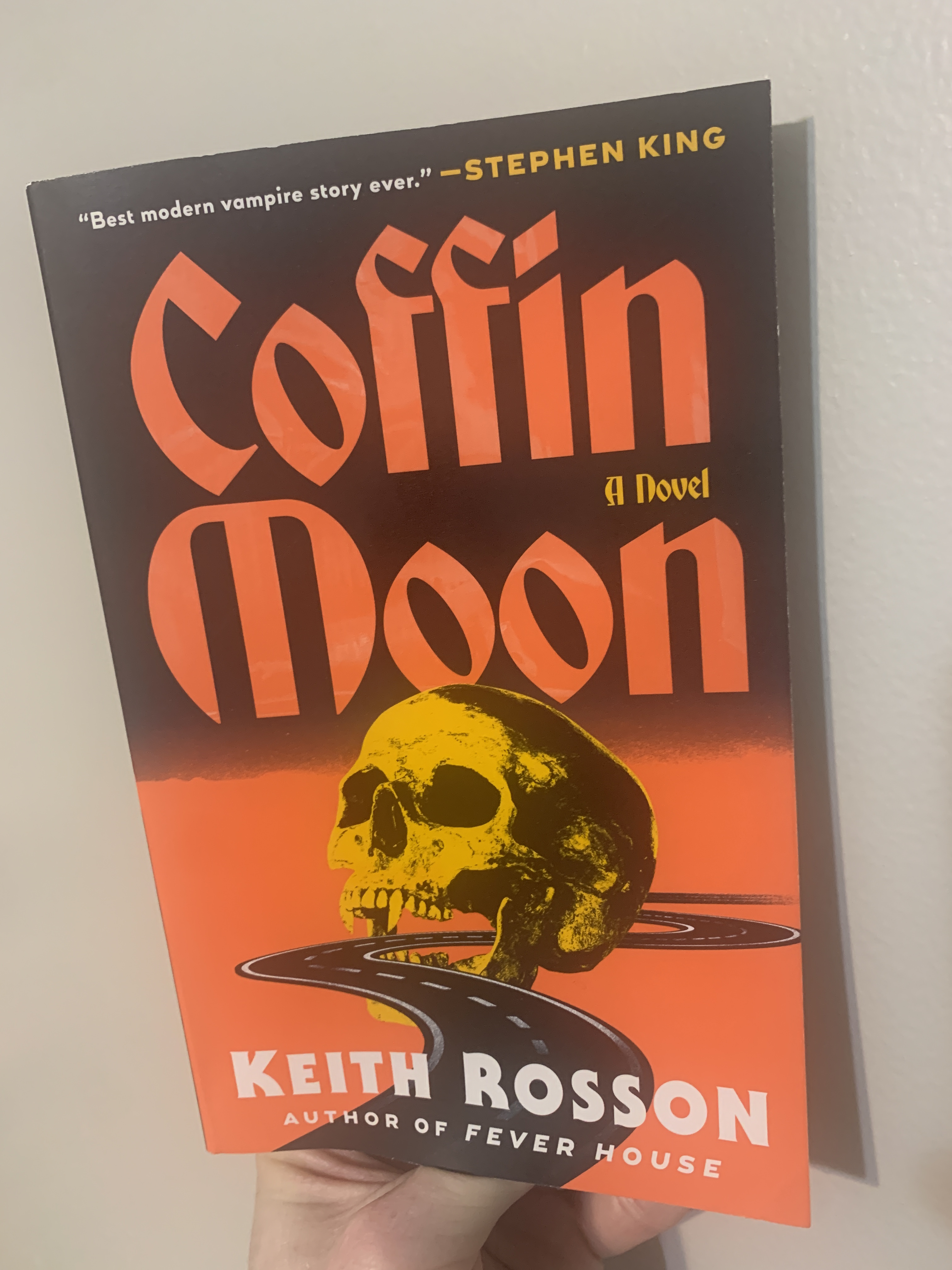
Revenge is a path that leads to something necessarily less than human. A kind of unbecoming. An undeading, all under a pale coffin moon, if you will. In Keith Rosson’s macabre hands, 2025’s Coffin Moon is a blood-curdling, haunting, and feverish nightmare. Both a coming-of-age and an unraveling revenge tale, and also an allegory for the deindividuating unbecoming necessary for violence and war, Rosson’s book is one for the ages, breathing fresh death upon the subgenre. To use his kind of vernacular, nobody is writing like Rosson, man. The brother just has it. His prose is well, biting, and leaves you thirsting for more. (I couldn’t resist, but seriously.)
Set six months before America’s bicentennial, Duane Minor is a Vietnam veteran haunted by his wartime demons — the violence he was forced into committing, given the draft, although, of course, there’s always choices, as far as that goes up against the federal government — and trying to stave off the drink while being a bartender at the aptly named Last Call, no less. Last Call is a bar his wife, Heidi’s, parents inherited. Duane and Heidi live in an apartment over the bar with Julia, Heidi’s niece, a troubled 13 year old girl. Troubled for good reason. She grew up in a traumatic household with an abusive, tyrant step-father (her own father died when she was younger). That is, until her mother killed him in self-defense, but was sentenced to life in prison, hence, Julia landed with Uncle Minor and Heidi.
Even though Minor is trying to do right by Heidi and Julia, stave off the temptation to drink and being mired in his own subconsciousness by his PTSD, external forces have other ideas. it all starts with a very real human force: his mother-in-law, Joanna, makes a deal with, well, the son of a devil, a man named John Varley. Varley wants to run heroin through the bar, and she’s willing to let him … if Varley turns Ed, her husband, who is dying of cancer. But Minor tries to stop it, worried about the implications of drugs running through the bar and not knowing the deal-with-the-devil aspect. Varley, who has a hair trigger temper and his mistress is rageful violence, brutally murders Heidi, Joanna, and Ed (Julia was at a friend’s house, her first sleepover, and Minor was tending bar).
So begins our revenge story overlaid Julia’s coming-of-age (an endless age?) story. Heartbroken and grief-stricken, Minor is trying to hold together his sanity and the old life desire to protect Julia still, and Julia is just all revenge. Pent up, youthful rage. She wants revenge against Varley. On this new journey, these two are clearly going in opposite directions, with Minor falling back into drink and Julia becoming a brazen detective trying to sniff out Varley’s whereabouts. Along the way, though, what becomes clear is the unmentionable: Varley is a vampire, turned sometime in 1903, and as we learn, by a Maker, one of the handful of original vampires. That makes Varley particularly strong. Yes, like all vampires, he fears sunshine and silver, and must satiate the hunger for human blood, but he’s stronger than your average vampire, plus, he can do a blood-calling to summon other vampires to do his bidding and petition his Maker for help. As for the Maker that turned Varley, it (Varley sees it as a thing, definitely less than human) is even more terrifying because of its added powers, including the ability to transform into a werewolf and protrude claws. The Master is so strong it even survived a brush with sunlight that would have turned other vampires into ash.
The way Rosson renders most vampires, though, is that they are miserable barflies. That if they had an ounce more of courage than of the blood they seek, they’d walk into the sunlight and end it all. But instead, they float within this awful undead twilight. It’s more curse than liberation. But Varley, who has these fears to be sure, embraces his power, his ravenous nature — and he is terrifying in the way he will rip a man’s head off and slurp from their gaping necks — but still wants to put some distance between the events of Portland, so, he heads to Sioux Falls, South Dakota. There he meets a European drifter, a normal human sociopath named Johan. They fall in love, as Johan becomes Varley’s “thrall” or human object, or means of conducting his business as such.
Back to Minor and Julia, the latter’s hunt proves successful, as she comes across a girl younger than her who is a vampire with a “Children’s Museum” of vampires similarly aged she keeps turning in hopes to find a good friend. Julia realizes the best way to ensure she can kill Varley is to be turned and become a vampire. Ah! She does this before Minor can stop her. Then, 18 months later, we learn Minor and Julia are still on the trail of Varley, just with the uh, minor adjustment, of accommodating Julia’s aversion to sunlight and need for human blood. Minor’s at least learned from his mistakes and has staved off his own kind of drink once more. Their goal now is to hunt down silver bullets to better take on Varley. They acquire some, often through bartering with Minor’s own blood distilled into vials.
After Varley utilizes his blood-call, which is essentially putting out a contracted (in this case, an obligatory) hit on Minor and Julia, a vampire surprises them at the motel they’re staying at. Thanks to the silver bullet, they are not only able to best the vampire’s attempts to kill them, but then torture him for information about Varley. Minor and Julia then run into Johan, who is cruising at a local bar for another human victim for Varley. Using the gun, Minor and Julia induce Johan to take them back to the barn where a weakened Varley is (weakened after the blood-calling). A showdown occurs that is such a great example of why Rosson is a writer unlike others. One, that the showdown even occurred already at that point in the book, but two, that Minor didn’t listen to Varley’s nonsense; he just shot Johan in the back, killing him. Then, Varley nearly kills Minor in return, or would have, if Julia wasn’t able to save him, get away, and then make the decision to turn him. Now, they’re both vampires. It is in the turning that Minor experiences the pull and power of the “coffin moon.” Also, a sick detail in the turning is that Minor (and Julia before him) is sweating out all of his human blood to make way for the other human blood he will subsist upon. What a grisly image.
Varley is aghast over Johan’s death, the first and only love his life. This tit-for-tat revenge is just an endless cycle of violence and grief. And he’s not experienced that grief side until now. He decides to summon the Master, and as alluded to, he realizes the Master is weakened, a husk of a thing. The Master, like Varley’s real human father decades ago, rejects him and his request for help. So, Varley kills it, only possible thanks to its weakened state, and that allows him to become Master-like, and more powerful. Oof, as if Minor and Julia needed that! But they still have the silver bullets. So, when Varley uses another Master power, the push, to get a Portland detective to tell him where Julia is likely to go next — the cemetery where Heidi and the grandparents are buried — he’s ready. Varley dispatches with the detective, and then he’s toying with Minor (playing with his food!), when Julia once more saves the day, shooting Varley twice. The silver bullets rip up his jaw and arm. He scampers away.
Minor and then Julia follow him to a homeless encampment. Minor is just freakin’ tired, man. He’s done with it all. That’s why he doesn’t mind listening to Varley’s villainous rantings and ravings. But Julia? Again, this is where Rosson shines. She walks in, still holding the gun with the silver bullets even though it’s charring her hand and arm, puts the gun right to Varley’s head, and without saying anything, pulls the trigger, killing him. Bad-ass. She then parts ways with Minor, fulfilling her promise to return to the Children’s Museum.
As for Minor, he goes full circle, returning to Last Call, which has now been bought by someone else and renamed, and reads Heidi’s unpublished manuscript, aptly titled, The Hollow.
The reason Coffin Moon also works on the level of an allegory about war and being drafted into it, as Minor was, is that the same thing happens to him when Julia turns him. He had no choice in the matter. The way in which Rosson describes the former when Minor reflects on returning home from Vietnam is eerily similar to the aftermath of a turning, one must think: “When he finally got home … it felt like he was stepping back in time, attempting to reclaim some vestige of his old self, only to find that that old self had been chipped away, sanded, scrubbed and crafted into something new. Maybe into something worse, certainly not better, but irrevocably something different.” Haunting as hell. War sucks. Drafting people into war is like a vampire seeking thralls. The difference at the end of Coffin Moon, though, is I’m not so sure the more experienced Minor now, who has been through some shit, believes he’s stripped of choice. He doesn’t have to feed. To drink blood. He could walk into the sunlight, which in essence, reading Heidi’s manuscript finally, is his first step into the sunbeams. Beautiful. Raging for the coming of the light, as it were.
Mayhem, madness, melancholy. Nobody writes horror like Rosson. And at such an unbelievably frenetic pace. I can’t wait to see what he does next.


