
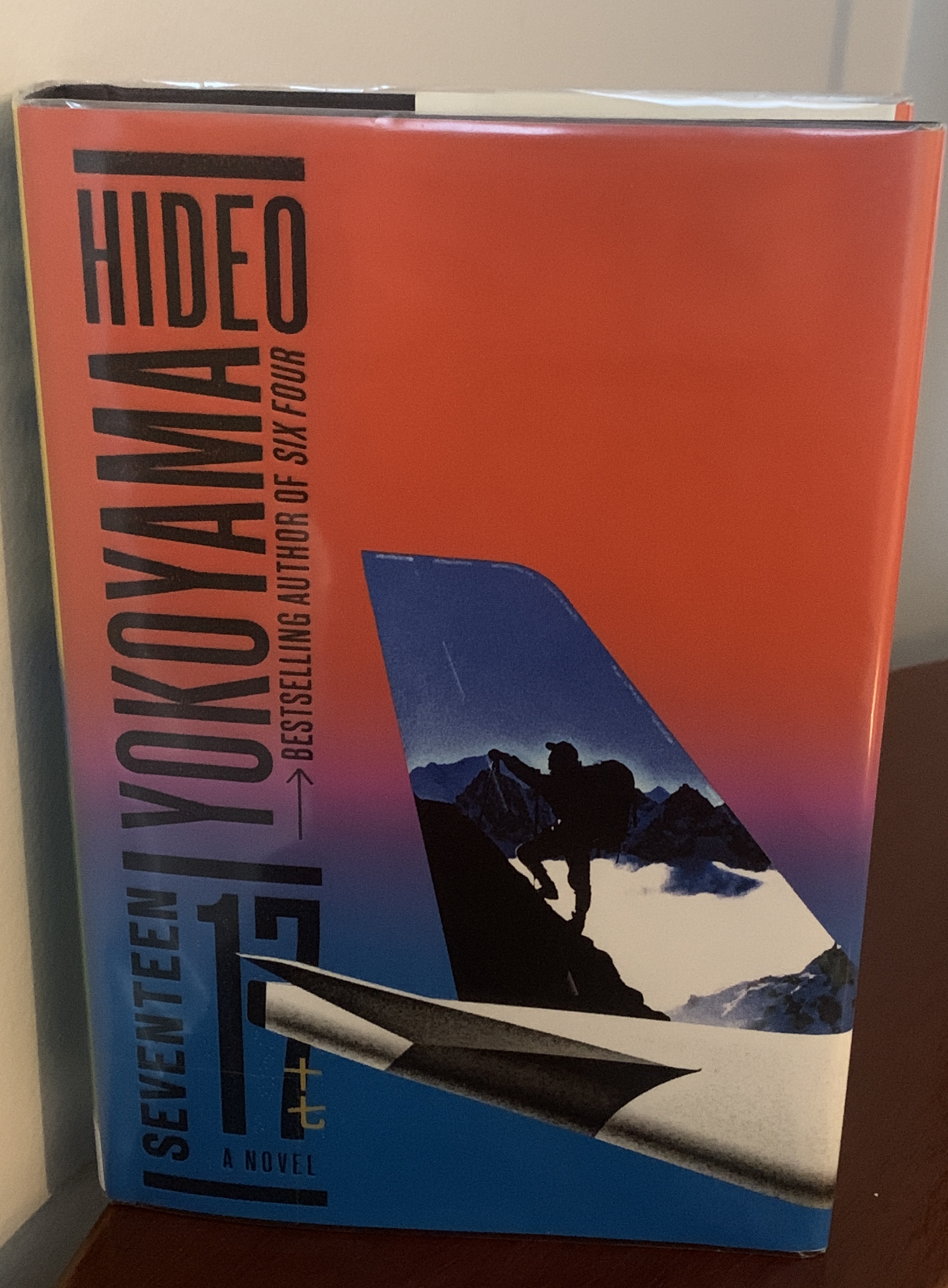
I climb up to step down. Hierarchy, newsroom tension, fatherhood, and even life and death are explosively explored in Hideo Yokoyama’s 2003 book, Seventeen, which was translated into English in 2018 by Louise Heal Kawai.
As a former journalist, like Yokoyama, I was enthralled by the newsroom scenes, as the fictional journalists tackled the real life 1985 Japan Air Lines Flight 123 crash that resulted in 520 deaths. The reporters at this local newspaper, the North Kanto Times, which covers Gunma Prefecture, now had to cover one of the deadliest airline crashes in world history because the crash site fell in Gunma, despite there being no flight path over the prefecture, competing, as it were, against much bigger newspapers from Tokyo and elsewhere. The main character, Yuuki, has been something of a lone wolf “roving” reporter, bucking hierarchal tradition to move up to a management position in favor of still being a reporter. Even so, he’s tasked with being the JAL Crash Desk Chief after the plane goes down, and now oversees the paper’s response to the crash. Professionally, Yuuki also recently blew up at a young reporter, Ryota Mochizuki, who then apparently killed himself thereafter. Neither he nor the newsroom, feel any guilt over it, though. Again, there’s this interesting hierarchy where Yuuki, for example, can choke his subordinate, but if the subordinate were to punch someone senior to him, that’s a termination-worthy faux pas. Meanwhile, personally, Yuuki has the shame of being the “son of a whore” because his widowed mother was a prostitute, and at home, he doesn’t know how to be a father to his two children, especially his son Jun. Yet, he is able to be a fatherly figure to Rintaro, the son to his climbing friend, Anzai, who suffers a hemorrhage that results in a persistent vegetative state just as they were about to climb the fabled and feared Tsuitate. It is Anzai who leaves Yuuki with the aforementioned riddle, I climb up to step down.
In a newsroom, there is a natural and intentional ethical divide between the Editorial Department and the business side, or the Advertising Department. However, in Yokoyama’s book, that divide is heightened to ferocity. They hate each other and don’t understand or have any insight into or respect for what the other does. The same is true of the Circulation Department. Then, even among the Editorial Department, there is a divide between those who wish to see the Chairman of NKT, Shirakawa, ousted, which is fair because he’s a creep and sexual harasser, and those who support him. Moreover, relevant to the JAL crash, there are those who see it as a, well, full-court press situation that requires continuous front-page coverage, and there are those who think it was an “inherited accident” and why are we covering it anyway? Let’s move on. Part of that sentiment derives from the editors having made their name on a case 13 years previously known as the Okubo/Red Army era, when the reporters covered both a serial killer leaving his victims in Gunma Prefecture, and the Red Army siege. They don’t want these young reporters to usurp them and create a new legacy. Those are all the dynamics Yuuki is dealing with as JAL Crash Desk Chief, in addition to his own insecurities and doubting himself. Through the course of the book, though, he rises to the occasion, defends his reporters’ work, and believes in their course of action covering the JAL crash full-throttle. He doesn’t always win those battles, though, as sometimes Shirakawa shuts him down, or Oimura, the managing editor, nicknamed “The Firecracker.” The most commendable thing Yuuki does, though, from a journalistic standpoint, is not rush through what would be a worldwide scoop on the cause of the crash because he knows it hasn’t been fully verified. He could have gone with conjecture to get the scoop and instead chose not to. That was the right move. Journalists err when they aim to be first rather than right.
What was remarkable to me, and I don’t know if it’s true to Japanese culture, or at least Japanese culture in 1985, or if it’s heightened for fictionalized dramatic reasons by Yokoyama, but in any case, the dialogue between colleagues and boss-employee is so awful! I mean, the way they talk to each other, not the dialogue as written being awful. They are blunt and mean. Again, even among the Editorial Department people, much less the invective spat out between members of the different departments. Talk about a hostile work environment, and yet, Yuuki and the others seem to think it’s normal.
As for the namesake of the book (at least the English title; the Japanese title is Climber’s High, which is a fair reflection of something approaching an analogy for the “high” reporters feel covering something they know is an unfolding historic event), 17 years after the events of the JAL crash and its coverage, Yuuki and Rintaro are climbing Tsuitate. Yuuki never could do it with Rintaro’s father, who would die after his hemorrhage, but he can do it now with the son. But what about the riddle? I climb up to step down. Yuuki learns through Anzai’s diary that he was worked to the bone in the Circulation Department, and beyond that, forced by his boss to try to find evidence to help oust Shirakawa. Anzai was planning on leaving NKT and restarting his climbing adventures. (Anzai himself had stopped climbing around when his son was born because his slipped on a rock while climbing and the rock tumbled down, killing his climbing partner.) To Yuuki then, the riddle is literal: Anzai stepping down from NKT in order to climb. For his part, Yuuki never did step down, even after being threatened with termination by Shirakawa for printing a letter from Mochizuki’s cousin, who bemoans how media, like NKT, separate lives by those deemed important (the JAL crash victims) and those who are not (Mochizuki, or her father, who also died in a car accident), or to use her terms, heavyweight lives versus lightweight lives. There is obviously a lot of truth in that. She added that she sheds no tears for the JAL crash victims. Oof. NKT received nearly 300 complaints from readers for publishing the letter, but none from the JAL crash victims’ families.
For what it’s worth, I took Anzai’s riddle both literally, albeit in a different direction, and more philosophical. Literally, when climbers ascend a peak, by necessity, the other half of it is climbing back down, an almost anti-climber’s high, if you will, and sometimes, though, the climb back down can be as treacherous, if not more so than the climb up. Regardless, actually being on the peak itself is the smallest part of climbing. The real time is the climbing and the stepping down. There’s a lesson in that, and that’s where I think also it becomes a riddle with a philosophical underpinning, especially if you apply it to the newsroom tension: the old guard has to know when to step down and when their time on the peak is over. Oimura and his ilk clearly didn’t and they tried to stifle those on the upswing.
I’ve read a handful of Japanese authors’ work now that has been translated into English. Something I can’t quite put my finger on, and I don’t know if it’s a function of the act of translating or not, but Japanese authors have a writing style distinctly their own compared to English authors. Directness perhaps? Again, Yokoyama’s dialogue was searing, as was Yuuki’s inner monologue. There also isn’t a lot in the way of descriptive writing or scene setting per se. There is some, but most of it is just getting into the action of the moment through dialogue and inner monologue. All that to say, I enjoy that writing style! And I enjoyed Yokoyama’s book; I largely inhaled it over three reading sessions, with one of them being more of a binge than the other two. I’m surprised it took so long to translate this book into English, but I’m glad they did it!


