
Spoilers!
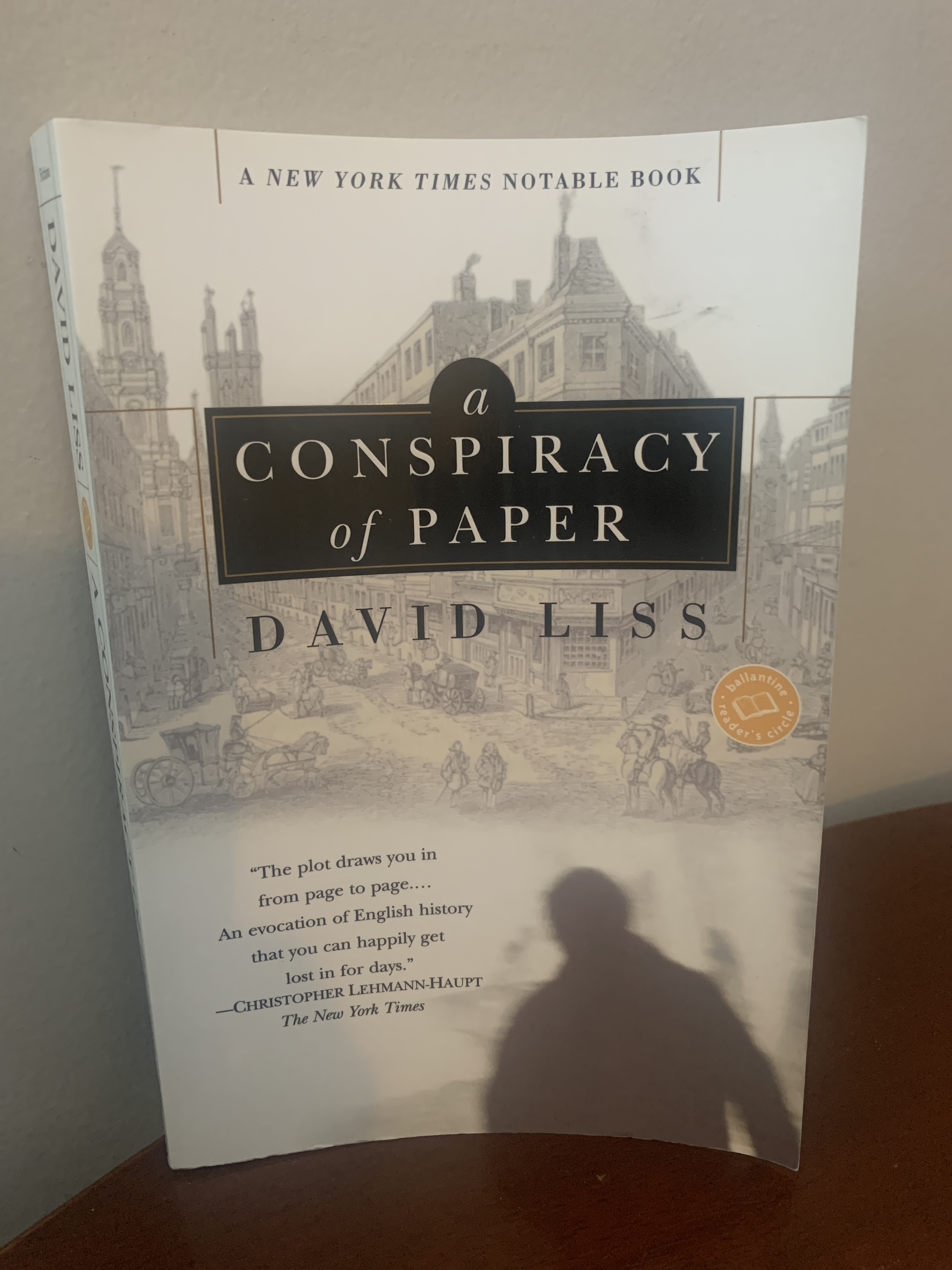
When a pugilist and a philosopher meets ruffians, rascals, and villains in 18th century London, I’m all in. David Liss’ 2000 book, A Conspiracy of Paper, is a compelling, gritty, often times jovial and hilarious, Sherlockian romp through a city on the precipice of monumental change, financially and socially. Liss, owing to his genuine research into this time and the financial machinations, offers authenticity and credibility to his world of fiction, with snappy, gentlemanly talk, but enough thrill around the stock-jabbering to make for an intriguing, endlessly readable book. By the end of 2026, I imagine I’ll look back on A Conspiracy of Paper as a sneaky dark horse favorite book of the year.
The book is set in 1717, and told by Benjamin Weaver, who is telling this tale 35 years after the fact in first-person memoir form. In the time of the tale, he was about 28-years-old. Weaver is a (lapsed practicing) Jew, which factors prominently into the anti-Semitic milieu of 18th century London. He is also the aforementioned former pugilist, who is credited with making boxing into a science or artform, and has since become more of a Sherlockian philosopher, helping people find their stolen goods. Then, a man named Belfour walks in and tells Weaver that he wants Weaver to track down who killed his father, and that he believes the same person must have killed Weaver’s father since they died around the same time. Weaver must now turn to murder. The added wrinkle to this is that Weaver was estranged from his father. As a young man, he grew angry with the ways of his father, and his money machinations as a stock-jobber, that he left home and never returned. Instead, his older brother stood to inherent the wealthy estate upon his untimely death. For the record, the family knew the elder Weaver was killed by a presumably drunk carriage driver, but the judge let him off, thinking it largely an accident. Belfour’s introduction into the story puts a macabre sheen over those events.
And like any Sherlockian character, Weaver needs a sidekick character to provide moments of levity, but also just as importantly, a character that helps Weaver with his scheming to uncover the truth, and ultimately, to better understand how to use his mind to deduce facts rather than his fists, although there is plenty of the latter, too. Elias is his sidekick, a doctor and playwright. Because the “modern” medical practice of the day is bleeding someone, Elias repeatedly cracked me up with his attempts to get Weaver to let him bleed him. Weaver always refused. Later in the story, when Elias is hurt during one of those schemes, he bemoans to Weaver, “Bleed me,” and I genuinely laughed-out-loud. But no, Elias was a great friend to Weaver, who couldn’t have solved the mystery of the book, or rather, the conspiracy of paper, without him.
London being the epicenter of the greatest empire then known to man was also on the precipice of a new era financially, which like the dawning of any new era, frightens some men and galvanizes others, spurs on crookedness and indeed, reflected in Weaver, also spurs on its counterbalance, goodness. For most of history, if Person A wants something from Person B, then Person A must give something Person B prefers more than keeping that which Person A desires, i.e., money. Money was reflected in bartered goods and such, and then also, physical items that seemed imbued with intrinsic value (although not actually since we’re still assigning them value), like gold and silver. Then, paper money came into the dynamic between Person A and Person B, where it’s just paper with the promise of money. In other words, the entire edifice relies on trust. Which gets tricky in a world of those who try to game the market through speculation and other schemes. A byproduct of this system, although it’s not as if these “symptoms” weren’t around before in other forms, is that some people who played the market and lost money assumed someone or something must be to blame. Something unfair must have occurred. Often times, Jews were the scapegoat, hence the disgusting stereotype of them controlling the money and the overall financial markets. Women were also castigated by men fearful of this system. One person Weaver talks to notes that all this trading for paper turns men into “frenzied, fanciful women.” (Weaver’s uncle is also doubtful that women, like his late son’s widow, can handle finances, running an estate, and business.) This same person, bemoaning all of this activity driving the country further into debt, adds, “I tell you, all this Jewish stock-jobbery shall destroy the Kingdom.” Mind you, he’s telling this to Weaver, a Jew, who in his mind is trying to be gentlemanly and not pummel him on the spot. These same men, Sirs and Lords and all the rest, get at the heart of their true uneasiness: this system replacing “birth and gentility with money as the measure of quality.” They’re worried about their status. Blood and soil. Which is what makes America so exceptional as a founding concept for a country since we were founded on ideas instead, but I digress. For what it’s worth, Weaver is as apt at sparring with witticisms as he is with fists, as he responds, “I wonder, my lord, if Jews or anyone else need to plot the demise of those who are so effective at undoing themselves.” Mic drop (if there was a mic yet to drop then.) As Weaver’s uncle, also a man of business, often seedier business, explains to Weaver, who is trying to wrap his brain around this, the benefit of moving to a system such as this, is that it allows for large sums to be conveyed with ease and relative safety. He continues, “They have allowed for the flourishing of international commerce we see today. Yet for many men, there is something most unsettling about the replacement of value with the promise of value.” It’s hard to imagine a system before the “promise of value” working in a world of nearly 8.3 billion people and the even greater interconnectedness and globalization therein. But Weaver’s uncle does gets at an additional undercurrent of uneasiness for people new to such a system: who it makes powerful, like the South Sea Company and its directors. Men who make promises hold the power, not he with gold.
In the London of 1717, there is the Bank of England, which is guaranteeing, or shoring up trust, of these banknotes, the paper money. A competing company, the South Sea Company, offers to do similarly. Both are powerful, and indeed, rivalrous. So much so, that people begin talking about the South Sea Company holding millions of pounds, which astounds people. There’s even talk of millionaires! Could you imagine?! All of this plays into the politics at the time, too, of England running hot with its expenditures, i.e., being in debt, having leveraged itself too much to finance its wars and empire. The South Sea Company is promising (heh) to help pay down the debt through their machinations. For the Company, everything is seemingly threatened when there’s whispers of fraudulent stocks being sold and bought, which would inflate or distort the value of the Company. Those whispers apparently originated from Belfour’s father and Weaver’s father. This, then, is the beginning of the conspiracy of paper.
All of this intrigue around money and this new system is ripe for a conspiracy and is ripe for violence and murder. That is, to silence those who would speak against it. While all the above is true to history, and indeed, the first stock market crash in the English-speaking world happened shortly thereafter in 1720, when the very real South Sea Company’s bubble popped, the murders and violence are fictionalized, although one of the characters, Jonathan Wild, is thought to be the first English-speaking “crime boss” of his day, largely lost to history. He is what Weaver is: someone who ostensibly recovers stolen items for people. However, the reason he’s a crime boss is that his cronies are the ones who stole the item in the first place! So, he’s profiting off of recovering that which he stole.
Weaver also goes on a side quest during all of this to help a Sir Owen recover stolen documents that would scandalize his upcoming marriage to a Sarah Decker. These documents apparently are love letters between him and his late wife.
Then, Weaver also hears word of who the person behind the murders might be, someone named Martin Rochester. It doesn’t appear, though, that this is a flesh-and-blood person, but rather a disguise or a persona that a real person is hiding behind. Whatever the case, it was Rochester’s men who did the actual killing of Belfour’s and Weaver’s fathers.
The side quest and the main story then merge because Weaver comes to think Sir Owen is Rochester. There’s a great juxtaposition of drama and comedy when Weaver confronts Sir Owen at the theatre — where Elias is putting on his first comedic play! — and despite a dramatic swordfight and pistols being wielded, Elias and his fellow actors continue projecting out their lines to the crowd! That is until Weaver knocks Owen to the stage nearly to his death. It is the South Sea Company through abundant insinuation who finishes Owen off.
As it turns out, Wild was the maestro behind everything. He began to worry about how powerful the South Sea Company had become and wished to extricate himself while not appearing to do so, similarly with his relationship to Sir Owen, which is why he surreptitiously enlisted the help of Weaver, but he also couldn’t be seen as helping Weaver, so he had his people rough him up.
I did not, and cannot possibly, do justice to the way in which Liss weaved the tale of Weaver through the underbelly of London and the echelons of its new powerbrokers, while also commenting on being a Jew in the 18th century, but well, trust me when I promise that it was an enthralling book. Clever, ingenuous, patient with detail, and masterful in character design — both the flesh-and-blood variety and London itself. This will make you want to read more of Liss’ work and Weaver’s escapades.


Agreed, this book is dope
LikeLiked by 1 person