
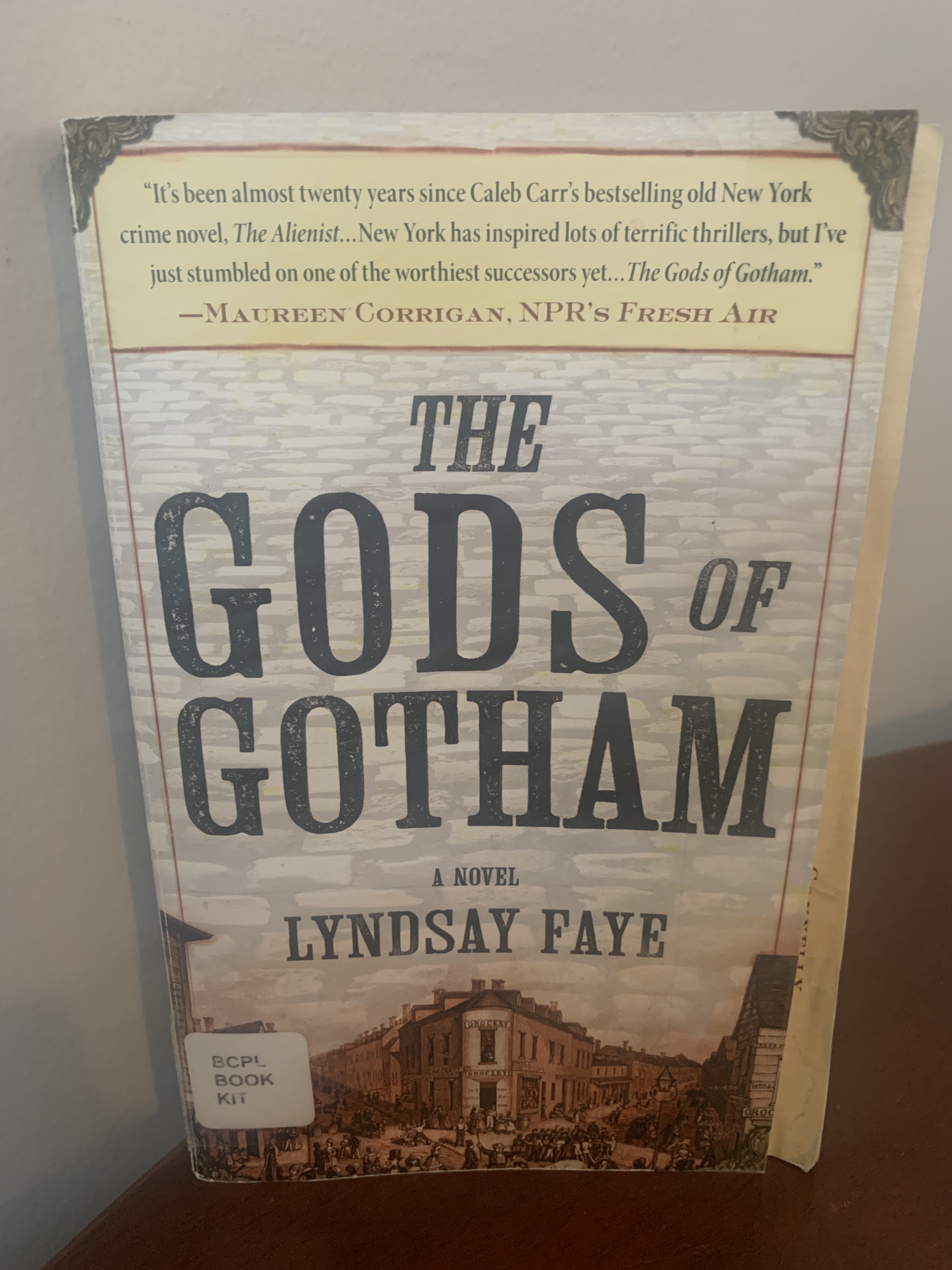
Copper stars. Protestants and Catholics. Nativists and Irish. 1845 in New York City, which only had 60,515 people to begin the century, now teems with more than half a million people. Lyndsay Faye’s 2012 book, The Gods of Gotham, explores this tumultuous time in the greatest city in the world, when its most revered police force, the New York City Police Department, was only weeks old, and its best “copper star” is a former bartender with a keen eye for detail and observation. Then, like any great story of intrigue, murder happens, and of children, no less. What ensues is a totally engulfing trip through mid-19th century America, with its still-salient issue of immigrants arriving at its shores, religious pluralism, the role of children, women, African Americans, and the poor in society, and even down to the topsy-turvy nature of brotherly love and unrequited love, too. What a marvelous work of fiction that is a great inducement to read more of Faye’s work and that of her detective (or unraveler, as opposed to rounder), Timothy Wilde.
Wilde is in his late 20s, with an older brother, Val, who is a “dead rabbit,” or rowdy fellow, a heroic volunteer firefighter, street brawler, and someone enmeshed in the Democratic Party of NYC. Val essentially raised his younger brother after their parents died in a barn fire. Wilde was perfectly content being a barkeep, with fantastical dreams of having a sailboat and marrying his longtime friend, Mercy Underhill, but the Party and its people demand a police force in NYC, and as Captain, Val encourages his brother to become a copper star (on account of them wearing badges). It helps that a kerosene fire destroyed his home and the $400 Wilde was saving up. Owing to that aforementioned keen since of observation, Wilde takes to the job like a “bird to air.” Three weeks in, a 10-year-old girl with an Irish name that partly means Bird, so she goes by Bird, appears on his doorstep with tattered, bloodied clothes. Eventually, he gets the yarn to unravel from her: she was a “kinchin-mab” of Silkie Marsh. That is, a child harlot, to use the vernacular of the “flash” or the criminal underbelly, as compiled by George Washington Matsell, fittingly the first NYPD Police Chief, who also understands what he has in Wilde. Marsh has a number of kinchin-mabs at her “establishment.” She also, not coincidentally, is in love with Val and a big benefactor of the Democratic Party. Bird informs Wilde that a fellow kinchin-mab, Liam, went missing. His body is soon discovered in a nearby trashcan. Thanks to Bird’s testimony, 19 children’s bodies are discovered buried in a wilderness area of Manhattan. At first, it seems the work of a religious zealot, owing to the cross-like etchings on their bodies. Organs are also missing.
Then, it only gets worse, as an active murder occurs: a little boy is killed, with the same cross etchings, and pinned to the door of St. Patrick’s, clearly in an attempt to implicate Father Sheehy and further incite the Protest/Catholic, Nativists/Irish tensions in the city. Wilde is smart, though, and knows what’s going on. Or at least, knows that it wasn’t Father Sheehy who killed the boy.
At this juncture, I had two likely culprits in mind. The first was Dr. Palsgrave, a rare for the time kinchin doctor, who also was stubbornly trying to invent an elixir that would cure all childhood maladies. My thinking being, he wasn’t actually killing the 19 kids found in the wilderness. Rather, he was waiting for them to die by whatever manner, like Liam of pneumonia, recover their dead bodies from Marsh’s establishment since she had a ready supply of them, and then do his experiments ostensibly for the betterment of children. The second culprit I was eyeing was Mercy’s father, Reverend Underhill, because he delivered a diatribe to Wilde not exactly subtle in his hatred for the “unwashed masses” of Irish Catholics coming to NYC’s shores, but even deeper than that, his wife died after trying to help these sick “unwashed masses.” Mercy, for her part, is following in her mother’s footsteps (including her abolitionist footsteps!) trying to care for the poor, sick Irish immigrants when nobody else will.
I was right with both guesses. Wilde lets Dr. Palsgrave off without arresting him because he believes in Dr. Palsgrave’s work to help more children. Nobody else cares about children, especially these children. That said, Wilde does end the practice of paying for the dead bodies from Marsh’s establishment. Worse still, he begins to suspect she hastened their deaths — murdered the kids — to get the money Dr. Palsgrave was willing to pay. Wilde confronts her, and gets her to confess to killing at least seven of the kids. He asks for $350 since they were $50 a piece. He knows he can’t arrest her because of her connections to the Democratic Party and the necessity of maintaining the fledgling NYPD, but he can use the money to save Mercy and help her get to London, her true dream. Which leads us to her father. He killed the kid and tried to frame Father Sheehy for the two reasons I mentioned. He compares the Irish Catholics to rats and vermin. It’s disgusting. His mental break came when he realized that Mercy was doing the same thing that killed his wife, and worse, that she was also a prostitute at Marsh’s establishment. Worse still for Wilde, initially, is learning that she slept with and was in love with Val. That resulted in a brotherly fight, but then Wilde reassessed his brother: the guilt he was carrying over having accidentally caused the fire that killed their parents, as he reveals, and all that he did to try to raise Wilde despite their circumstances. Their relationship turns out to be quite tender and lovely, all things considered. As for Mercy, as I mentioned, it was an unrequited love on Wilde’s part, and he comes to realize as much.
Back to Underhill, he tries to kill Mercy and then himself, but Wilde is able to rescue Mercy, and then he essentially allows Underhill to kill himself, but have it reported as a murder to protect Mercy, as I read it.
As for Bird and other kids rescued from Marsh’s establishment by Wilde, they’re going to Father Sheehy’s newly built Catholic school. And Wilde, well, he’s made his first two choices in his life: he actually wants to continue being a copper star, and he wants to stay in New York City, because for all its faults, its tensions, its bad people, it’s still the greatest city in the world.
What a fantastic book. It felt apiece with my recently read books, A Conspiracy of Paper by David Liss set in 19th century London and The Devil in the White City by Erik Larson about late 19th century Chicago, as well as earlier this year, Team of Rivals by Doris Kearns Goodwin about Lincoln in the 1850s and 1860s. I’m really quite enjoying any deep dive, whether its historical fiction like Faye’s, or nonfiction, from that period. It’s a fascinating time of immense change and the beginnings of what looks recognizable to modern eyes.


