
Spoilers!
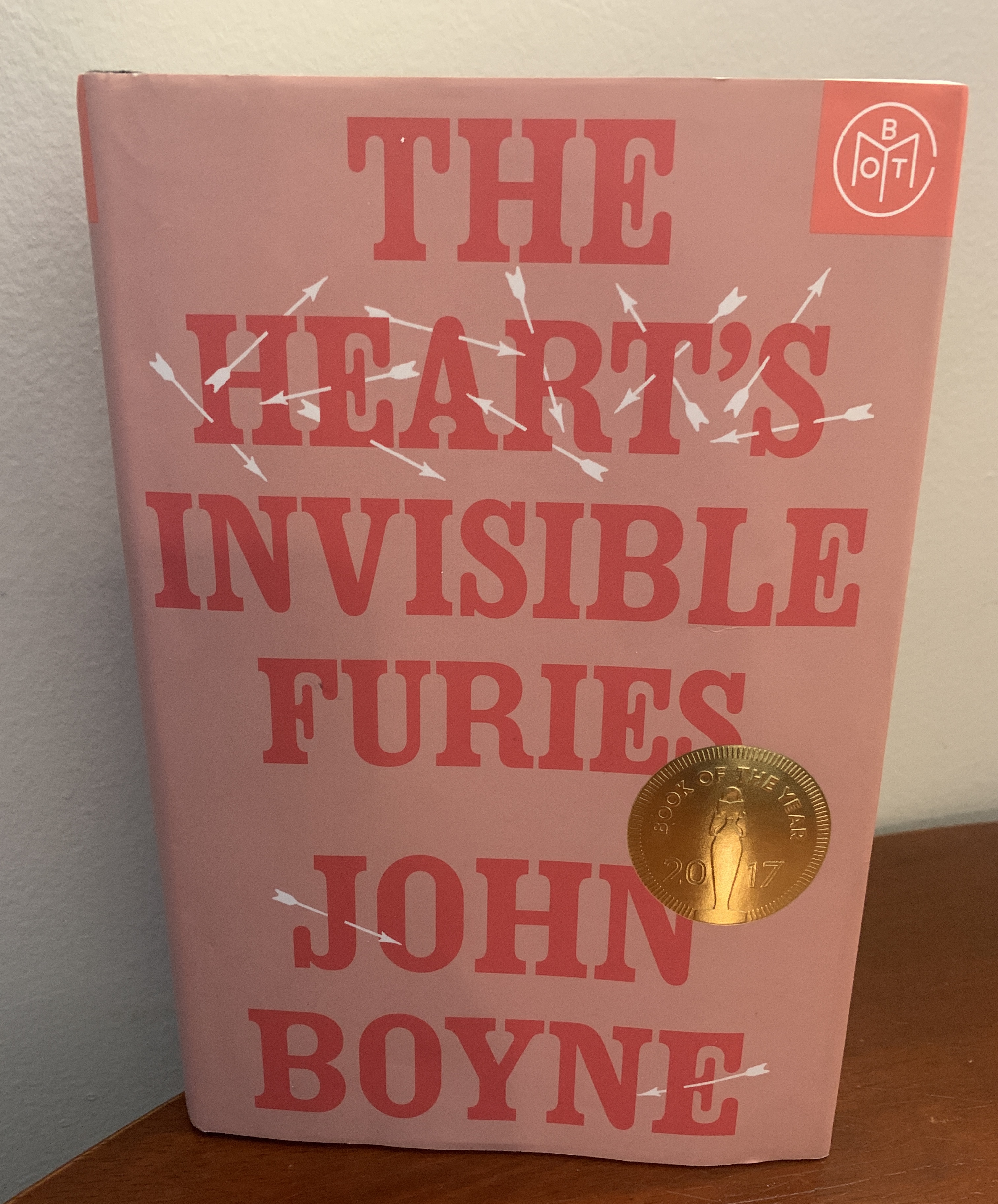
Humans make the best choices they can make at any given time under a certain set of circumstances. Those choices define the unfurling of our lives, but they don’t necessarily have to define us in perpetuity. The corollary to this world of choice and its machinations — at least in the world I want to live in — is one of grace and understanding. John Boyne’s 2017 book, The Heart’s Invisible Furies, is an ode to choices and grace, longing and companionship. A tour-de-force stretching across 70 years, hopping from Ireland, Amsterdam, and the United States, Boyne’s book is heartbreaking as those “furies” come to the fore, but also, inevitability when it comes to giving ourselves grace, and the self-deprecation needed therein, he imbues his book with a great deal of humor and levity. What a remarkable achievement, ambitious in scale and scope, while ultimately evincing intimacy, humor, and heart.
The title of the book, an all-timer, naturally comes from an all-time thinker, Hannah Arendt, who remarked of her friend and poet W.H. Auden, that “life had manifested the heart’s invisible furies on his face.” The heart’s invisible furies, be what they may, are unyielding on one’s mind, body, and spirit. No amount of social pressure or individual willpower can repress them. Even 1945 Ireland, arguably the villain of Boyne’s story, along with the Catholic Church, can’t suppress the heart’s invisible furies. Although, they can certainly make a go at it and create difficult circumstances for those trying to indulge them. Such is the case with our protagonist, Cyril, born in 1945, to 16-year-old Catherine, who was pushed out of her local Catholic Church by a priest owing to her out-of-wedlock “whorish” pregnancy. Indeed, she was exiled not just from the Church, but the town of Goleen in Ireland itself. But it does provide a memorable opening to Boyne’s book, “Long before we discovered that he had fathered two children by two different women, one in Drimoleague and one in Clonakilty, Father James Monroe stood on the altar of the Church of Our Lady, Star of the Sea, in the parish of Goleen, West Cork, and denounced my mother as a whore.” You see, the funny thing about the heart’s invisible furies is, the more one tries to repress them, the more one sometimes oppresses those who did indulge them. Father Monroe, or other “good Catholics” of Ireland, would not see any tension with their faith and their bigoted attitudes, be it toward women or homosexuals, like Cyril.
On her way to Dublin, Catherine meets a boy around her age named Seán. She warms up to him when he doesn’t seem so threatening. Once they reach their destination, Seán decides to help her by inviting her to live with him and his friend, Smoot. Thanks to another friendly woman, the tea manageress at Dáil Eireann, the equivalent to the U.S. House of Representatives, Catherine is able to get a job serving tea to the Teachtaí Dála, or TDs (politicians). This woman experienced a similar, if more awful ordeal, as Catherine, so she was happy to take her under her wing. Catherine would go on to be the tea manageress for the next 50 years. But back with Seán and Smoot, it quickly becomes obviously that they are a secret couple. Again, mind you, in 1945 Ireland, homosexuality isn’t just a faux pas of polite society, but it’s illegal. Homosexuality wouldn’t be decriminalized until 1993. Quite literally, this illegality drove homosexuality underground, where men met other men in pub bathrooms and the like just to have a semblance of affection and fleeting companionship. Seán’s father tracks him down to Soot’s apartment, barges in, and bashes Seán’s head in until he dies. He nearly kills Smoot, too, had Catherine, 9 months pregnant, not intervened. Smoot kills the man with a knife. In that bloody, violent, oppressive miasma, Cyril is born.
Choices. Catherine made the choice that upon her son’s birth, she’d give him away to a nun to have a better life than she could have given him. A local couple, Maude and Charles Avery, childless, take the baby as their own. Maude is a writer, whose quote from her fictional book is at the front of this one, eschewed the “vulgarity of popularity,” writing because she needed to, and also, eschewed any health sense when it came to chain smoking (cancer would go on to take her young). For his part, Charles was an eccentric philanderer, to put it mildly. The most peculiar thing about the couple, though, was that, as Cyril describes it, they treated him like a tenant of the house rather than a son to be doted on. Indeed, Charles reminded Cyril often that he wasn’t a real Avery, and Cyril called them by their “Christian names” and corrected anyone who called them his mother or father as “adopted mother” or “adopted father.”
At age seven, and it should be noted here that the book moves in increments of seven years starting with 1945 through 2015 in the Epilogue, Cyril meets Julian. From that moment on, Cyril not only comes to realize his gayness, but that he’s in love with and attracted to Julian. Julian, even when they met at that age, is sex-crazed; it’s all he talks about. His lust is oriented to girls, though, much to Cyril’s everlasting chagrin. Interestingly, at a boarding school run by priests, Julian and Cyril, now 14, are among a group that visits the Dáil Eireann, where Julian, the charming rebel, takes himself and Cyril to the tea room to drink beer under the guise of being a TD. This brings Cyril into proximity with Catherine, or as he knows her, Mrs. Goggin, for the first, but certainly not the last, time. Indeed, in a memorable scene, when the priest comes to scold Julian and Cyril, Catherine stands up for the boys and scolds the priest instead, perhaps the first time, Cyril reflects, that the priest had ever been addressed in such a manner, especially by a woman.
Into his 20s, like those before him, Cyril is driven underground, risking arrest for affection. But then he also reasons that perhaps he should put up a front, as it were, by having a girlfriend. He sort of sleepwalks into having a girlfriend — this occurs after a wild side story where Julian is kidnapped by the Irish Republican Army on account of his dad’s bloviating and held for ransom, wherein they send his dad Julian’s toe, finger, and ear, and the kidnapping occurred after a double date Julian and Cyril were on — and that’s where the next major inflection point of the story occurs. His girlfriend, Mary-Margaret Muffet (helluva name), is a severe Catholic, who seems to, nonetheless, like Cyril. However, she grows suspicious of him, not suspecting he’s gay, as I don’t think she even had the imagination for that, but suspicious all the same. In the course of following him, she sicks the police on Cyril while he’s about to hook up with another man. Before Cyril can be arrested, the IRA comes into play again by bombing a statue that topples over, killing the police officer and Mary-Margaret. Cyril flees. This wouldn’t be the first time he flees a scene nor witnesses death.
Eventually, Cyril and Alice, Julian’s younger sister, who is interestingly enough, writing a thesis about Maude’s posthumously successful books, begin dating and are engaged before long. Again, Cyril is sort of sleepwalking into all of this, perhaps forcing himself to be “normal” and denying those invisible furies. But sleepwalking lessens his autonomy here; he is making the choice to marry Alice, after all. Yes, the extenuating circumstances in Ireland of that time matter, but he didn’t have to hurt Alice by pretending to love her. It’s particularly bad because Alice was already left at the altar by a prior fiancé! When Cyril starts hinting at his predicament to Julian, he decides to go full bore with it: he not only acknowledges that he doesn’t love Alice and can’t marry her, but that he loves Julian and has always loved Julian. Julian is aghast. Importantly, he is not aghast to learn Cyril is gay. Rather, he cannot believe Cyril has lied to him this whole time. That the friendship itself was built on an edifice of longing and lust rather than true friendship. He punches Cyril, and not wanting Alice to go through a terrible wedding experience again, threatens Cyril to go through with it. Cyril does, but then hours later, he flees once more, this time to a slew of countries before arriving in Amsterdam. We jump another seven years, and now, Cyril is dating a Danish named Bastiaan. I should also note at this time, that Cyril is working at the Anne Frank House, and is still rather unlikable, because prior to meeting Bastiaan, he was giving into those furies at the museum, if you catch my meaning. Anyhow, later, Cyril and Bastiaan help a 15-year-old boy named Ignac, who is being sex trafficked by his own father. In a violent encounter that harkens back to Catherine, Seán, and Smoot, Ignac’s father tries to take him back and in the process, attacks Cyril and Bastiaan. Well, guess who steps in and saves them? Smoot! He’s the owner of a bar named after Seán in Amsterdam. Smoot kills the father and with the help of Catherine (Cyril didn’t know at the time), they get rid of the body. (Ignac goes on to be a successful children’s author, and have a wife and children of his own.) After that violent scene, Cyril, along with Bastiaan, flee to New York City.
We’re now in the 1980s, and the AIDS epidemic is rampant, along with the associated fear, stigma, and demonizing of homosexuals. Bastiaan is an AIDS researcher, and Cyril volunteers at a local hospital to be with AIDS patients who are dying without family present, either because they have no family or they didn’t want their family there. Guess who comes into Cyril’s life again, dying of AIDS? Julian. They rehash their arguments, as well as Julian seeming to be more derogatory of homosexuality this go-around, referring to Cyril as a “dirty queer.” I didn’t like that, as it went against Julian’s character, but he was also dealing with what was seen as a “gay disease” and he didn’t want his family or others thinking he was gay. He dies in Cyril’s arms, but not before Julian reveals that Alice was pregnant when Cyril left, and he has a child named Liam! Whoa. Alice was trying to talk to Cyril after their wedding, but he abandoned her before they could talk. Moreover, Julian’s dying wish is for Cyril to tell Alice what happened to him. Awkward. But before Cyril can make good on that promise, as they’re leaving the hospital and Cyril is grief-filled, they are attacked by random bigots in Central Park, who kill Bastiaan and leave Cyril for dead. The latter survives, but with a permanent limp. It also delayed him talking to Alice. He first writes a letter, and then they meet. They argue, of course. Cyril was in the wrong with both Julian and Alice. Absolutely. For as much sympathy as I have for what he went through in an oppressive, hateful Ireland at the time, that doesn’t excuse his betrayal of those two. Nonetheless, where the book takes a bit of a turn into more comedic and light-hearted territory, is with Cyril and Alice slowly, but surely, getting along. It especially gets quirky when Alice starts dating someone named … Cyril, which our Cyril takes to calling Cyril II. And of course, Cyril wants to be in Liam’s life, who at this juncture, is 20.
In a fascinating parallel, just as Cyril turned out to be more of a father to Ignac than his actual son, Liam, Catherine was more of a mother to her son she had after Cyril, Jonathan, than she was to Cyril. Unfortunately, on Christmas Eve 2001, a different kind of parallel happens. Liam’s second son, who they name after Julian, is born. So, that’s great, particularly because Cyril is the first family member allowed in to see the new baby. But Jonathan, who has a wife and two kids now, dies of cancer. Catherine, heartbroken, finds her way inside the hospital’s chapel, of all places. Before Cyril leaves, he recognizes Mrs. Goggin and comforts her. In the course of their discussion, she offhandedly mentions giving away her first son to a hunchbacked nun. That triggers Cyril’s memory of Maude and Charles referring to his origin story that way. After more than 50 years, and many interactions without realizing it, mother and son have finally reunited. It takes a little bit more effort on their part to fully reunite, mostly because Catherine is worried that Cyril will be bitter over the choice she made to give him up. He’s not. While Cyril, 70, never has a long-term relationship again, through Liam and Ignac, he has many grandchildren, and the book ends with his mother, 86-years-old, marrying a guy she met through Tinder. This, all contrary to what Father Monroe said would be possible all those years ago for a shunned, sinful “whore.”
During this wedding ending, we learn Cyril is close to death, thanks to a brain tumor, the same condition that took Charles’ life. Cyril has “conversations” with the spirits of Julian and Bastiaan. He knows his time is coming to a close and he’s ready to reunite with his friend and lover, respectively. He also realizes something transcendent and important: he’s finally happy. He’s lived a life of meaning with his unconventional family of Catherine, Ignac, Alice, Cyril II, Liam, and all the grandchildren. But it was his life, and his furies, as they manifested. For better and for ill. That’s life, both the beautiful and the ugly, the loneliness and the companionship. Boyne captured it all lovingly, heartbreakingly, and amusingly here. In some ways, I can’t help but compare it to Hanya Yanagihara’s 2015 book, A Little Life, which I read earlier this year. While not as dark and unrelenting by any stretch, Boyne’s book similarly puts you through the wringer alongside Cyril, but for those who thought it was too much wringing in Yanagihara’s story, they will find Boyne’s treatment, and ending, much more pleasant and optimistic. One could argue the takeaway in Yanagihara’s book is that “life is fucked up,” whereas Boyne’s is, “Life is fucked up, and yet.” His characters readily acknowledge that first half, and also clearly, realize the second part, too. The Heart’s Invisible Furies is a more satisfying read because of that meaningful difference.


