
Spoilers!
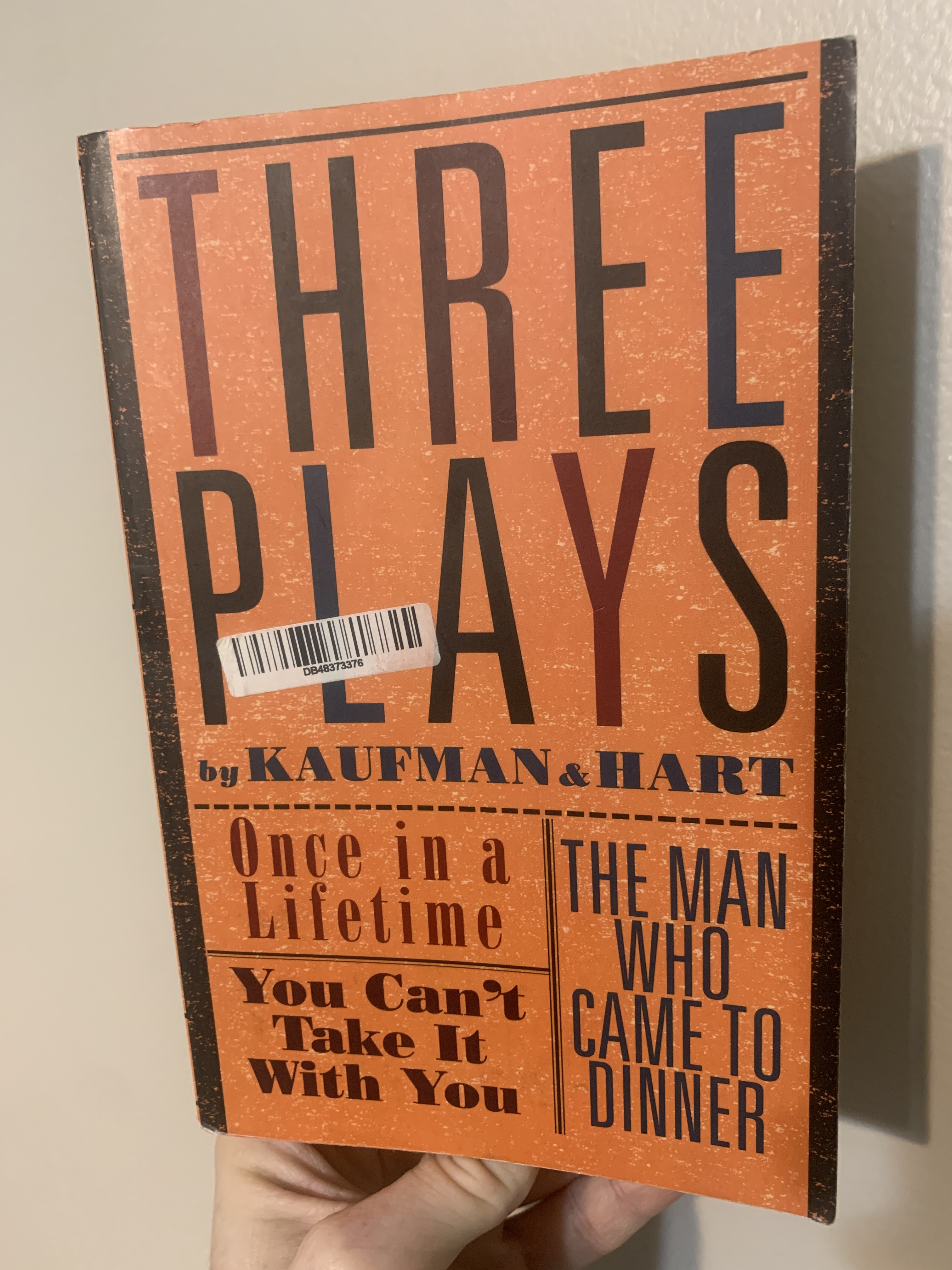
I love to read and see plays, primarily because I absolutely swoon at the power of good dialogue. The way it can envelope you into a story and the dynamics between people. And good dialogue is very difficult to pull off! Unfortunately, I don’t read and see plays as often as I like. Nonetheless, I was at Half Price Books and came across a collection of three plays by George Kaufman and Moss Hart appropriately titled, Three Plays. It features their collaborative plays, 1930’s “Once in a Lifetime,”; 1936’s “You Can’t Take It with You,” and 1939’s, “The Man Who Came to Dinner.” The second one won a Pulitzer Prize, and the third became one of the longest running hits in the history of Broadway. The collection also opens with essays Hart and Kaufman wrote each other, respectively titled, “Men at Work,” and “Forked Lightning.” Even though these plays were written nearly 100 years ago, their themes of human hubris, the poignancy of frivolity, and the humorous interplay therein still resonate and leap right off the page. I laughed-out-loud often.
The Personal Essays
First, with the essays Hart and Kaufman wrote each other, I found it amusing how they depicted the other. Hart saw Kaufman almost otherworldly, as this godlike figure in the world of playwrighting, who was indefatigable, working all hours of the day, meticulously sculpting each sentence again and again, bolstering that adage about how playwriting is really about rewriting. Indeed, Hart writes that Kaufman “frightened me to death originally.” As for Kaufman, his essay belies this depiction, given his more loose, playful writing about Hart, sharing an anecdote about Hart’s abnormally long visits with the dentist, so much so that he couldn’t maintain a dinner engagement because he’d still be with the dentist. “There are times, I think, when he is not completely sure whether the curtain is up or down,” Kaufman says of Hart. That’s what makes him a good playwright, though, in his estimation! What a “marriage” as Hart describes it.
“Once in a Lifetime”
Hilarious. I was constantly laughing-out-loud at the antics between friends, George (a dope), May (the ringleader), and Jerry (the dependable one), a vaudevillian act in NYC, who cross the United States to try to make it big in Hollywood. Their scheme? Talkies are the new thing after 1927’s The Jazz Singer, so naturally, they’re going to open an elocution school and teach Hollywood actors how to talk and breathe correctly. On the Pullman train West, they meet a famed gossip columnist who buys into their scheme (that they have a renowned school in England already), and will connect them once arriving in Hollywood. The trio also meets Susan Walker, who dreams of being a movie star. She’s a dope like George, so naturally, they hit it off. Once in Hollywood, their scheme works, initially, within the Glogauer studio run by Herman Glogauer, who is inundated by a cadre of assistants, secretaries, pages, a coat check girl, and even a cigarette girl (exactly what it sounds like: she comes around with a silver tray of fine cigarettes). The rub? Every single one of them pines instead to be in one of his pictures, so they are liable to break out into dance or song to prove their talent. The hilarious conceit of the play is that even when everything seems to be going wrong for the trio, and Glogauer is giving them the riot act and then firing them, everything ultimately turns out okay, thanks to the genius of George! Or at least, people ascribing genius to George. For example, George somehow gets tasked with producing the movie starring Susan, but he uses the wrong script and makes the wrong movie. Critics love it! Glogauer’s studio is saved. Critics even love “choices” George made, like dark lighting (because he forgot to turn on the lights) or the knocking noise heard during scenes (him obnoxiously chomping away on his favorite Indian nuts). It is so damn funny and ridiculous, Kaufman’s and Hart’s lampooning of Hollywood and the sycophants that make up that oddball circus. Or the playwrights, too! One playwright, Lawrence Vail, is summoned to Glogauer’s studio to write, as are half-a-dozen others, only to be given nothing to do, and not even an audience with Glogauer, for months. When he tries to get an audience with Glogauer, the secretary keeps forgetting who he is minute-to-minute. He finally has a nervous breakdown and goes to a sanatorium opened by another playwright for playwrights experiencing similar nervous breakdowns. I loved this play, and would happily read more adventures with this trio.
“You Can’t Take It with You”
I did not want to leave the quirky, absurd, but earnest and lovely Sycamore family. There’s the patriarch, Grandpa Vanderhof, who hasn’t worked in 35 years because he hated the work he was doing, so now he prefers to attend commencement addresses and play with his snakes. He’s also being accosted by the IRS because he owes 23 years of income taxes, which he’s not too concerned about because, he argues with the IRS man who arrives at the house, what does he get out of giving his money to the government? Flustered and then scared by the snakes, the IRS man leaves. Grandpa’s daughter, Penny, randomly took up the typewriter and wants to be a playwright. That’s what she does, writing rather salacious pieces. One of her daughters, Essie, dreams of being a ballerina, despite being terrible, while also making candy known as Love Dreams, so she’s constantly prancing around, especially whenever her husband, Ed, starts playing his xylophone or her boisterous Russian music teacher, Kolenkhov, comes around. Ed also has a printing press that he likes printing random things on and including them in the boxes with the Love Dreams. Penny’s husband, Paul, is tinkering away in the basement with Mr. De Pinna, an ice salesman who came eight years ago and never left, to build fireworks to sell. Rheba and Donald, the Black servants, try to manage the chaos as best they can. Finally, there’s Alice, Penny’s other daughter, the more “normal” one of the family, who works in an office and pines after Tony, the VP, the son of a well-to-do family, of course. The unabashed zaniness of the family is incredible to witness leap off the page, like Essie in one of her awful attempts at a pirouette. Upon Alice and Tony’s engagement, they invite his parents, Mr. and Mrs. Kirby, to dinner — on the wrong night before Alice can give the house a “normal” makeover! — and chaos ensues, naturally. First, there’s nothing prepared food-wise, but Donald is sent off to fetch beer and canned salmon. Secondly, Gay Wellington, who was to act out one of Penny’s plays and is described as a nymphomaniac, is instead drunk; she is hidden away upstairs when Mr. and Mrs. Kirby arrive, but then she stumbles downstairs and flirts with Mr. Kirby. Then, they play a hilarious game at the dinner table, initiated by Penny, where they are given a word, like “sex,” and have to write down the first word they think of, which Penny then reads aloud. When she gets to Mrs. Kirby’s, Mrs. Kirby associates “sex” with “Wall Street” because the implication is that Mr. Kirby is always thinking about Wall Street, even during sex with her. And Kolenkhov also tries to wrestle Mr. Kirby and instead hurts Mr. Kirby’s back. I’m dying. And the climax of this fiasco of a dinner is the FBI raiding the house because of Ed’s printed pamphlets that say random things like, “Dynamite the Capitol,” and “God is the State; the State is God.” Lmao. Meanwhile, De Pinna is worried about his pipe left downstairs after the government goons accosted him and brought him upstairs. Before he can retrieve it, the fireworks explode. Everyone is arrested, including Mr. and Mrs. Kirby, who suffer the indignity of a strip search, a night in jail, and newspaper coverage thereafter. Alice, of course, is aghast, and not only breaks off the engagement, but seeks to go live in the Adirondacks for a bit. That is until Grandpa and a pleading Tony convinces her to stay. Tony says he contrived for his parents to come on that night to show them what a real family looks like, and for Mr. Kirby to remember the dreams he used to have before becoming a Wall Street man. The moral of the story is that Mr. Kirby can’t take all his wealth and prestige with him, so you might as well enjoy life while you can, as Grandpa and his zany family are. This is further established when Kolenkhov brings the Grand Duchess Olga Katrina, now a waitress, to dinner in Act Three, showing how even former Russian royalty has been reduced to menial jobs in America. Oh, and Grandpa evaded the pesky IRS since they had named the milkman who came to visit, never left, and then died, by Grandpa’s name. So, they think the dead man is the man who owed those back taxes. Ope.
“The Man Who Came to Dinner”
Famed outlandish radio critic, Sheridan “Sherry” Whiteside, for whatever reason was in Mesalia, Ohio, visiting the home of Ernest and Daisy Stanley in the weeks before Christmas, when he tripped on ice, injuring his hip. While convalescing in their home, his arrogant, curmudgeon ways take over. He domineers everyone, from his secretary Maggie to his nurse Miss Preen and Dr. Bradley (who wants Sherry to look over his book, something like, 40 Years as a Physician in Ohio) to even Mr. and Mrs. Stanley. Not only does he threaten them with a six-figure lawsuit, but he orders them to not use the telephones and to not interrupt his space. He also tries to influence their children, Richard (by telling him to leave his job and become a photographer) and June (by telling her to elope with a union organizer Mr. Stanley disapproves of). Meanwhile, Sherry is also ahead of his time as someone fascinated by true crime, so much so that he invites convicted killers into the Stanleys’ home. I think I’d take the convicted murderers over Professor Metz’s gift to Sherry: a glass-encased cockroach colony. Ew. A newspaperman and aspiring playwright, Bert Jefferson, also stops by to do a profile on Sherry, which results in Maggie falling madly in love with him, so much so that she intends to marry him and leave Sherry behind. Sherry, ever the conniving figure, cannot allow this to happen. So, he conspires to bring famed starlet, Lorraine Sheldon, to Ohio, to woo Jefferson. Meanwhile, Dr. Bradley said he misdiagnosed Sherry, and he’s good to go. He can leave. But again, the conniving Sherry is enjoying himself too much, so he milks his injury and confinement to a wheelchair just a bit longer. Maggie is wise to Sherry’s conspiracy with Lorraine and tries to use the help of the British actor, Beverly Carlton, who has also arrived at the home, to trick Lorraine into leaving. Beverly can do a great impression of Lord Bottomley, an Englishman Lorraine wants to marry. Lorraine buys the impression, where “Lord Bottomley” asks her to marry him, and so, she tells her maid to let everyone know she’s heading to London to marry him. The tit-for-tat continues, as Sherry gets Lorraine to realize the ruse, only further pushing Lorraine into seducing Bert more. Maggie can’t take it anymore and decides to quit. Now, it’s Sherry who wants to get Lorraine out of Mesalia to cajole Maggie back to him. Enter his visiting comedian friend, Banjo, who tricks Lorraine into stepping into an Egyptian mummy case (a Christmas gift for Sherry, naturally). All this is happening as a deadline looms: Mr. Stanley is trying to take back his house and has given Sherry 15 minutes before he’s evicted. Then, ever the one-upper, Sherry realizes that Mr. Stanley’s eccentric sister, Harriet Stanley, is an axe murderer, so he blackmails Mr. Stanley into helping them ship the mummy case on Banjo’s plane. Lmao. Clever. Then, Sherry gives up the ruse, stands, and says Maggie is “free” to marry Bert and he’s ready to return to New York. Instead, as he walks out of the home, he slips on ice again, injuring himself and is carried back in the house screaming all the while. Lmao again. I don’t think this one has a strong moral to convey like the previous one, rather, it’s having fun with the lampooning and satirizing of bigwig NYC radiomen, especially in contrast to small-town Ohio. Admittedly, I didn’t enjoy this one as much as the previous two — the former being the funniest and the second just so lovely and endearing — but Kaufman and Hart sure can write a house of chaos filled with eccentric, unforgettable characters.
If you’re looking to switch up your reading journey, you can’t go wrong with these three dynamic, hilarious, and still-relevant plays from the powerhouse duo of Kaufman and Hart.


