
Spoilers!
When I first saw the trailer for Kane Parsons’ 2026 film, Backrooms, I had finally read the experimental debut book from Mark Danielewski , 2000’s House of Leaves. So, I immediately thought, This must be inspired by that book. Like the book, where the inside of a family’s home is bigger than it ought to be, to put it mildly, the conceit of Backrooms is an improbable space “connected” to a furniture store. While the premises are similar enough and certainly, immersive and mesmerizing in the same way, I think Parsons, and Will Soodik, who wrote the script, have enough flourishes of their own to distinguish themselves from Danielewski’s towering work. Indeed, while Danielewski’s vision was grander in scope, I think Parsons and Soodik were aiming for something more intimate, albeit infinite within the intimate, as it were. And from its unfurling of unreality comes hard realities. The result is a film I won’t soon forget: bristling with unease, palpable tension, and an unyielding macabre curiosity.
Set in 1990, the film begins with a researcher from the Async Research Institute exploring the “backrooms,” which I immediately thought had to be some sort of extradimensional space. To compare it to another book and film, Stephen King’s The Mist had the military accidentally open a portal from another dimension that unleashed all manner of monsters upon our world. I figured the same had occurred with this Async Research Institute. The researcher is attacked by an unseen monster.
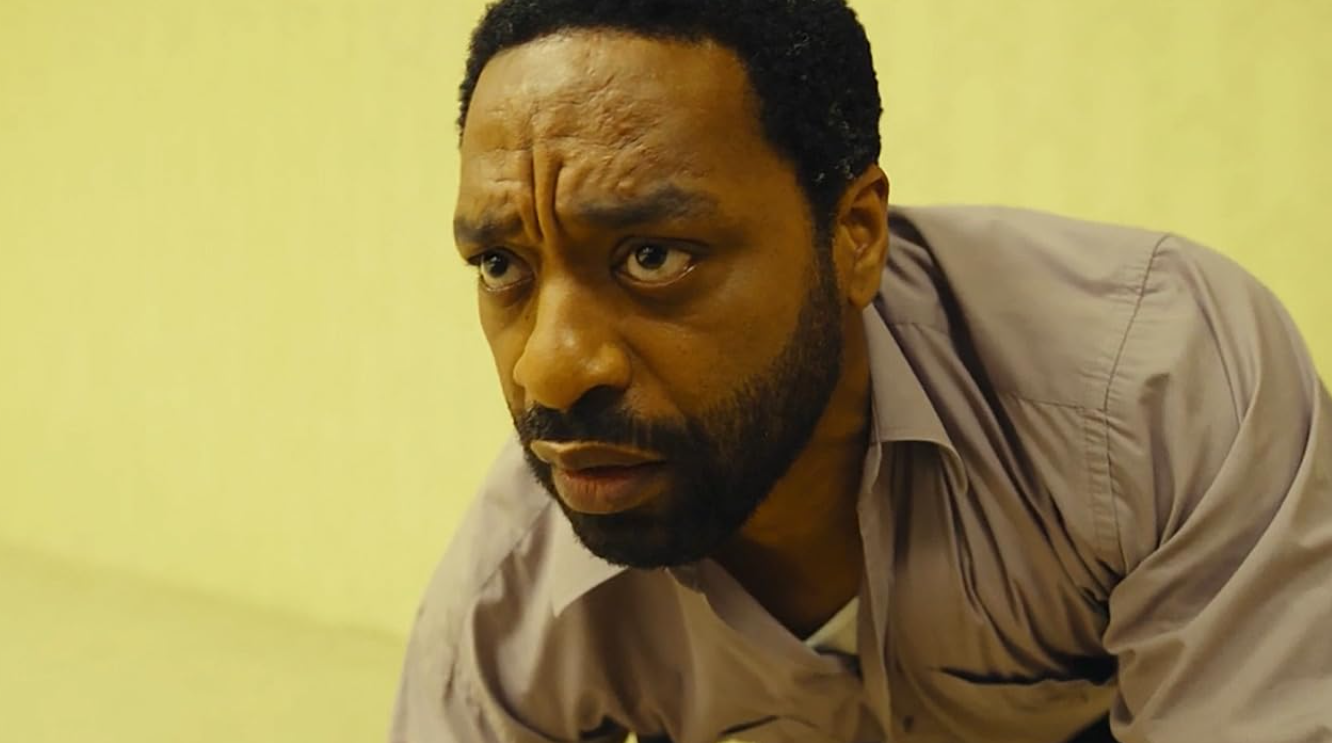
The main character is Clark (played by Chiwetel Ejiofor, whose facial expressions and body mannerisms are as mesmerizing as the backrooms’ labyrinthic corridors), who owns the furniture store, but dreams of being an architect. He’s seeing a psychiatrist, Mary (played by Renate Reinsve, who has the appropriate amount of a psychiatrist’s concealed, What the fuck?, displayed on her face throughout until she cracks at the end to great effect), on account of his marriage imploding. He’s quick to anger, resents his wife spending her time as a graduate student, and again, he pines to be an architect. One day, while frustratedly exploring the basement of the furniture store due to its inexplicable flickering lights, he discovers the “door” to the backrooms. The backrooms are this pale yellow labyrinthine of endless corridors, weird doors and entry points, and yes, monsters of some sort, including a distorted gigantic version of Clark’s furniture mascot character, a pirate. For her part, Mary is working through her own childhood trauma of her mother’s descent into madness and institutionalization. Interestingly, her mother seemed scared of space and people, essentially hiding away her and Mary at their home. As an adult now, Mary still carries around with her an imprint of her hand into the concrete of her childhood home’s driveway.
After that first foray into the backrooms, Clark tries to tell Mary about it, but she doesn’t believe him. He intends to provide proof. Off screen, he apparently visited the backrooms multiple more times trying to get a better understanding of its dimensions. Then, he enlists the help of his assistant manager, Kat, and her boyfriend, Bobby, to record the backrooms. Both are quickly attacked by monsters. Clark also seems to be attacked by a monster before we cut back to Mary. However, when Mary receives a distressing call from Clark that he’s “opened the window” — alluding to her therapeutic advice to open the window into your subconscious and escape the endless loop you’re in keeping you stuck in place —, Mary goes to the furniture store to investigate. She heads down to the basement and steps through the backrooms. Very bravely, she continues searching until Clark appears. He chokes her out, and when she comes to, she’s at a table with Clark opposite her, and next to her, a comatose, for lack of a better word, gentleman with multiple eyes. Like the space and objects within it, the “people” or monsters, are distorted. There’s also a man in a wheelchair and a woman with a blurred face. Clark tells Mary that he feels at home now, that he’s found his place because here, in the backrooms, there is no pain. The creatures around him feel nothing. Indeed, he’s been eating them (their “insides” are some weird white substance, not actual organs), having been in the backrooms for unknown amount of time.
It’s at this dinner table where Mary snaps, as I teased earlier, and gets Clark to realize she can’t help him in his madness. Although, she seems to doubt herself, saying she can’t help anyone, likely because she still feels like she hasn’t helped herself. Nonetheless, she’s able to convince Clark to free her from the restraints binding her to the chair. That’s when the gigantic pirate emerges and kills Clark, and thereafter, gives chase to Mary. What’s great is that the concrete imprint of her hand comes into play to save Mary: she uses it to bash at the pirate monster’s wooden leg long enough to escape and enter a different room that takes her to where the Async Research Institute researchers are. She is then asked a series of questions by one of the scientists, Phil, who had been watching Clark and then her on a surveillance camera. He’s also been trying to figure out more about the space. Startlingly, when Mary asks if she can go, Phil tells her it’s not up to him. Ominous!
The film then ends with the backrooms seeming to resemble the trauma points of Mary’s life and a malformed version of Mary is in the same “interrogation” room she was in with Phil.
What does it all mean?! Well, as it went along, I wondered if the backrooms were a representation, malformed as it was, of the mental maladies of whomever enters it. That is, first Clark’s brain, hence the malformed pirate that quite literally eats him to death, and then Mary, institutionalized, if you will, like her mother. And because the subconscious is limitless, not bound by the laws of physics or reality as we know it, it can take on that labyrinthic blueprint, where not everything makes sense, like a door with three knobs, but only one works. Or a sloping corridor to a small entryway. That’s why despite the infinite unreality at play here, I see Backrooms as a more intimate story than the utter vastness conveyed in House of Leaves. The mind is a funhouse of mirrors, but it’s ours, intimate to us. Of course, this is just my interpretation of the film!
What a movie that I will absolutely need to rewatch to catch more hints and subtle details as to what is going on. I also would love to explore the YouTube series that inspired this feature film adaptation.


