
Spoilers!
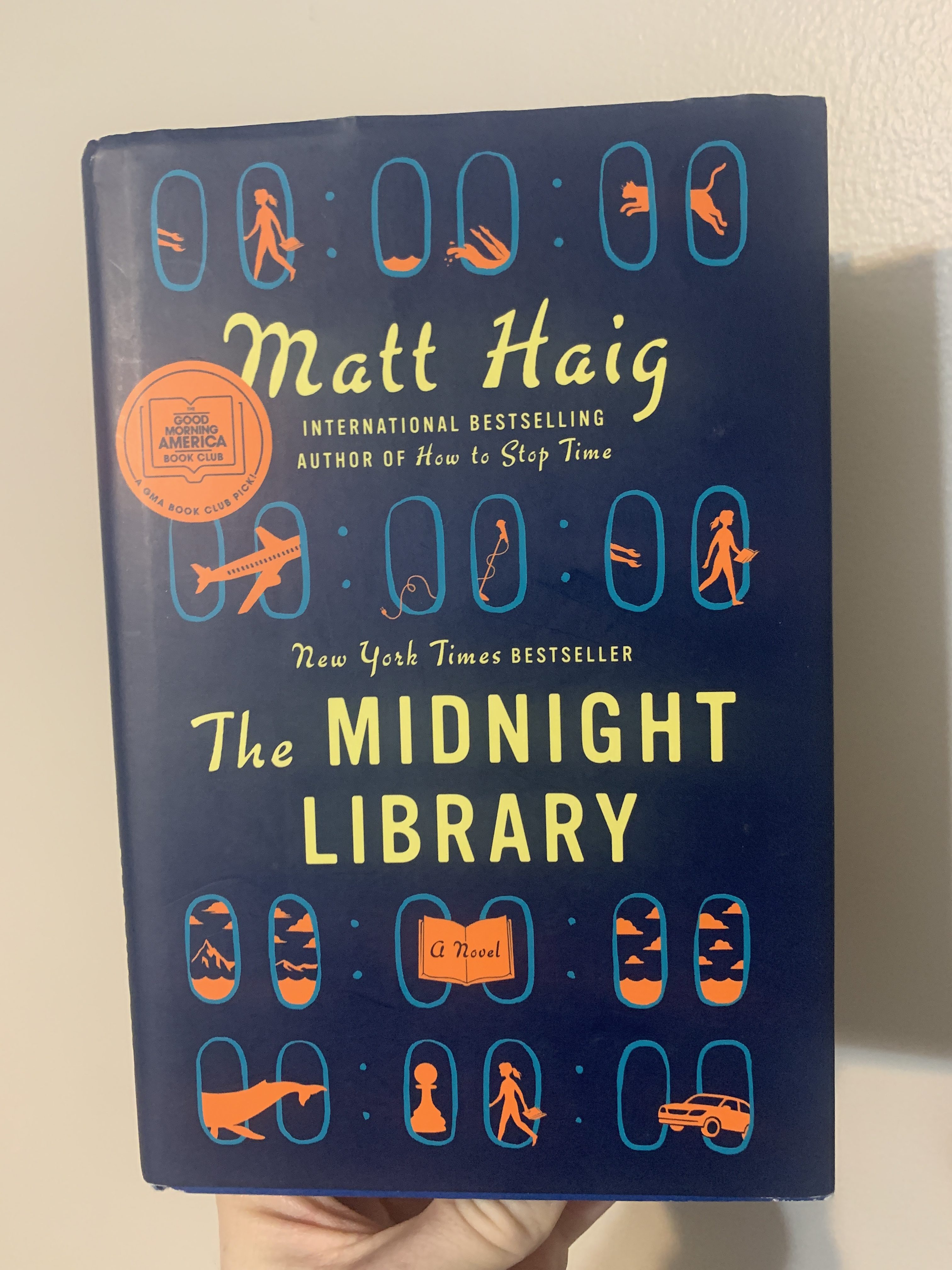
We have but one wild and free life to live, but within that one life are infinite possibilities. Life is bursting with potential, and obviously, those possibilities are only stymied by one’s limited imagination, and ultimately, death. To be alive is the thing. To be alive is to make those possibilities … possible. This is what Nora Seed, who loves Henry David Thoreau (I lifted his “wild and free” phrase for the opening), dogs and cats, glaciers, music, and swimming, must learn. To use another of Thoreau’s quotes, it’s not about what you look at that matters, but what you see. Nora saw only despair until a multifarious trip through the quantum mechanics-inspired multiverse helped her to see more clearly. Matt Haig’s 2020 book, The Midnight Library, is a lovely ode to living, to not being suffocated by one’s regrets, and to realizing the “big importance of small things.” Haig has been open about his own mental health struggles. Similarly, I’ve been open about my own mental health struggles and suicidal ideation. The Midnight Library is like a dam in the flow of despair, which hopefully is helpful to those similarly situated as Haig, myself, or Nora is at the beginning of the book.
Nora, 35, works at String Theory, a local music shop in Bedford, England, and teaches piano lessons on the side. When she was 14, she was the fastest swimmer around, with seemingly a smooth path toward an Olympic career. Or maybe she would forgo swimming for a rockstar life with her brother’s band, The Labyrinths. Or maybe she would lean into her love of philosophy and write books about Thoreau. Or a great fiction book. Or maybe she’d fulfill her yearning to study glaciers at Svalbard, an archipelago in the Arctic Circle. Or maybe she’d follow her friend, Izzy, to Australia and take a job on a whale sight-seeing boat. Or at least she’d marry Dan and they would have children and a great, quiet life.
None of that happens. She gives up swimming, resentful of her dad who pushed her into it. Then he dies of a heart attack. She gives up music, both embittering her brother because she initially took up his dream and angering her bandmate because they could have made it. She loves Thoreau still, but hasn’t done anything with that love. She didn’t go to the Arctic Circle or Australia. And before her wedding, her mother dies, and then literal days before the wedding, Nora breaks it off with Dan, who still pines after her. He had his own dream of starting a pub with her. A consistent theme Nora will find is that the genesis of many of her potential paths was fulfilling someone else’s dream.
On the day when she decides to kill herself, Nora’s boss says he can’t make a profit with a sales person like her who has a “wet weekend face.” Oof. He fires her. It’s raining, speaking of wet weekends, and as she’s huddled under a newsagent shop, she’s castigated by her former bandmate she runs into, and then reminded of how much she hasn’t accomplished by a former classmate. Upon arriving home, she learns from a passerby, Ash, that her cat, appropriately named Voltaire (Vols for shorts since even he thought that was pretentious), has died. With nothing seemingly left to live for or anyone who cares about her existence — this is the deadly calculation those in the throes of depression make, that any benefit their still living has is outweighed by the burden they put onto others — and so, she decides to overdose on her antidepressants.
Instead, Nora wakes up in the titular Midnight Library with Mrs. Elm, her former school librarian, who showed her kindness as the person who delivered the news of her father’s death. They also often played chess together, which will be a consistent metaphor for life throughout the book. (So long as there are pieces on the board, the game can still continue, or that a pawn can become a queen.) Nora has entered the multiverse, where an infinite number of her potential lives are stored in books on endless shelves accompanied by a very large Book of Regrets. Different people would enter different places. For example, she meets another “slider,” as he calls it, Hugo, whose version is a video store with a different guide (his uncle). This is Nora’s chance to experience what her life would have been like as an Olympic swimmer, or a famous rockstar, or a glaciologist, or a resident of Australia, or a philosophy professor and author. Or a wife to Dan. Or to Ash. A mother. A better sister. And so on.
But the “catch,” if you will, is that all of those lives have their downsides, too, because that is life. There is no such thing as the perfect life or the perfect path one could have taken, which makes regrets awfully silly when one considers them. After all, the choices we have made have led us to the life we’re currently living, which is ultimately what Nora realizes: that her root life, as they call it, or “original life,” is the life she needs to return to. That it was still worth living. That it was still worth being alive. Warts and all. Paths not taken and all. (Here’s a quirky thing I wondered while reading. When Nora arrives in a new life, she’s there as herself, so she doesn’t have the necessary memories or knowledge of that life’s Nora, so she improvises a lot or Googles herself to figure out what’s going on. Let’s say, then, that she chose the life she seemed to like the most otherwise, with Ash and Molly, her daughter. What happens to the existing Nora that was there before? Do they meld into each other? Mrs. Elm did mention that if she did truly choose that new life, she’d forget all about the Midnight Library, so perhaps.)
Of course, when Nora returns to her original life, she’s nearly dead from an overdose. She seeks help from a neighbor, and then her brother, who she left a “last voicemail” for, arrives. They rekindle their relationship. She realizes he doesn’t want to live without her, and she already experienced a life (as the rockstar) where he died. I also think there is something to be said for what Nora also realizes: that regardless of which path she could have taken, it still would have been her walking that path, which is to say, we bring our complexities, our maladies, our baggage with us. Sure, not every life she chose included her taking antidepressants, but many did, and even without antidepressants, she was still Nora and still had to manage what being Nora entailed. In other words, she still had to manage what being alive entailed. It’s difficult work, but it’s better than not being alive. Haig wrote a memoir, Reasons to Stay Alive, and what’s beautiful about Nora’s adventure is that she experienced the possibility of infinite reasons to stay alive and ultimately chose the original version, the root version, because when you think about it, that decision reverberates out like a ripple across all those possibilities.
The Midnight Library is such a great book, and if you haven’t read Haig before, a great introduction to him, his style, his worldview, and his gentle awe of the world and appreciation for being alive. I loved it.


