
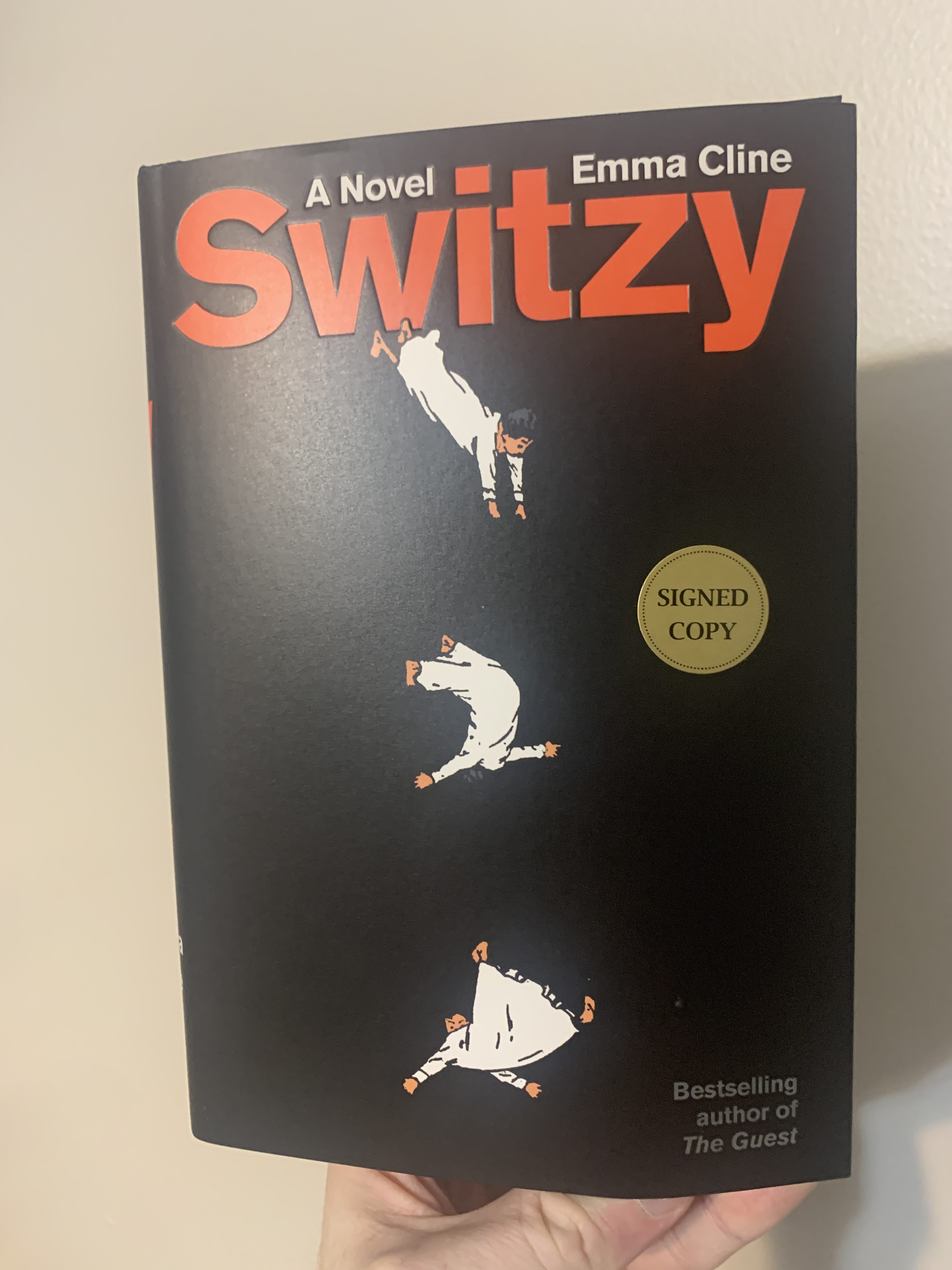
The Nirvana song, “All Apologies,” came to mind as I closed Emma Cline’s 2026 heartfelt, heartbreaking, irreverent book, Switzy. Because all in all is all we all are, right? All we could be is who we were. Are. At the end. Time is sometimes analogized to a flowing river, where “no man steps in the same river twice.” And yet, for our brains, time is more like a finite flowing river, where the debris from earlier floats back again and other debris somehow sifts away, without discernable logic. That which we retain at the end — memories of a song lyric, random trivia or other pop culture, a childhood birthday party, a high school lover, regrets, awkward moments, often these little, seemingly insignificant trappings of life — has no discernible reason for floating still in our consciousness as we near the precipice of death. Alas, there it is, making up who we are. All we were. Are. At the end. Switzy is a beautiful, tearjerking ode to our humanity once we’ve been stripped of nearly everything that makes us … us, to life, and to death with dignity.
That which makes us … us are our memories and the autonomy to act on those memories, including, it must be said, the autonomy to function at all. There is, however, an insidious disease, Alzheimer’s, that either all of a sudden, as life (and death) tend to be, or agonizingly gradually, reduces us to something less than what we are, and yet, still who we are, but fading. Or as Cline puts it, like a light dimming. In that way, Switzy is a horror book in a such a damn human way because Alzheimer’s is an awful, frightening disease, and inhabiting the main character, David, as he experiences it on his final trip to Switzerland to be euthanized, is devastating. His confusion, inexplicable anger, attempts to mirror expectations of what it means to be a human in social situations, that psychic itch of failing to recall words and names, the recognition that he’s losing control over his mind and body, the fondness he has for the memories that do remain, horror at others compounded by the inability to redress those horrors, his inability to conceptualize what managing the disease confers onto his (and hopefully yours, if it ever comes to that) patient caretakers treating him with necessary kid gloves to forestall those aforementioned inexplicable angry outbursts, and the fading, always the fading. This fading is such that, as David explains, he no longer “desires his desires.” This is the becoming less of who you were until you’re not you and the world spins as the world spins. The unbecoming. All in all is all we all are.
David was a very successful businessman until his Alzheimer’s. Until the forgetting. He was married, with a child named Rebecca. The marriage David had fell apart, and he wasn’t always as gentle with Rebecca as he could have been (or at least, he remembers one particularly shouty moment). His relationship to Rebecca, well into her adulthood, was stunted and therefore, stilted. Rachel has a 9-year-old son now. But her own marriage appears hollow, enough at least to lead to perhaps her cheating with a woman. One of the most salient memories David does retain is that of his high school dormitory friend, Tom. They became more than friends at a time when such a thing would have been roundly repudiated by society, ostracizing them both. So, instead, David joined the side of the would-be bullies and tormentors to … bully and torment Tom. After a particularly ghastly hazing David partook in, him and Tom didn’t speak to each other for another 60-some years until the penultimate day of David’s life.
Because you see, as mentioned, David has decided to use his connections to another rich friend, Stearns, and his indefatigable assistant, Cody, to fly to Switzerland for a physician-assisted suicide. At the time these plans were made, ostensibly David understood what he was doing, which is to say, he still retained that last morsel of autonomy to decide his end, freely and clearly. Along with that is the desire for his ex-wife and Rebecca to not know what he is planning on doing. Yes, he sees Rebecca and the grandson one last time, but they do not know as much. And he will see Tom in that penultimate meeting, but by then, David lacks the ability to fully articulate everything that needs to be articulated, so, similar to the Nirvana song, all apologies is all he can offer during their terse encounter.
During his time in Switzerland, David tries to buy a gift for the grandson, which turns out to be an antique (and overpriced) copy of Twenty Thousand Leagues Under the Sea, but forgets what it is for, unwraps the packaging, and then decides to give it to Tom. After the terse meeting, Cody ends up leaving the book in Tom’s mailbox. During another scene, David, as he’s likely to do, wanders from the hotel room (that same penultimate timeframe), somehow finds his way back, and encounters Cody with his partner, Sam. He thinks Sam is wearing his sweat after they ransacked his hotel room, and to appease David, Cody implores Sam to hand the sweater over, which he does. Or the time David wanders again, that time to the bar, and ends up bringing a woman back up to his room, obviously confused, and only then later does he seem to realize she wants to Pretty Woman with him. But he no longer desires his desires.
Cline’s book is structured like how I described the no discernible logic of our retained memories, with vignette-like paragraphs of the sad chaos and confusion that is David’s mind, flitting from reflections and regrets to a funny observation or realization of how he’s supposed to act in public, or catching the tail-end of a song lyric or movie quote without context, and then these little, often poignant scenes leading up to his death. It’s so tender, so raw, so achingly beautiful. So precarious, this straddling we do between wellness and sickness, us and not us, life and death. But so beautiful, too, this return to the stars, dust-to-dust, this reaching of our hand out to infinity, as David does in the end after taking the pills that kill him. With Cody by his side, who he sometimes thought of as Tom. And he tries not to go down the rabbit hole of, what will Cody do now? Or the physician? Is she going to buy groceries tonight after this? Bizarre it is this, well, business of death. But so is this business of life. And so it goes. All is all we all are.
To use one of David’s fleeting lyrics he retains until death, you didn’t have to love me, but you did, but you did. That’s life, right? The cold, unthinking universe owes animals like us nothing, but its manifestations — man and animal alike, often, and the intrinsic wonder and beauty of that cold, unthinking universe — did love us for however long we are able to wade in the river of time. What a gift. And what a gift it is, if we’re being honest with ourselves, to die in the manner David decided because he decided, with dignity, as it still remained with him before the disease took that, too.
Do yourself the gift of reading Cline’s extraordinarily gentle and incisive book about life, love, our fragile humanity and sense of self, and dying.


