
Spoilers!
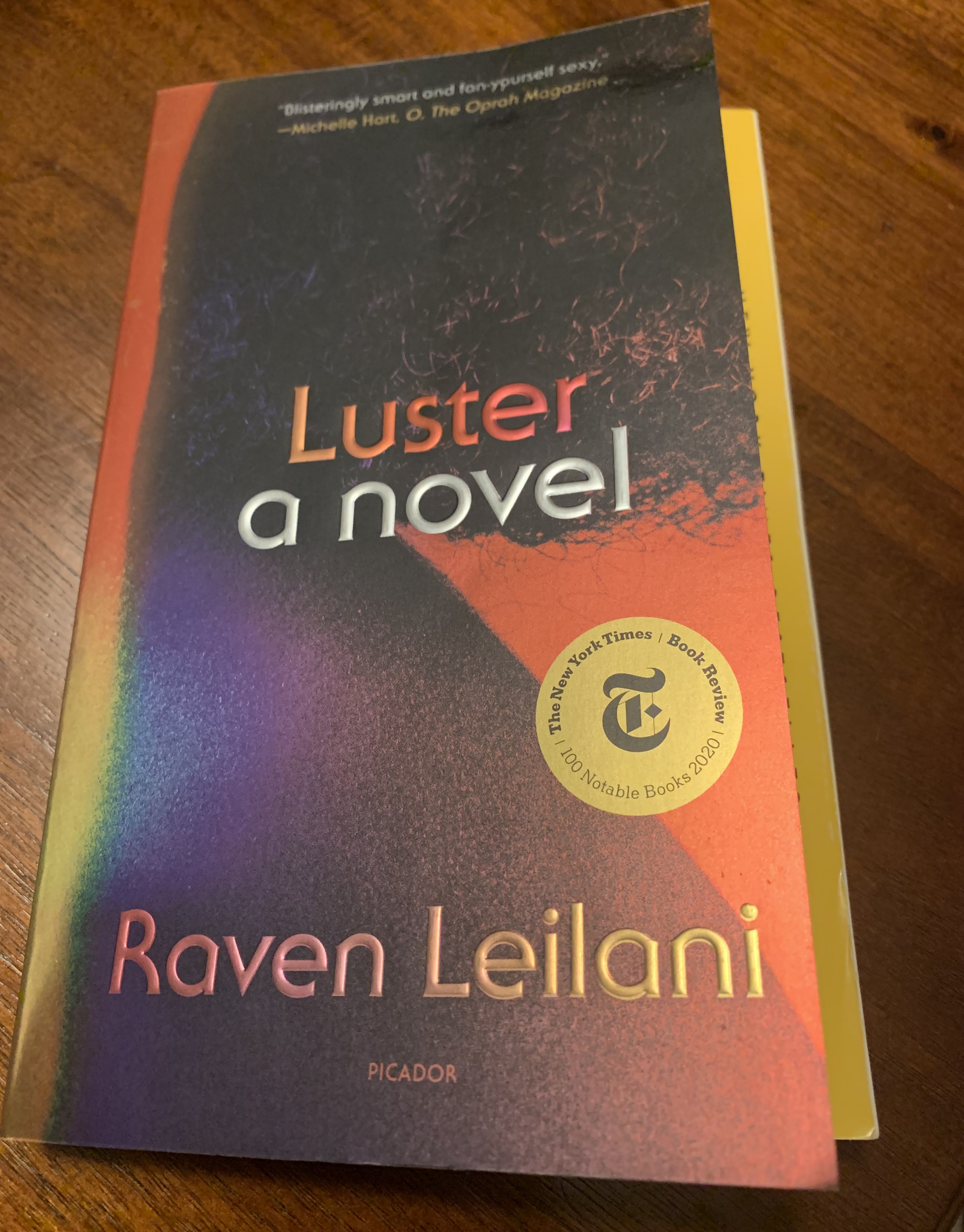
I think I just read my first Generation Z book. It’s possible I’ve read other books by a Gen Z author and not realized it, but this was the first book that truly captured the zeitgeist of that generation (which also overlaps with Millennials since none of of this generational delineation maps on neatly). Broadly speaking, of course, it’s a generation that embodies the “I’m dead inside” posture, somehow simultaneously aloof and intensely interconnected, and errs toward nihilism, itself a shallow veneer for the aforementioned intense need to feel connected and be connected. Raven Leilani, who is actually a few days older than I am, so a younger-ish Millennial (hence, the overlap!), captures these sensibilities with such appropriately dry candor that becomes funny in an unfunny world in her debut novel, 2020’s Luster.
Luster is about Edie, a Black woman in the publishing world of New York City, who is disconnected from any real connection in the world in real life, or IRL (although, she’ll delete a Tweet in cyberspace if it’s not getting any “likes”), and also exudes a sense of masochism and hedonism. That both works on the level of wanting to feel something and the aforementioned nihilism of, if nothing matters, then this pain inflicted upon me is transactional and fleeting anyway. Or this hedonistic sex with a co-worker is just sex. She meets Eric, a man more than twice her age who is also married, online and which soon translates to IRL. It’s not quite the same once they meet in-person, plus she doesn’t have the benefit of formulating her perfect responses in her iOS Notes. Even worse for her, Eric won’t put out! Nine dates in, and he still hasn’t had sex with her.
Of course, they do eventually have sex, and even break the rules set up by Eric’s wife, Rebecca, that included no unprotected sex and no sex at their house. They broke the latter when Eric brought them to their house. Eric claims they are in an open relationship, but I’m not quite sure how to interpret it because it doesn’t seem open on her end. Anyhow, it’s after first leaving Eric’s suburban home in New Jersey — a nice contrast to one of the themes in the book, Edie’s poverty and her shame over it — that Leilani gives one of the best descriptions of what makes NYC … NYC, and it’s a perfect microcosm of the yin-yang nature of the zeitgeist she’s already tapping into with Gen Z. Even though I’m not a resident of New York City, I have a sense of the city as a character from visiting it and from what I’ve come to understand of it. On page 41 of the paperback edition, “… as the city rises around me in a bouquet of dust, industrial soot, and an overripe squash, insisting upon its own enormity like some big-dick postmodernist fiction and still beautiful despite its knowledge of itself …” There is a self-deprecation that underscores Millennials and Gen Z: that like NYC, we intend to rise up insisting upon our enormity, but we know there is a meta foolishness to it, if not a sense of futility, but despite that and the meta quality of it, there is still beauty to be found. It’s in searching for that beauty, we struggle, and to paraphrase Ta-Nehisi Coates, there is beauty in the struggle. Not that Edie would necessarily agree at all turns, as a Black woman navigating the world, a world where her mom killed herself and her dad was aloof. Seeded within her brain at all times, she tells us, is that she sometimes wants to die, and if she was ever in a situation where she could die, her attitude is, fine, whatever, I’m ready.
Rebecca does something unexpected, though, once Edie is fired from her publishing job (for being sexually inappropriate — she had sex around the office) and can’t maintain her apartment: She invites Rebecca to live with her, Eric, who initially is away on a business trip, and their adopted Black daughter, Akila. Which aside from inviting your husband’s mistress into the house and the awkwardness that engenders, Edie also worries that she’s being brought in as a token Black woman to help with the Black daughter. Akila is the quintessential precocious, self-aware 13-year-old girl, who has been through a few families and doesn’t want Edie to ruin this family for her. She’s also just a big nerd who writes cool fan fiction about Batman and Superman, listens to Japanese music, and plays video games. She wants to be a nerd without feeling the shame of a Black girl being a nerd. Similar, in fact, to how Edie wants to be an artist without the attendant shame she feels for claiming that descriptor.
Edie and Rebecca become … well, close isn’t the word, but there is a bonding of a kind. Rebecca works at the VA morgue because “bodies are data.” There is no hiding one’s life once on the morgue table. That’s also similar to Edie’s view of art when she’s painting, which she begins to paint all sorts of things in Rebecca’s household, including Rebecca herself as a nude model later, in that the body is data. Alive, too, not only when dead. If you really look, at least.
To really drive home the point that this is an unfunny world, as it were, despite the dry humor of the situations Edie finds herself in, Leilani has Edie reflect on the ugliness of her laugh and the fact that her mother never laughs. But even better yet, in the course of applying for a new job, Edie interviews for a position at a clown school. She’s shocked to find that the other interviewees and the interviewer are taking it all very seriously. At some point, Edie comments to the interviewer that she thought being a clown was supposed to be fun. The interviewer essentially sighs and tells her that being a clown is about reflecting the human condition, or some such pretentious mumbo jumbo. Which is hilarious. In this book, even the clowns are so serious.
Three times in the book, a Glock 19 is mentioned. First, Edie finds it in Rebecca’s house in a Monopoly game box, which is also funny in a macabre way, given a 13-year-old is in the house, too. Then, Edie finds it in the glovebox of Rebecca’s vehicle when it breaks down and they need to call AAA. Finally, the police accost Edie and Akila outside the family home for being Black, basically, and when Rebecca arrives, they ask her if she owns a gun because a neighborhood dog was recently killed. So, given these three instances, I was worried Rebecca was going to kill herself, or worse. Fortunately, Chekhov’s gun never comes into play in that way. (Did Rebecca kill the dog?!)
Eric and Edie continue their sexual encounters, eventually resulting in Edie becoming pregnant. For a moment, she begins to imagine what it would be like to have a child this time. I say this time because she was impregnated at 16 by a much older man then, too, and her dad had her abort it. A lot of thoughts ran through her mind about bringing a child into the world, including the generational racism stew that its brain chemistry would be formed out of, among other issues. But it’s not to be. She has a miscarriage. After the miscarriage, Edie gets an internal communications job and a new place with a new roommate and moves out of the house, on Rebecca’s orders. Rebecca helps, though, and that’s when she becomes a live model to Edie. Edie feels bad, though, for being yet another person who walks away from Akila, but alas. Maybe their time together still helped Akila. Even so, Edie wonders who will do Akila’s hair now.
In the end, Edie is obsessed with how it is we manage to survive given how hard life is, and what Edie most wants is someone “with merciless, deliberate hands, to put me down onto the canvas so that when I’m gone, there will be a record, proof that I was here.” Nothing matters and everything is fleeting. And yet. The clarion call to say, “I was here,” begs to be heard.
What a first book of 2025 to read. This one is going to be in my head for a long time to come. Leilani’s debut novel is an unflinching look at what makes all of us so painfully, fallibly human, and how we persevere anyway. It’s a must-read.


