
Spoilers!
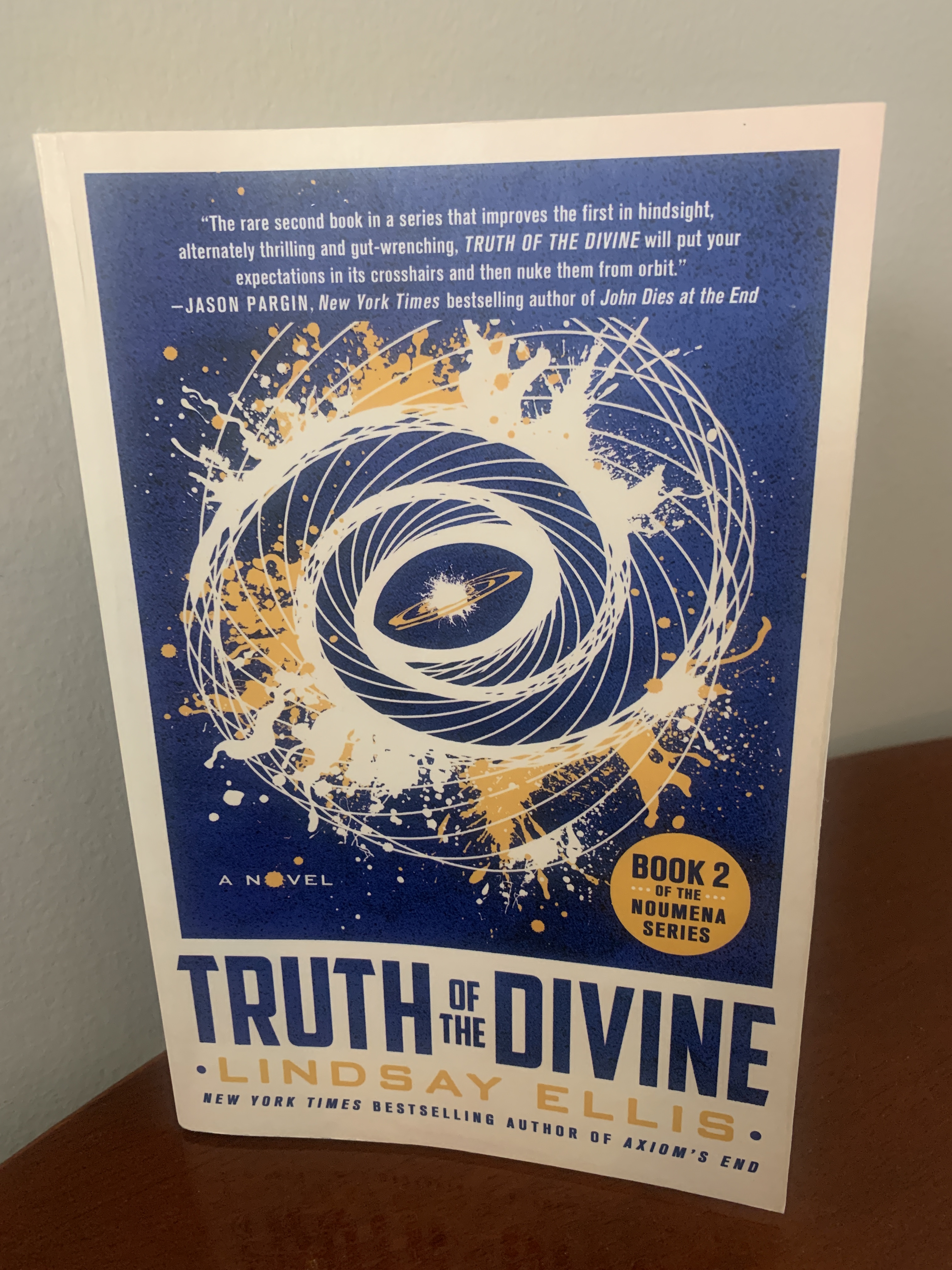
First Contact with aliens would likely go how one can imagine as far as the human response goes. There would be those who embrace the beautiful miracle of the contact; those who are fearful and protective against the alien presence, just as they are about so-called “human aliens”; there would be those who worship the aliens as new gods; and there would be those who are largely apathetic and don’t give much thought to it. In other words, humans would project onto First Contact all of our best and worst impulses, all of our feats of empathy and fear alike. In Lindsay Ellis’ 2021 book, Truth of the Divine, the follow-up to her 2020’s Axiom’s End, she explores more of how humans would react to aliens in their midst, both from a day-to-day level and at the larger philosophical and legal question of how to incorporate them into our society as intergalactic refugees. What’s particularly interesting about what Ellis does with her sequel in this Noumena series, is that she also explores with unflinching depth the traumatic toll interaction with an alien species — especially owing to its existential, life-threatening possibility — has upon her main character, Cora. This made for a much darker read than Axiom’s End, but ultimately, a richer development of the Cora character and the wider story Ellis is telling.
To recap the prior book, in an alternate history of 2007, a Julian Assange-like whistleblower, Nils Ortega, reveals the United States government’s secret: aliens, known as the Fremda group, post-natural quasi-mechanical being, landed here 40 years ago. Bush resigns the presidency. Cora, a 21-year-old college dropout, who is also the estranged daughter to Ortega, is a proficient linguist who becomes the interpreter for Ampersand, the name given to one of the aliens who heard the Fremda group’s distress call and has newly arrived on Earth. His species, the Superorganism, visited Earth nearly a millennium ago and deemed us unlikely to become an advanced civilization. Oops. The other unique orientation twist Ellis provides is that the aliens see us as monsters: pugilistic, flesh-eating monsters! Once the Superorganism realizes we are advancing, then they believe we pose an existential threat to it. The aforementioned distress signal was also heard by Obelus, who is a higher-up being in their caste system. The cultural norm within this system is to euthanize those who are deemed defective, diseased, or weakened, like the Fremda group. Ampersand came to like Cora and appreciate her kindness. So much so, that they pair-bonded, a common practice in their world. When Obelus’ own guards realize he may be defective himself, they attack and kill him.
Interestingly enough, when I wrote my review nearly two years ago of Axiom’s End, I noted that I wished Ellis had delved deeper into the public’s point-of-view on First Contact, and the issues with government secrecy. That’s what Truth of the Divine does!
Cora is traumatized and suffering from post-traumatic stress disorder after being quite literally gutted by Obelus during the events of the previous book. It’s a particularly perplexing traumatic event because Ampersand saved her and in so doing, removed any visible scars from her body making it appear as if this traumatic attack never happened. And yet, it lingers. (It’s also not as if she can talk about it with a therapist given how top secret everything is.) This PTSD is only deepened when she realizes Ampersand has brought Obelus back, at least to the extent of his mind and personality in a new body, because Obelus is one of his pair-bonds and he doesn’t want to lose him. Meanwhile, Ampersand’s remaining pair-bond arrives on Earth by folding space somehow, something even the Superorganism cannot do. A rabble-rousing candidate for political office calls this newly arrived alien the Enola Gay. Ampersand is able to capture Enola, who he fears. That’s when Cora, on her way to Ampersand, stumbles into Kaveh Mazandarani, a 35-year-old Iranian-American, recovering alcoholic, and Pulitzer Prize-winning journalist, who also happened to work with Cora’s father on an article. Cora doesn’t know this, though, and instead thinks of him as “MurderGuy.” She takes him hostage in the same place Ampersand is keeping Enola! After everything is later cleared up and Kaveh is released from his bondage, Kaveh is empathetic toward Enola’s plight. He wants to help him. Through this kindness, similar to Cora’s kindness shown to Ampersand previously, Kaveh and Enola form a friendship of sorts. In fact, Kaveh becomes Enola’s interpreter. Not liking the association with the destructiveness of the nuclear bomb, Kaveh renames Enola Nikola after Nikola Tesla.
Kaveh and Nikola are not the only ones who bond, though. Kaveh and Cora begin to bond, too, and in fact, it turns into lust and infatuation, and later, love. Admittedly, I did not much care for this pairing. First, owing to his association with Ortega, I was worried that Kaveh would hurt Cora! Fortunately, he proved himself caring enough. Secondly, though, I just didn’t think Cora needed a love interest and that when those scenes were developing, I was itching to get back to the aliens and the political question of their personhood. Moreover, the relationship began to feel codependent and unhealthy in the way Cora’s relationship to Ampersand was beginning to feel codependent and unhealthy. I don’t know; it just didn’t sit right with me for Kaveh to bed Cora given the state she was in. The initial sex scenes were super uncomfortable to read! But I also take the argument that Cora needed a human companion and human support, too. Perhaps it didn’t need to rise to the level of love, though.
While all the above is going on, there’s also a lot of political happenings, too. First, there’s the Gadsden Line, a far-right militant group, which forms online to “defend” the United States from aliens. They soon take their threats from online into the real world with guns and somehow the knowledge that the aliens can be neutralized with an EMP. It doesn’t help that Jano Mirando, someone running for Congress, and a Senator with ambitions to be president, are boosting the xenophobia and “other-ing” of the aliens. Indeed, Mirando calls for a “third option” amid the debate about whether to grant the aliens legal personhood or not. Kaveh will later call this the three-fifths person conception. Basically, a legal avenue for discriminating against the aliens. What’s unfortunate is that there is a legitimate grievance coming from Ortega, Mirando, and others: the government is holding back information. The problem though is thinking the solution is discrimination, fear, oppression, and violence.
After a Miranda rally turns violent upon the appearance of Nikola in the crowd (he was curious to be among the people!), which then prompts a skirmish between the LAPD and the Gadsden Line, killing five people, Ampersand is noncommunicative. Cora is so distraught at this, she thinks the only way to get his attention is to self-harm by cutting her wrist. That’s not healthy, obviously, and more so, we later learn that part of her does want to die. She has suicidal thoughts and is already thinking about the next attempt. Kaveh does try to help her, though, and be patient and supportive. Ellis really put Cora through the wringer in this book!
The two fears in this book that reach a climax are: a.) other aliens are seeking Obelus, too, and will kill whomever are in their way; and b.) that Nikola will become an addict again in his alien way and try to mercy-kill Ampersand and himself. When Cora and Kaveh intercept the moving of Obelus’ body in an effort to locate Ampersand, who now goes by Jude, and Nikola, those other aliens show up. The Gadsden Line morons are also there. One of them, ostensibly shooting at Nikola, instead hits and kills Kaveh. Again, Cora is just going through it in this book. The other aliens take the new Obelus. Cora is later able to rescue Ampersand before Nikola can kill him (Nikola nearly killed himself in the process, but Ampersand saved him enough to put him into an induced coma).
The other overriding issue at stake in Truth of the Divine is that the Superorganism is far closer to being able to reach Earth than previously understood. Like, within five or 10 years instead of hundreds of years. Meaning, humanity faces an existential threat: sterilization by the Superorganism. Earlier in the book, when Nikola was talking to Kaveh, he proposed saving the human genome at least by folding space again and finding another habitable planet to escape to. At the end of this book, Ampersand essentially offers the same to Cora, who actually agrees, believing humanity in some sense is unsalvageable. That, even if the Superorganism doesn’t come and destroy us, we’ll destroy ourselves. This is another inversion of how it usually goes with alien books by Ellis: typically, it’s always believed that in the end, humanity is worth saving despite our faults. Cora has been so traumatized and hurt, she cynically no longer believes we can rise above those faults. This is a diametrically opposed viewpoint, I think, from what Kaveh offers in his last column he wrote prior to his death. He is in the camp of humans I mentioned at the top who sees beauty in someone like him and Nikola existing at the same time and able to converse with each other. In that beauty is hope. In that beauty is our salvation. And in that beauty is the truth of the divine.
I’m not sure I was necessarily as enraptured by this second outing by Ellis, even though she certainly delivered on my hope for more of the public and political grappling with First Contact, but that’s also because it’s such a different book than Axiom’s End, and not in a bad way. Ellis went darker, waded more into human trauma, and the Kaveh romance notwithstanding, I think she succeeded at this effort. While I didn’t need the Kaveh romance, I appreciated Kaveh’s voice as the voice of humanity’s better side. As the side that is still redeemable, even if Cora’s lost hope in it. For now.


Very cool! 😎❤️✨🙏💯📚
LikeLike