
Spoilers!
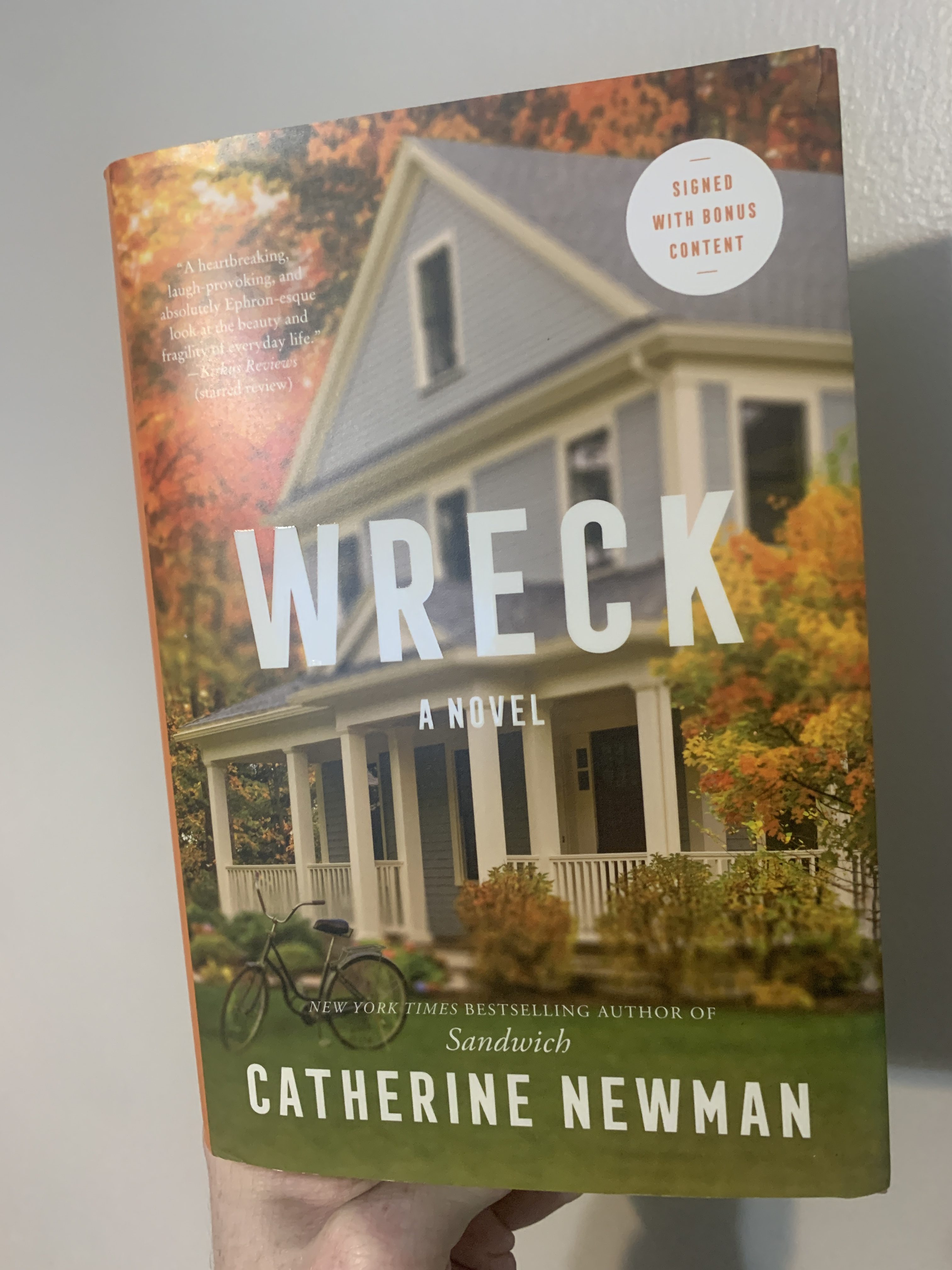
Sometimes, life is shitting in a bucket, or having to wear the shit bucket, or even loving the shit bucket in spite of its contents. Catherine Newman’s 2025 follow-up book, Wreck, continues with the introspection, hilarity, and macabre observations that made the first book, Sandwich, lovely and biting. Newman reminds me of my favorite comedians: they don’t always have to be funny, as I remain enthralled by the rhythms of their craft on display. So it is with her, where her books aren’t these elaborate narrative plots or filled with twists, but I’m enthralled by her craft (prose) all the same. I love her voice and the voice she lends her main character, Rocky (in my Sandwich review I wondered why she had that nickname, and it’s answered in this one: her friends named her after Rocky Balboa because she’s scrappy and a fighter). Life is not gentle. But it’s all we have, and that’s something to hang on to through its unexpected ups and downs.
Rocky, 55, is a Bostonian, a writer of spatchcocking (among other things), menopausal, an empty-nester-ish with her husband, Nick, and two cats, Chicken and Angie, and under a year removed from the events of the previous book where her mother died and her son, Jamie, married Maya. She’s an empty-nester-ish because her 92-year-old father moves into a retrofitted “shack” behind their house, as he navigates his grief, and her daughter, Willa (who was teased to have a tragic backstory of her own in Sandwich that still hasn’t been examined!), has a lab job, but still lives at home. Jamie and Maya live in NYC.
Life is not gentle and that is expressed in the weirdness of just having a body. Yes, as the joke goes, we all have a terminal condition in that we’re going to die, but on the way there, the body goes through a lot. And Rocky is going through a lot, with an inexplicable rash spreading throughout her body and a slew of doctors unable to ascertain what the heck the underlying cause it. Eventually, she’ll learn that it’s a condition my mom also has (and which also stupefied doctors), primary sclerosing cholangitis, related to the bile ducts and the immune system.
The other off-the-tracks moment that occurs for Rocky is the sudden train crash death of someone Jamie’s age, Miles Zapf. Then it’s right back on track enveloping her family, as Jamie’s consulting firm in NYC, Dickens, contracted with the railroad company implicated in the crash and death. Moreover, Jamie himself worked the account. For Rocky, and especially stalwart idealogue Willa, who also has bad anxiety and panic attacks, that puts them into a moral quagmire; they love Jamie and think of him as good, and yet, he is connected to something seemingly not so good. In other words, it doesn’t appear as if Miles attempted to die by train. Instead, irregular mechanical upkeep could be to blame, which was advised as an acceptable risk by Dickens. Eventually, Rocky and Willa talk with Jamie, realize he’s struggling over these detached, awful calculations and the money made from it therein, and realize it’s not as if he’s happy this happened. It’s just, well, the side of the tracks he was on at the time.
In Sandwich, fueled by the craziness of her menopause, Rocky was quite acerbic toward Nick. Here, she’s more so that way, or at least, exasperated, with her aging father, who is being difficult. However, what Rocky comes to understand, and not just applied to her father, in what is the most poignant reflection of the book, is that it all comes back to love; because we’re humans, we struggle with directly saying we love someone or we miss someone, so if you notice it, you’ll start seeing all the ways in which we say, “I miss you,” and, “I love you,” without actually saying those words. Her dad misses his wife. His “difficultness” is often an expression of that. And by extension, in excavating these expressions of love from their daily trappings, Rocky begins looking for the ways in which Miles’ mother is publicly grieving her son on Facebook and out in the world with his funeral and his dance group. (Between her medical chart portal, WebMD, Google, and Facebook, Rocky spends a lot of time scrolling in this book.) At the funeral, Rocky describes Miles’ mother like this, “The way she was entirely made from sorrow now, dragging her body around not because she was attached to the idea of life but simply because she couldn’t shake it.” That’s one of the best descriptions of grief I’ve read in a while. Haunting.
There are no easy answers in life or certainties. Not about Rocky’s difficult-to-name-and-diagnose-and-treat maladies, and not about Jamie’s career choices, who does decide to leave Dickens. Or about her dad, who decides to move back to his apartment in NYC. Or Willa, who finally decides to leave the nest with a new girlfriend. But there are two ways that help us approach the difficulty, pain, complexity, and uncertainty of life, as Rocky comes to believe. First, recognizing that people are different from you, and the way to “survive that” is to not mistake difference for loss. To do otherwise is how you lose everything, Rocky sagely points out. That is another way of saying grace. Second, loving each other, whether we explicitly express it or demonstrate it in other ways, is the only way we can operate under life’s conditions. That is another way of saying gratitude. So, grace and gratitude. I think that’s about right.
I will devour anything Newman writes at this point because of her inviting and irresistible prose, the characters she creates within and through such little moments, her ability to evince bigger moments without applying too much sap, and of course, the dark humor. Because life is a dark comedy. Everyone should read Sandwich and Wreck.


