
Spoilers!
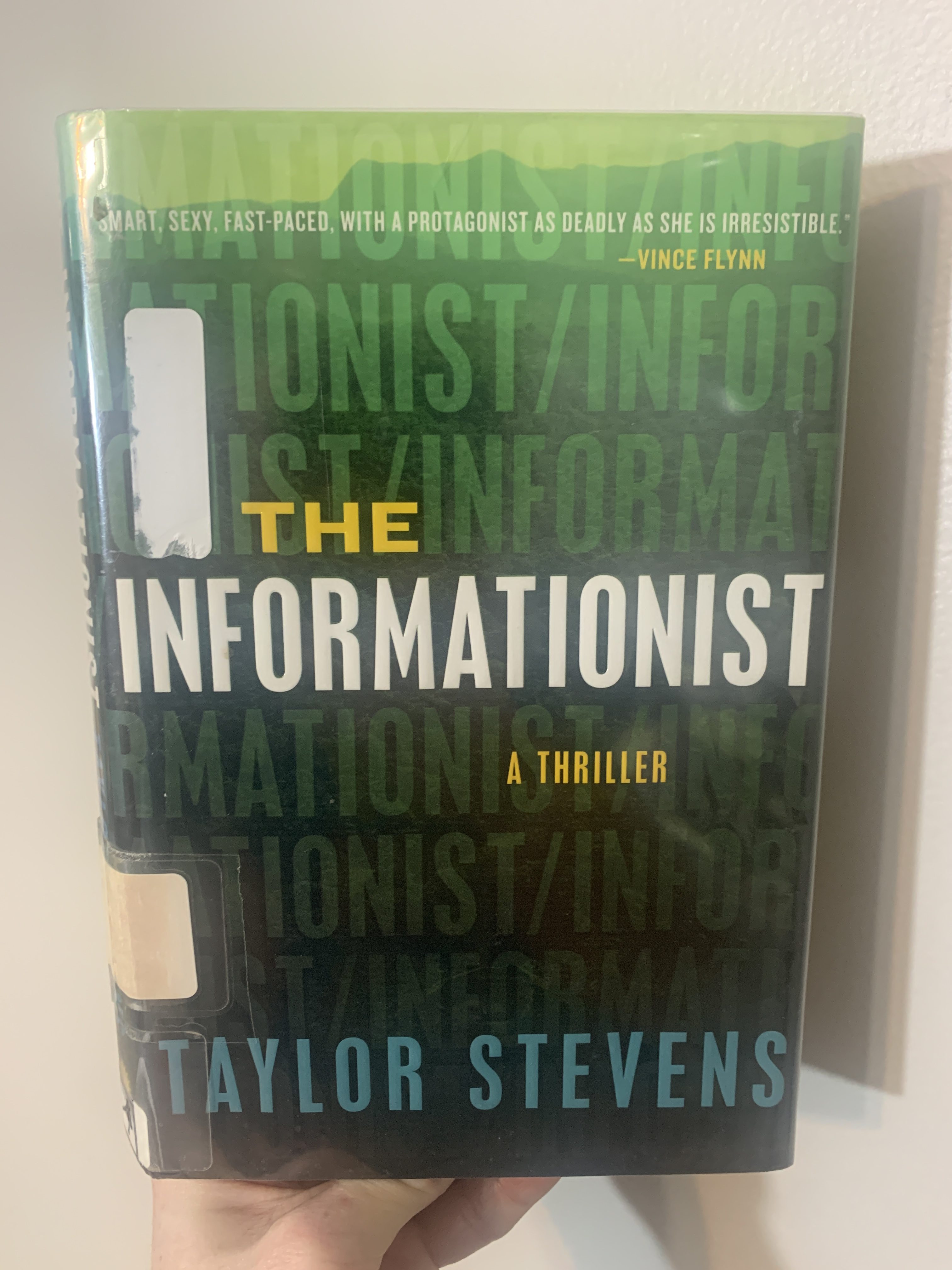
I’m always down for a globe-trotting, ass-kicking thriller as a palate cleanser — a way to have fun after a heavier book. Granted, even thrillers bring forth difficult subjects. Taylor Stevens’ 2011 book, The Informationist, introduces a new heroine, who slips in and out of countries like a deadly vapor, and the currency she trades in is the namesake of the book: information.
Vanessa Michael Munroe, who goes by Michael when she’s working a job, has a tumultuous past. She grew up in Cameroon, although if you ask her, she claims no country as her own. Through her experience in Central Africa, she can speak 22 languages and knows the dialects, customs, and cultures of a great many people, hence the ability to navigate in and out of countries and amongst the populaces to acquire information she needs. Then, she ended up in a camp of some sort with a guy named Francisco and Pieter Willem. She’s only 14, but they teach her all manner of survival and defense skills. All of this makes Munroe not just a savant with information and people, but with violence. Unfortunately, Willem was also brutal in his lessons, which would be bad enough for a 14-year-old, but additionally, he was raping Munroe. Eventually, she was able to get the better of Willem and kill him, then escape. Once in the United States, powerful people took notice of her skills at gaining information about countries nobody else could and hired her for jobs. That also led to working with Kate Breeden, her sidekick of sorts.
A new job comes along that is unlike any previous one Munroe has worked: a rich Texas oilman, Richard Burbank, is willing to pay her $5 million total — $2.5 million upfront and $2.5 million on the backend, plus expenses — to find his daughter, Emily, who has been missing in Central Africa for more than four years. Burbank’s one condition (other than regular check-ins and updates) is that she have Miles Bradford, a former U.S. Special Forces-turned-mercenary, come with her; Burbank trusts him and he’s worked the case for four years. Munroe acquiesces, although she doesn’t trust Bradford, preferring to work alone.
Once in Central Africa, Munroe and Bradford follow the trail through dangerous Equatorial Guinea, where Munroe is captured and awakens on a boat in the middle of the water surrounded by military men (funny enough, they are speaking a language even she doesn’t know!) intent on clearly killing her and dumping her body in the water. She’s able to escape and barely survive. While trekking through the woods, she realizes Francisco is nearby and relies on him for help, although still not entirely trusting him, either. We learn that they have feelings for each other, which is weird from Francisco’s end since he knew her at 14, and stated he was lusting after her at 15, if I read the book correctly. So, I was not into their budding, inevitable romance and relationship from the beginning. And as for whatever led to Munroe being nearly killed, she’s primarily thinking it was Bradford who betrayed her. For his part, Bradford was never captured, made it back to the U.S., and doesn’t know what the hell happened.
Now with Francisco’s assistance, resources, and local connections, Munroe reliably learns that not only is Emily alive, living in Equatorial Guinea, but that she has a husband and two children. Before she makes contact with her, Bradford insists on being allowed back in and to be there when they talk to Emily. Munroe agrees, but then has Francisco interrogate him upon his landing in Central Africa to ascertain if he is on their side or not. Munroe believes Bradford after he tells Francisco that his true motivation has been Elizabeth, Emily’s mother, who he loved. So, everyone goes to talk to Emily, and the bizarre thing isn’t that she’s essentially captive in her own home, unable to leave (it would seem obvious that she was a prisoner), but that she tried to call Burbank to come home and he told her to never call again. What is going on?!
Burbank’s monies were buoyed by Elizabeth’s trust fund, and now his oil monies and other ventures are collapsing. Her trust fund is what he needs to stay financially solvent. After her death, which Munroe now wonders was murder, Burbank set out to have Emily ruled dead in Central Africa to gain access to the trust fund. That’s why he was willing to accept a clearly phony death certificate from the government in Equatorial Guinea. On top of this twist, it seems like Breeden was working with Burbank to give him insider information that would derail Munroe. (Too many B last names to keep track of here!)
Before Munroe, Bradford, and Francisco can help Emily and her two children out of Equatorial Guinea, the connections Burbank has to the country (blackmailing Emily’s husband, who can control the military), soldiers are closing in on them. They can’t risk moving Emily and the kids with them, so they escape without them. However, the military catches up with them, and shoot Francisco in the head. Because of the aforementioned distaste with Francisco, I wasn’t as overly sad as Stevens probably intended me to be. Anyhow, to use Munroe’s words, she then leans into her demons, or to put a name on it, into her Willem side, and kills all the military men, including the commander who executed Francisco, beheading him. Whoa. That is almost too far for a morally-rooting-for-you protagonist.
The book closes with Munroe and Bradford returning stateside, with Munroe concocting an elaborate scheme to kill Burbank and Kate in what looks like a jilted lover murder-suicide. However, she realizes upon confronting Burbank that she doesn’t want to lean into her Willem side. She lets him live, although after showing how he’ll be ruined reputationally and financially, he kills himself anyway. She also lets Kate live; she’s now being charged with Burbank’s murder after enough of Munroe framing evidence was left behind. In the Epilogue, Bradford informs Munroe (which is ironic!) that Burbank had also been blackmailing Kate and she unwittingly revealed information to him that comprised Munroe. In other words, it doesn’t appear as if she intentionally betrayed Munroe.
I enjoyed The Informationist. It was fast-paced, intriguing to be in a different part of the world with Central Africa and those dynamics, and Munroe was a compelling, nuanced enough protagonist. If I had constructive criticism, I would have liked more of Munroe’s “informationist” thinking and strategizing on the page versus implied. Also, interestingly, Munroe’s globe-trotting, her abuse and imprisonment, if you will, in the camp as a child, and even the Dallas setting are all reflective of Stevens’ real-life experience. She grew up in the Children of God cult and lived in communes all over the globe. She wasn’t even allowed an education beyond the sixth-grade. And now, she’s a published author! Very freaking cool in terms of resiliency and perseverance. (As for Dallas, Stevens resides there.) As happens with a series featuring the same protagonist, later books only improve upon that character and the story around them, which is why I look forward to reading more of Stevens’ thrillers.


