
Spoilers (I suppose)!
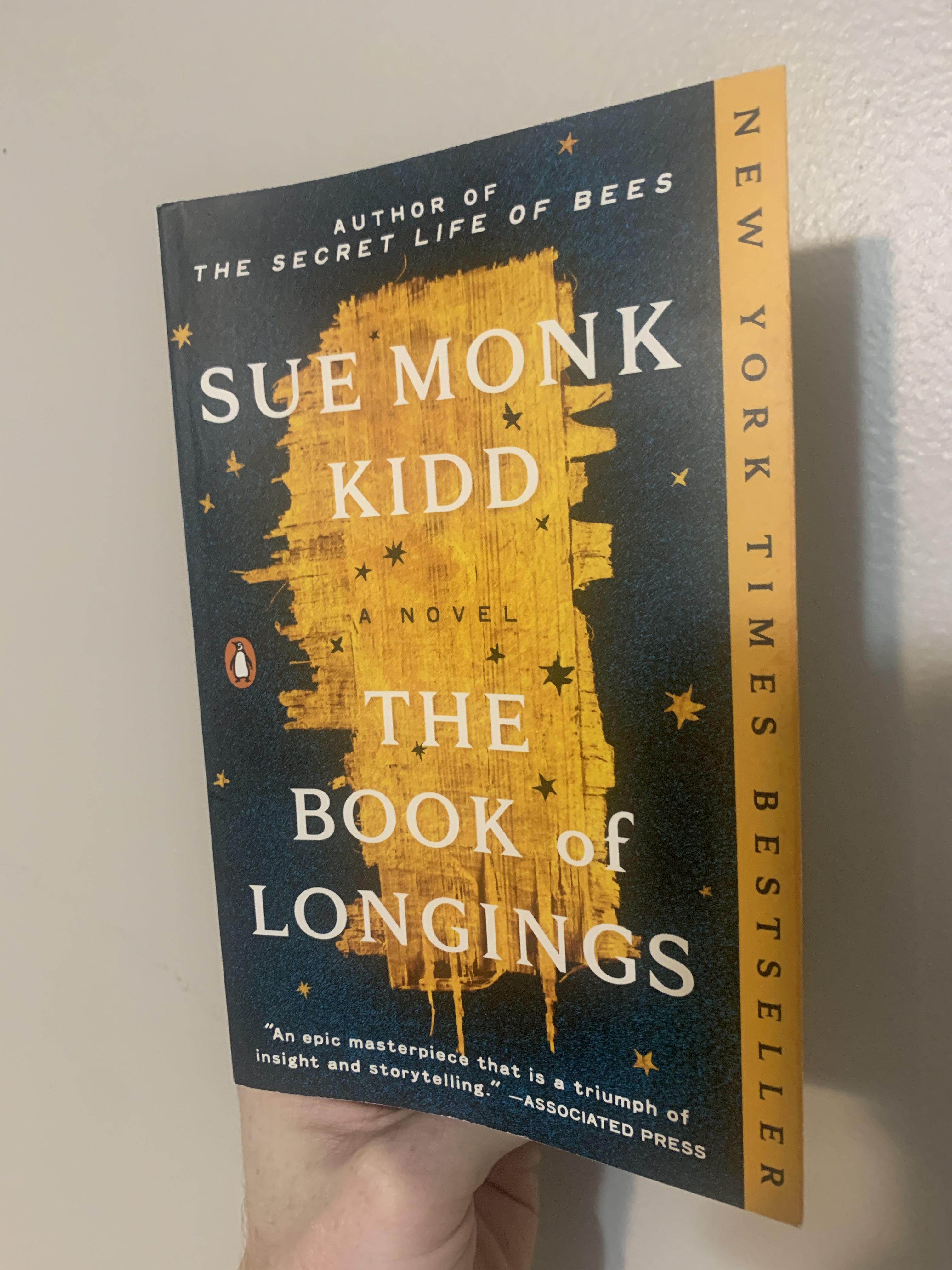
Yearning is perhaps too poetic a term for longing. At its rawest, longing devours and compels, insatiable in its quest to expel a kind of largeness from us. Longing is that which is our essence, inviolable within place and time and by people. And yet. A kind of silencing occurs, often literal, which does not render the longing eradicated, but displaced and unused. Women throughout history have had their longings ignored, belittled, attacked, and quieted. Unmentioned, unnamed, off the page, out of the room. History churns on apace. If Jesus had a wife, what would her longings be? With her voice, what would she say? And if her longings were denied, her voice silenced, and her life, including with Jesus, ignored by the churning of history, would she not, therefore, be the most silenced woman in history and most in need of a voice? That is Sue Monk Kidd’s argument in her audacious, beautiful 2020 book, The Book of Longings, which imagines that Jesus was married to a woman named Ana, who he lived with and loved for the near-decade leading up to his ministry and crucifixion. While Scripture and scholarly research do not indicate historical Jesus had a wife, it is at least conceivable to imagine that erasure as an artifice of history’s churning of women’s voices. Thus, the really audacious downstream argument Kidd asks us to consider in her Author’s Note is how Christianity, Western civilization, women’s equality, and our conception of sex would have unfurled from a married and noncelibate Jesus. Alas, it was not to be, but that is where fiction and books like Kidd’s come into the void, splendidly and imaginatively. And to be clear, while Jesus is a character within this book and he is the love of Ana’s life, this is a book about Ana and particularly within the milieu of the first century C.E. Ana as the narrator, navigating this milieu in Galilee, Alexandria, and Jerusalem, made for a rich, layered, and unique vantage point; indeed, an untold, unmined vantage point.
At 14, Ana lives with her parents in Sepphoris, along with Judas, an agitator against the Romans, who the family adopted (orphaned after his father was killed by the Romans and his mother sold into slavery). Her father, Matthias, is the head scribe to Herod Antipas, the tetrarch, or ruler, of Galilee. Because of that position, Matthias uncharacteristically and uncommonly allows Ana to learn to read and write, much to her mother’s chagrin. This engenders Ana’s lifelong longing to write and for her voice to be heard. Also not just her voice, as she’s initially detailing all the women in the Bible. She does not want to bend to the convention of her time for women, which is to marry and procreate. However, Matthias and her mother intend Ana to do just that by forcing her, at threat of destroying her writings and writing tools, to become betrothed to a much older man, Nathaniel. Their marriage contract will mean Matthias gaining property, as he’s always desired. Fortunately for Ana, she does have a woman in her family on her side, her aunt on her father’s side, Yaltha, who is educated and worldly, and encourages Ana to embrace her “holy of holies,” i.e., her longings and ambition. This “holy of holies” being that inviolable longing, which is contrasted to the Temple at Jerusalem (the infamous “den of thieves,” where Jesus would upend their tables) where only men could go and which seems to “confine God.” That’s a teaser for one of the most radical notions that comes from Jesus and Christianity: freeing God, as it were, to be everywhere and within all of us. For her part, Yaltha was cast out by her own family for being accused of killing her husband. Such was the shame and castigation that Yaltha’s own daughter was ripped away from her and adopted out to a priest. The relationship between Ana and Yaltha was lovely and it is the central relationship of the book, even more than Ana and Jesus. It is Yaltha who gives Ana an incantation bowl that Ana will cherish all her days and which brings her closer to God, in a way. It’s also I believe where she inscribes this powerful prayer, “When I am dust, sing these words over my bones: she was a voice.”
(Also fortunately, the marriage does not go forth with Nathaniel; instead he dies of a fever, freeing Ana, albeit anchoring her in her family’s eyes and that of society: now she’s a widow.)
A pivotal moment in Ana’s life comes when her friend, Tabitha, who loves to sing and dance with her lyre, is brutally assaulted and raped by a soldier. Instead of quietly accepting her assault, Tabitha stands on a street corner, essentially, and yells to everyone what happened to her. Her family sees this as shameful, though, and her father has her tongue cut. Ana is obviously aghast, and Tabitha’s story becomes another of her books. It’s also further kindling for Ana’s ambition for all women to have a voice.
Also notably, during one of the first interactions Ana witnessed between her father and Nathaniel, she also saw Jesus for the first time. He’s a carpenter, of course, and assists her when she faints, only to be shoved backward onto his head by a soldier guarding the rich Matthias family, thinking some peasant was accosting her. Later, when Ana is trying to secrete her writings away in a nearby cave to avoid being burned by her mother, she sees Jesus again. She conspires to return to that cave to see him once more. Eventually, they talk, and he, unlike other men of his time, treats her like an equal. Jesus takes to calling her “Little Thunder,” on account of how Ana’s longings and ambition are a kind of roaring, if you will, echoing Ana’s own inner monologue to “bless the roaring.” They eventually marry and go and live with Jesus’ family in Nazareth, where Ana, incidentally, has to quiet her longings in service to the daily chores necessary for day-to-day living, and where eventually, they will conceive a child, Susanna. She dies at birth, though. Ana will not want children again (she already was initially against children).
Jesus has his own longing to go into his ministry, but Ana cannot go with him. She’s being sought after by Herod Antipas, who desired her to be his concubine, with the willing help of her own father as one last effort by Matthias to accrue status and favor. So, Ana and Yaltha go to the Therapeutae, which is near Alexandria. (I’m skipping a big narrative arc, mind you, where they both originally go to Yaltha’s brother’s house, ultimately becoming de facto imprisoned in his home, albeit Ana is able to be a scribe again and surreptitiously takes up her own writing. They went to the brother’s house with the stated goal of finding Yaltha’s daughter, Chaya, who goes by Diodora now. They do find her and Diodora eventually accepts her mother’s love, but Haran, the brother, catches their scheming and they have to flee from there, too.). Therapeutae is a haven for spiritual, philosophical, musical individuals, including women. The place isn’t even penetrable by Haran and his soldiers, although they guard the streets going into and out of Therapeutae, such that Ana will eventually hide in a coffin to escape and return to Galilee to seek out Jesus again after more than two years apart.
However, when Ana returns, she does so upon Jesus’ arrest and crucifixion. So, yes, Ana’s brother, Judas, betrayed Jesus. They differed on how to overthrow Rome and bring God’s kingdom to Earth. Jesus did not want to use swords. Judas came to believe that if Jesus was killed and martyred, the people would rise up and overthrow Roman rule. Alas, Judas regretted his decision and hanged himself. Ana pitied Judas, but did not necessarily grieve him, as she did Jesus. What’s interesting is, because of those years apart when Jesus turned to his ministry, Ana never saw his miracles or proof of his Messianic claims the way his Disciples and the other people he encountered would have. And yet, she believed him, anyway.
As a scribe, Anna was able to write the Matriarchs (about the women of the Bible); the Tales of Terror (what happened to Tabitha); Phasaelis and Herod Antipas (Phasaelis was Herod’s wife who famously fled from him, and in the book, was kind to Ana); My Life in Nazareth (living with Jesus and his family); Lamentations for Susanna (her stillborn child); Jesus, Beloved; Yaltha of Alexandria; Chaya: Lost Daughters; The Ways of the Therapeutae; and Thunder: Perfect Mind. The latter is her magnum opus, stemming from the woman at Therapeutae asking her to compose a hymn and perform it. It’s also a real life poem Kidd used that was written around that time exalting the divine feminine side of God, Sophia. It’s a poem that joins together paradoxes, such as, “I am the whore and the holy woman / I am the wife and the virgin.” Women, like men, ought to have the freedom to live within these paradoxes. At the end of the novel, nearly 30 years after Jesus’ death, like the real life poem, Ana buries copies of her books in jars on a hillside near Therapeutae, on the advice of Yaltha, so that no men can ever stymie her voice again.
Over the course of the book, Ana grew, not only as she found her voice and how to use it, but also in her understanding of and relationship to God. Early in the story, when she’s trying to stave off convention and marry Nathaniel and bear his children, she pleads with God to rescue her. However, as an adult and after the hardships she’s faced, she no longer believes in the God of rescue, only the God of presence, which is a powerful message. That imbues her, and us, with the agency to rescue ourselves rather than placing it in God’s hands. And if you are the believing type, then God’s presence lifts us up in order to do that.
Kidd endeavored to write Ana’s story — the story of the most silenced woman in history — and elucidate the pull of one’s longings. In so doing, she created a richly layered story that brought the first century C.E. alive and its radical women to the forefront. I found it deeply affecting, compelling, daring, and yes, fun to read. I would highly recommend it to anyone else, believers or otherwise, although certainly the believers may have to go into it with more of an open mind and silence a different kind of roaring.


