
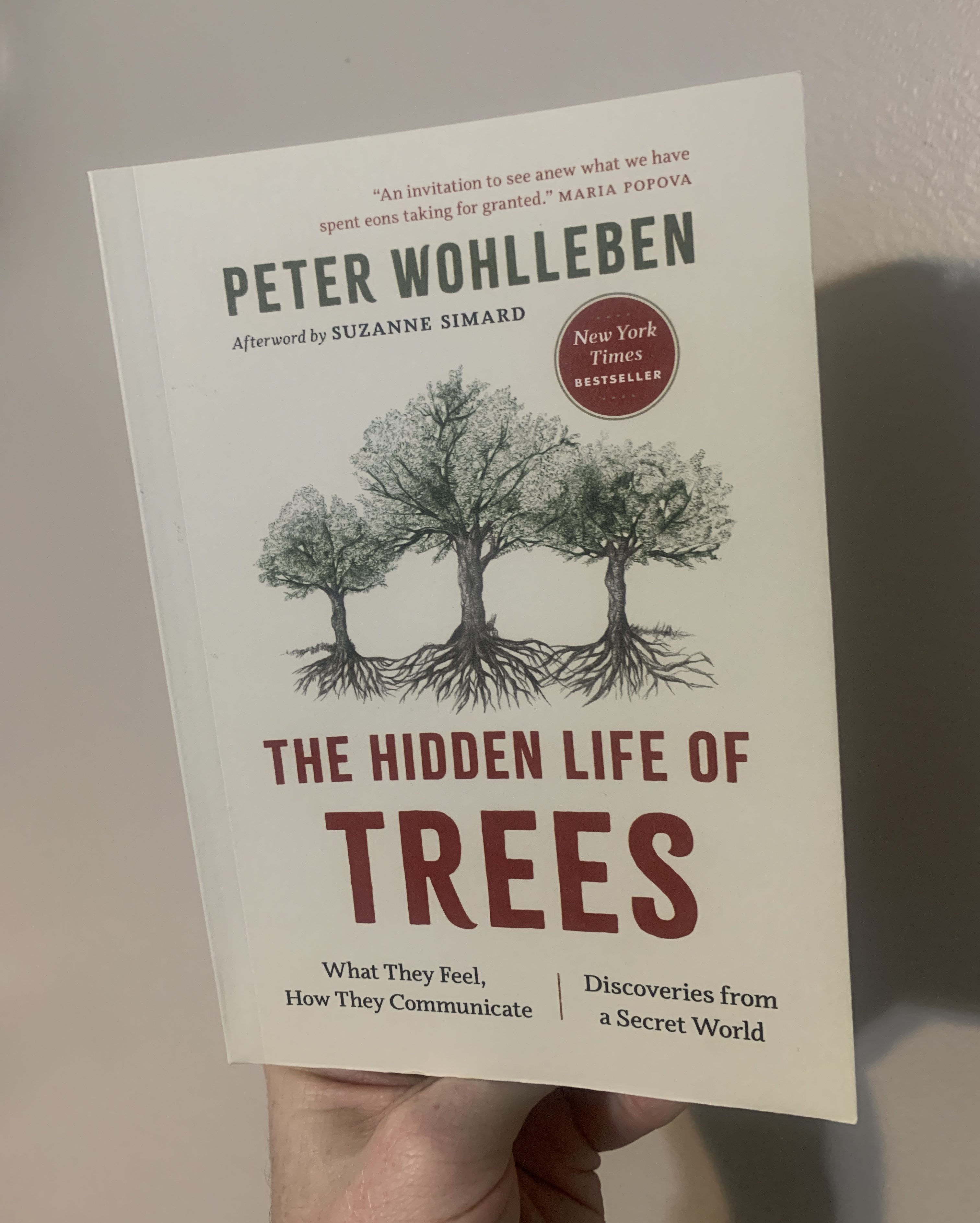
There is certainly a sensibility among humans that trees ought to be protected. After all, I believe most humans would be aghast to learn if a centuries-old tree was being felled. I would. Now, whether that’s because we identify the tree as “living” in the way we do animals, or because its age resonates profoundly with us, or a bit of both, to remove such a thing from the world cuts across that sensibility. As always, though, with such sensibilities, it’s a matter of degree. In his 2016 book, The Hidden Life of Trees: What They Feel, How They Communicate – Discoveries from a Secret World, Peter Wohlleben makes the case that trees are not only living, but social, interconnected, and poignantly fascinating creatures within the ecosystem that are owed our reverence, our curiosity, and our protection, which looks more like a hands-off approach than misguided stewardship. Readers’ mileage may vary on how deep they want to wade into Wohlleben majestic forest but regardless, they will walk out with a deeper appreciation of trees that populate the Earth all around us. Not only did I find Wohlleben’s book informative, but it teemed with liveliness – the same way a tree operates in the wilderness – from an author clearly passionate about his subject and I can’t help but be enraptured by that.
Trees are interconnected through their root system and communications channels therein, thanks to a symbiotic relationship with certain fungi. In a coin termed as recently as 1997, this is the “wood wide web.” In other words, our understanding of trees is relatively nascent, with plenty more to uncover and unknowns that create a sense of magical mystery for the Wohllebens of the world. Partly this is owing to what I started this review with: pointing out the age of trees; they outlive us by many generations typically, which means they operate very slowly. That creates a tendency, as Wohlleben suggests, to view trees almost as objects akin to rocks, and therefore, to overlook them for deeper study. (Of course, plenty of people are fascinated by rocks, too!) Studying trees is also inherently difficult since you can’t exactly put one in ideal conditions within a lab, and studying them in their natural habitat could potentially disrupt the very ecosystem you’re trying to understand. Associated with this gap in understanding and devoted research is a gap in understanding all the species that rely upon trees, whether living or dead. Thousands of species interact with trees in both conditions, and again, because they’re not the sexiest of animals to study, particularly because they can be at the microscopic level, especially millions of species of bacteria, and high up in the trees, making studying them difficult, we don’t yet have the full breadth of those species and resulting interactions. Likewise, the soil itself, teeming with life and providing the necessary fertile ground in which trees gain a “footing” and grow in the first place is still not fully understood. I will always remember one time interviewing a local farmer, who in the middle of our interview, knelt down in the dirt, picked up a handful of it, and told me how much life was in his hand at that moment. And he’s right! Thousands of species just in that clump of dirt! Remarkable. The diversity of the soil is such an important part of tree growth and development and the ecosystem therein, but is often disrupted by climate change and human intervention. As Wohlleben describes it, with enough human meddling, the soil quite literally stops being to these aforementioned animals’ tastes. They then starve and local populations die out. The hope in the future is that through birds’ migratory patterns carrying these species with them, such species will return to places where forests are allowed to develop undisturbed.
Notwithstanding then, the known unknowns and discoveries still to be made, Wohlleben provides details of what we do know, like the “wood wide web” and the symbiotic relationship with fungi, or conversely, the fungi that can be adversarial to trees. What do fungi get out of former relationship, though? A third of the tree’s total food production (sugar and carbohydrates). Not a bad deal! As another benefit to the trees, the fungi also filter out harmful heavy metals that can become bolete mushrooms.
Trees are certainly in competition within their own species and that of other species for sunlight, or the ability to photosynthesize and continue growing, and water and other nutrients from the soil. But they also cooperate a great deal because of that interconnectedness of their roots that allows for the sharing of nutrients, passing along messages of threats they face (trees also communicate through olfactory warnings of those threats!), and taking care of dying and dead tree.
Another “known” is how mother trees nurture their children trees, albeit they take a while to cede the ground and canopy space to their children. The fact, of course, that any new generation of life occurs, whether with humans, animals, or trees is astoundingly rare. Statistically speaking, trees only raise one offspring. To math it out, Wohlleben says the beech tree produces 30,000 beechnuts every five years. A beech tree is sexually mature at 80 to 150 years of age. So, if it grows to be 400 years old, it will produce fruit 60 times, or a total of 1.8 million beechnuts. Again, only one of those will develop into a full-grown tree. Wohlleben reminds us that in forest terms, that’s a high-rate of success! The rest of the beechnuts are eaten by animals or broken down into humus by fungi or bacteria (as I mentioned, that’s another big role-player in this ecosystem).
One of the more poetic “known” tidbits from Wohlleben’s book is why the leaves of many trees are green. It’s their trash! We marvel at the beauty of what is essentially unused waste from the tree. As Wohlleben explains, chlorophyll helps leaves process light, but it has a “green gap.” For whatever reason, chlorophyll cannot process this part of the light spectrum, so it’s reflected back unused.
Ultimately, what Wohlleben advocates for is the term I used earlier: forest growth that is undisturbed, which is different from a managed forest, like a nature center, that is carefully curated primarily for human interaction. Obviously, the latter has the benefit of not just being a dedicated greenspace, as it were, but useful for educational purposes and engendering an appreciation of nature. It’s similar to the trade-offs with a zoo for animals. But Wohlleben’s vision is to leave nature to nature and what unfurls unfurls unabated and undisturbed. That is the only way to ensure more “old-growth forests,” which is a long-term vision since that will take many generations beyond the humans contemplating it and attempting to ensure it today.
In his 2026 preface to the paperback edition I have, Wohlleben makes a great point. For how industrious and ingenious humans are, there’s only so much we can do to attempt to recreate this cooperative, delicate, “exquisitely balanced system” between trees, bacteria, fungi, insects, and vertebrates. He says, “We cannot plant forests. All we can do is plant trees.” Which leads into the clarion call to protect the ancient forests we do have since we can’t recreate them! Wohlleben also has resonant point for humans as well, beyond a deeper appreciation for trees: that we can learn from them that what makes us flourish is cooperation, tolerance (diversity is our strength!), freedom, and love. Amen to that.


Fascinating topic!
LikeLiked by 1 person