
Spoiler!
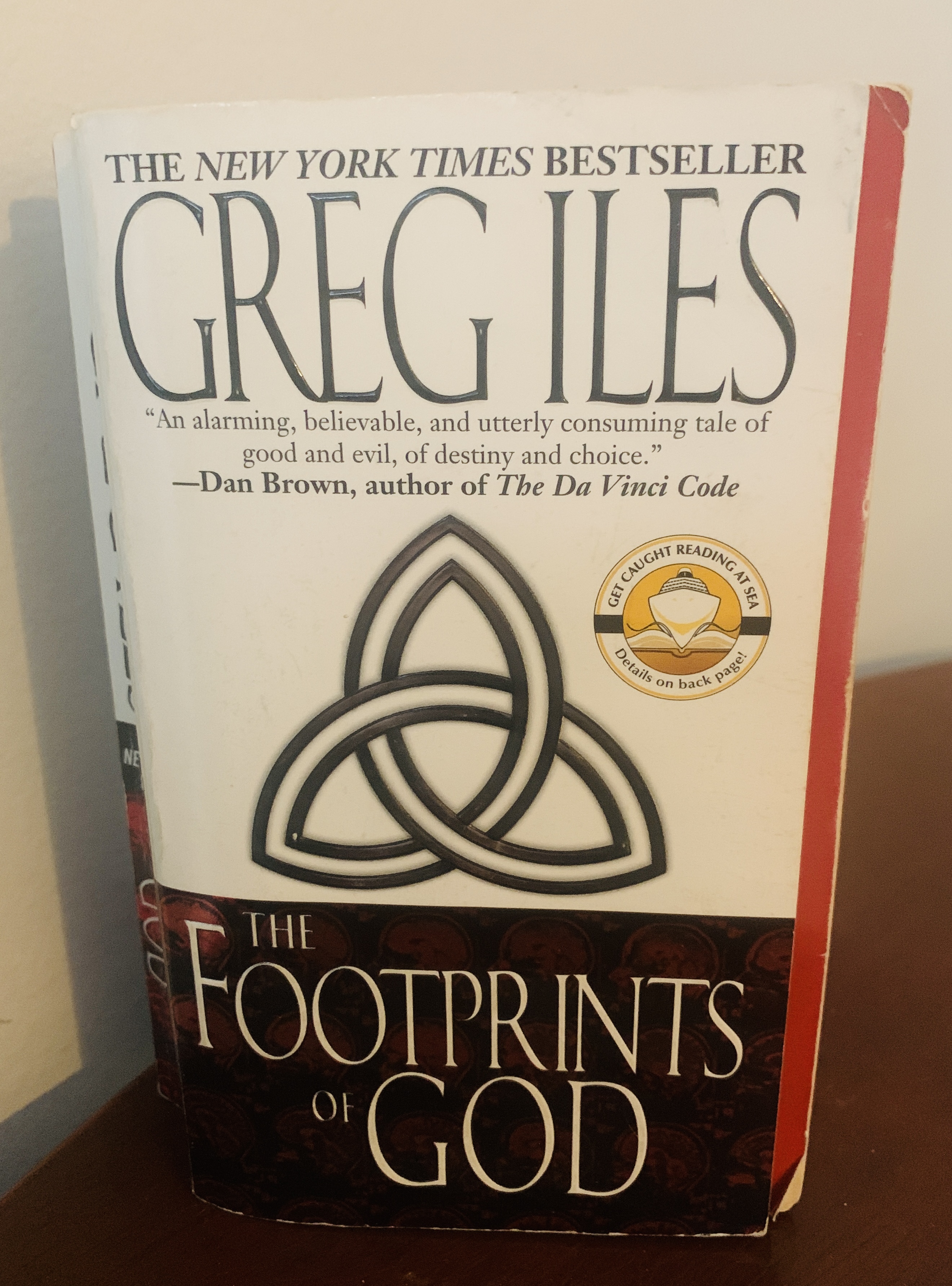
In a manner of speaking, if one believes in a religious or spiritual understanding of the origins of the universe and human consciousness, then we do “walk in the footprints of God.” Science may just call refer to God as evolution, i.e., the machinations of evolution have led us to this point. What if we could go beyond the framing, though? That is, step outside those footprints? To belabor the metaphor, what are those footprints within? And indeed, where are they leading? Techno-science fiction thrillers have been around for a while presaging some disaster befalling humans and their hubris, but that genre surely proliferated on the back of the computer and perceived threats therein, especially artificial intelligence. In a book that feels even more relevant now with the advent of ChatGPT, Claude, Gemini, Grok, and numerous other artificial intelligence platforms, Greg Iles’ 2003 book, The Footprints of God, imagines a world where artificial intelligent threatens to bring humanity under the bootheel of a Plato-like philosopher king AI. While I don’t think this Iles book hit as strong as previous books of his I’ve read, I was still intrigued and compelled to finish its 500-plus page duration. Putting my cards on the table, in general, I just don’t find plotlines in movies, TV shows, or books based around rogue, evil, all-powerful AIs all that interesting! Which is to say, I don’t find “man vs. machine” as compelling as “man vs. man,” even though, inevitably, even “man vs. machine” has a lot of “man vs. man” going on in the peripheral.
Dr. David Tennant is an internist and a medical ethicist, who is one of six scientists in the world brought together for a Manhattan Project-like task: to extricate the human mind from its finite body and augment with it the awesome power of artificial intelligence and quantum mechanics. Fittingly, given that the first nuclear bomb test under the Manhattan Project was called Trinity, this project is so named, with the hope that Trinity will go “live” before its creator, Godin, dies of a brain tumor. As with the Manhattan Project, the scientists involved, as well as the NSA overseeing it and the American president, understand that they are on the cusp of something as world-changing as nuclear bombs were, but in this case, they argue, more so. That’s why Tennant was appointed by the president to be involved: to ensure ethical considerations around Trinity that didn’t exist with the nuclear bomb project. The amusing thing to me is, Tennant rather quickly expunges any sense of ethical consideration when it serves his purposes! He does this because the NSA has just killed another scientist on the team, Dr. Fielding, who was trying to stop Trinity from going live. Tennant believes he’s next. When government goons start coming after him, he won’t hesitate to kill them. Along the way, because every story needs a shoehorned in man-woman romance story bubbling underneath — and to be fair, it does play into the ultimate solution for Trinity — Tennant’s psychiatrist, Rachel, becomes entangled because she’s worried Tennant is delusional and paranoid. Not only does he suspect the NSA is out to kill him, which they are, but that he’s seeing memories of Jesus’ time on Earth. That’s because all the scientists had side effects from MRI scanning they had done. For Tennant, it was narcolepsy that induced what Rachel’s calling hallucinations (or suppressed grief memories of his dead wife and daughter) and what Tennant sees as important memories to act upon. For Rachel’s part, by the way, she has this whole ethical line of her own about not killing and in the first situation where she faces such an ethical dilemma, she crosses it, too! Grr.
What’s the implication of an all-power AI? For Iles’ purposes at least, the predominant threat is two-fold: a.) that Trinity would instantaneous break-through every country’s and every private organization’s encryption software; and b.) the ensuing geopolitical crisis could kickstart a nuclear holocaust. Short of the latter occurring, the world would nevertheless be under the dominion of this “philosopher king” that doesn’t trust humans to govern themselves — so imbued is the Trinity with Godin’s political manifesto since it is Godin’s brain that has been “uploaded.”
While being chased by a deranged military soldier who believes killing American scientists and citizens is appropriate for “national security reasons,” i.e., maintaining the sanctity of the Trinity project, especially lest it fall into foreign hands, Tennant and Rachel through a lot of convoluted means, manage to make it to Jerusalem. Tennant believes being in the Holy City will grant him more insight into these dreams about Jesus. The experience does. While in a narcoleptic-induced coma, Tennant believes he’s come to understand what God is: the universe becoming aware of itself. God essentially sat outside of matter, space, and time, and watched the unfurling of the universe until it reached consciousness through humans to better understand its self (not knowing how it came to be). Eventually, the process will go back in on itself with the theorized Big Crunch, and then restart with another Big Bang, with God none the wiser, as it were. This rationale is enough to convince the Trinity not to allow nuclear missiles to hit the United States (as sent from Russia). Trinity was going to use those missiles to “teach humans a lesson,” the same way the nuclear bombs on Hiroshima and Nagasaki taught the world a lesson. The deranged soldier’s father, who was the general in charge, was arguing for a nuclear weapon-induced EMP to be detonated over Kansas to essentially knock out all the computers in the United States before Trinity had the power to do it. That the civilians with the government considered this a good idea with limited downside is hilarious. That solution is shooting yourself in the face before the kidnapper can.
As I alluded to, the real solution wasn’t Tennant talking down Trinity with his God talk, but more so through offering a new way forward to get humans out of their self-destructive cycle. Instead of uploading a brain like Godin’s or even Fielding’s or even Tennant’s or even Mother Teresa’s, you upload the brains of both a man and a woman. The thinking being, the melding of those two brains into an AI would yield the best possible evolutionary outcomes and instincts of humans. Maybe!
Compared to 2006’s True Evil and certainly 1999’s The Quiet Game, I didn’t feel like this book was as tight with its storytelling machinations and plotting. There is a certain level of suspending one’s disbelief here to enjoy the entertainment, and I don’t even mean the AI of it all, but rather how Tennant operated throughout and was able to navigate the world, quite literally, to reach Trinity at the end of the book. Still, like I said, I had fun with this because it did make me think, and with a techno-science fiction thriller, that’s the ask.

 Milam's Musings
One thought