
Spoilers!
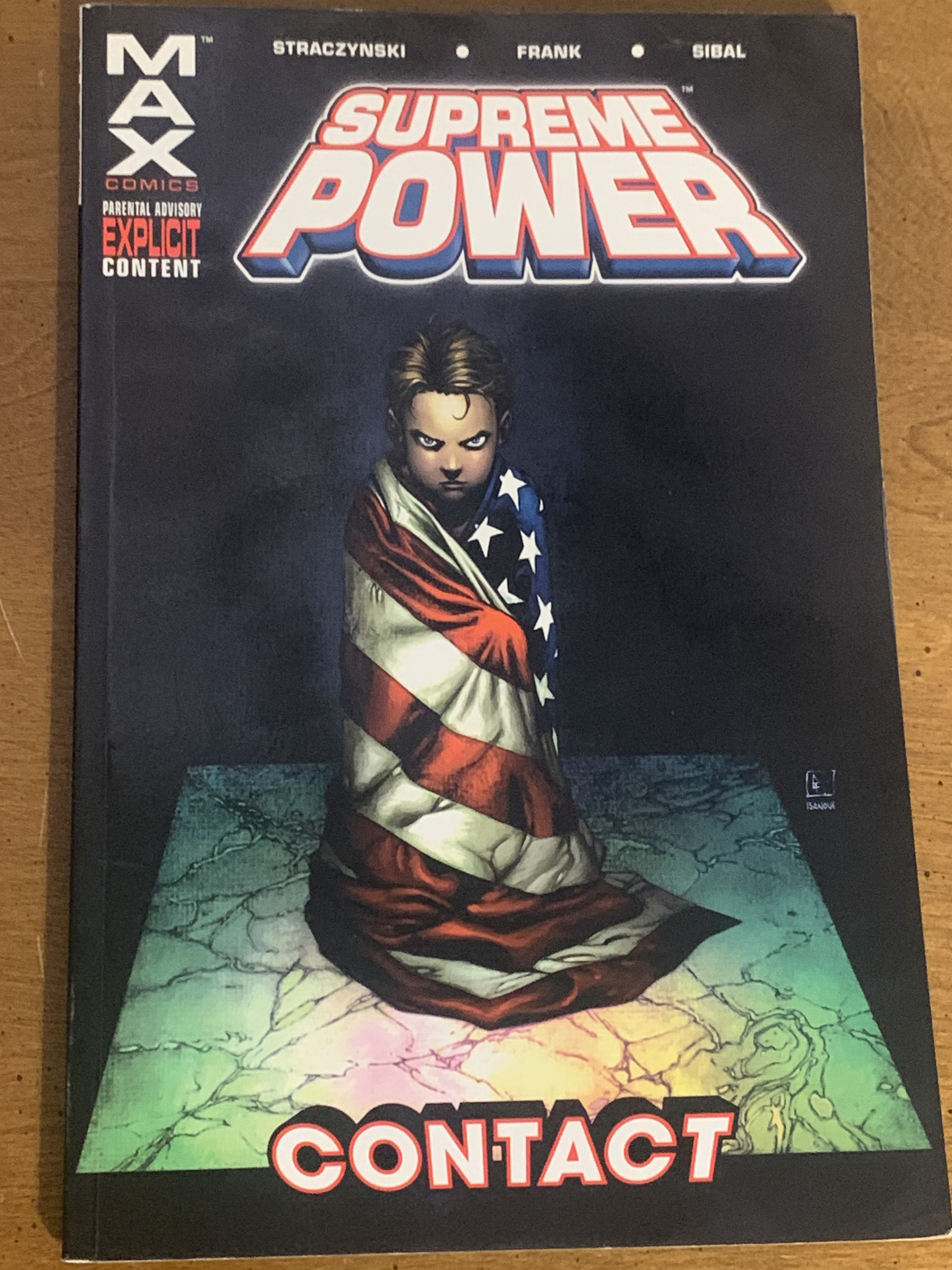
What if Superman grew up in a government lab with a carefully curated upbringing through focus group research and government-contracted parents? Writer J. Michael Straczynski and Illustrator Gary Frank imagine just that in Marvel’s 2004 series (through its imprint, Max Comics), Supreme Power, Volume 1: Contact. Jon Sibal adds his beautiful ink to the imagining. But no matter how much you try to bring Kansas and Jonathan and Martha Kent to a lab, there’s no duplicating the real thing.
Just like the Superman origin story, in Supreme Power, a small child crash lands in his spaceship out in the country where a couple finds him — and hopes this is what will put their marriage back together. Instead, government agents quickly collect the child and warn the parents off of every telling the real story. They name it (the spaceship and the child) the Hyperion Project after the Titan god of heavenly light and watchfulness. They give the child his “day name” of Mark Milton, even being self-referential about Marvel’s penchant for alliterative names. Mark is then given two government-contracted agents as parents. He assumes, of course, they are his parents. Soon, though, he realizes not only does he have powers, but that he is being caged behind barbed wire fencing with soldiers on guard. His “dad” tries to explain that it’s for his and the rest of humanity’s protection. Mark wants interaction with real people, though, so they try school with other government agents’ kids, but it doesn’t work out. They know Mark’s different, even if they don’t see his powers on display.
What’s fun about Supreme Power is that the Hyperion Project passes through four presidents over the course of Mark’s life. First is Jimmy Carter, when the ship landed (he’s the one that wants him to grow up with a Rockwellian upbringing). Second is Ronald Reagan, who didn’t get much play except for news stories during his administration is what Mark grew up watching and probably nurtured his sense of “right” more than his actual “parents.”. Third is George H.W. Bush, who Straczynski gives a pervy moment when, thanks to the energy crystal that powered the ship allowing someone to see what they are thinking, sees a data scientist as a scantily-clad warrior woman and quips that he needs to have Barbara try that out. But in more serious terms, H.W. Bush is the first president to meet Mark as a young man and start using him in the “field,” first through Desert Storm and then all manner of other American endeavors. Fourth is Bill Clinton, who is the one who makes Mark into a public-facing superhero with all the pomp and circumstance, including a costume. Clinton also did that because a reporter with the Washington Herald, Jason, was sniffing around the story. Even after learning the truth about Mark, Jason thinks there is something more the government isn’t saying, which is true, because they didn’t reveal the existence of the spaceship.
Similar to other classic comics — Supreme Power worked as a nice riff and homage to the classics — the government even “kills” Mark’s parents to help him become laser focused on his superhero mission. By kill, they actually just sent the government agents to Amsterdam. Also unlike Jonathan and Martha Kent, the two agents didn’t love each other and were excited to separate from each other once in Amsterdam. I found that rather sad! On the flip side, one scene made me chuckle. Mark wants to have a regular job and thinks wearing glasses would be the perfect disguise. Instead, the government agents scoff and immediately shoot it down. Ha.
Thanks to the incoming spaceship and some sort of bacterium that escaped from it, there are other superpowered beings in the world. One Mark quasi-befriends is Stewart Stanley (alliteration again, plus perhaps an ode to Marvel legend, Stan Lee, get it?), who is like the Flash, a speedster. Funny enough, in a nice bit of satire and absurdity reflecting what could happen if a superhero did exist in our midst, Stewart hooks up with “booking agents” to get sponsored by racing companies. He wears their logo on his suit, which was also created by them. Then, the government creates their own version of a Cyborg-like superhero by happenstance. They enlist a black ops soldier, Corporal Joe Ledger, to see what that aforementioned energy crystal from the ship can do. The government hopes to use Joe as their counterbalance, should Mark, an alien they don’t fully trust, go wayward. Joe fuses with the energy crystal and more than Cyborg perhaps, he becomes godlike. Maybe Doctor Manhattan is a better analog.
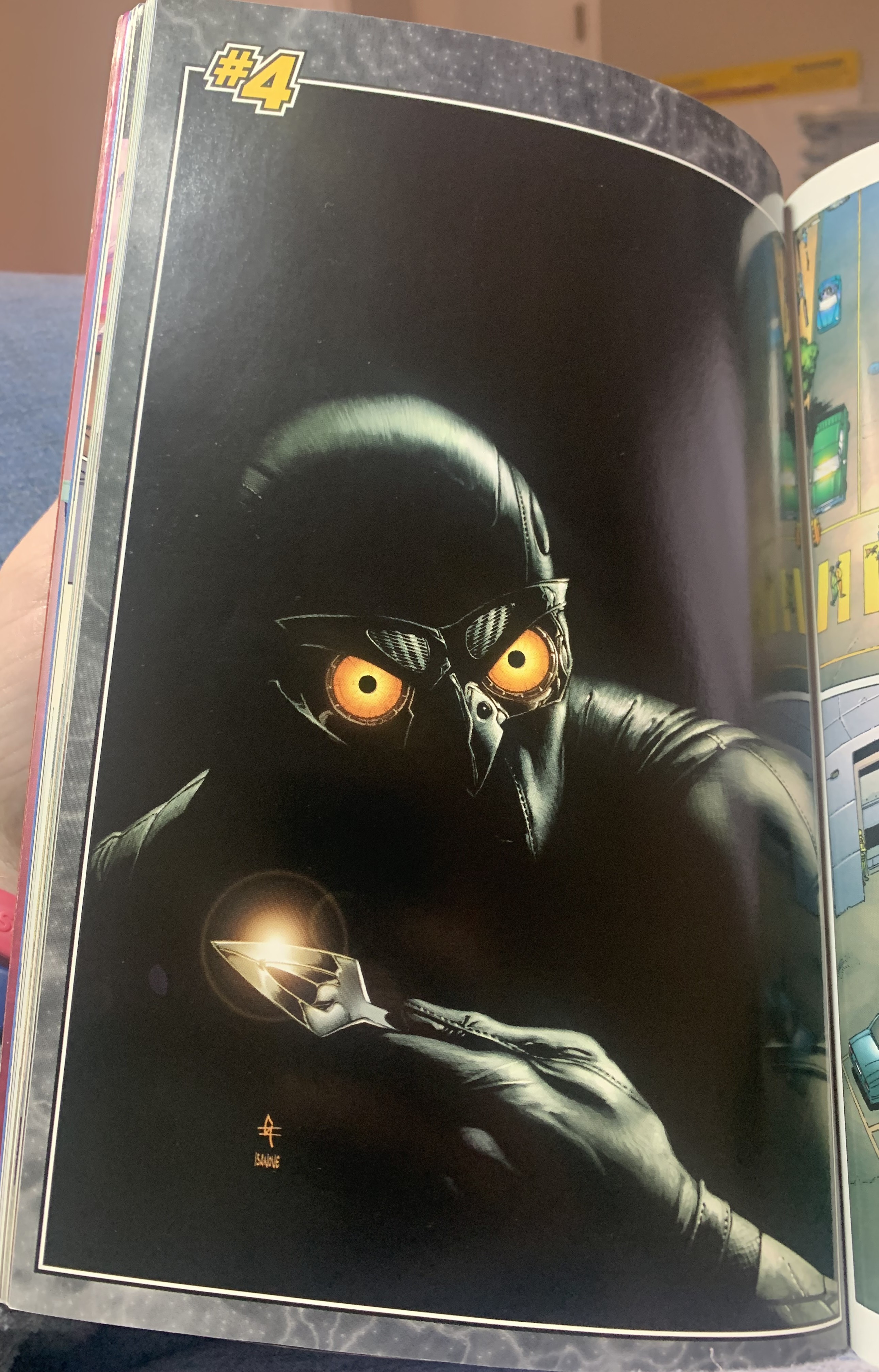
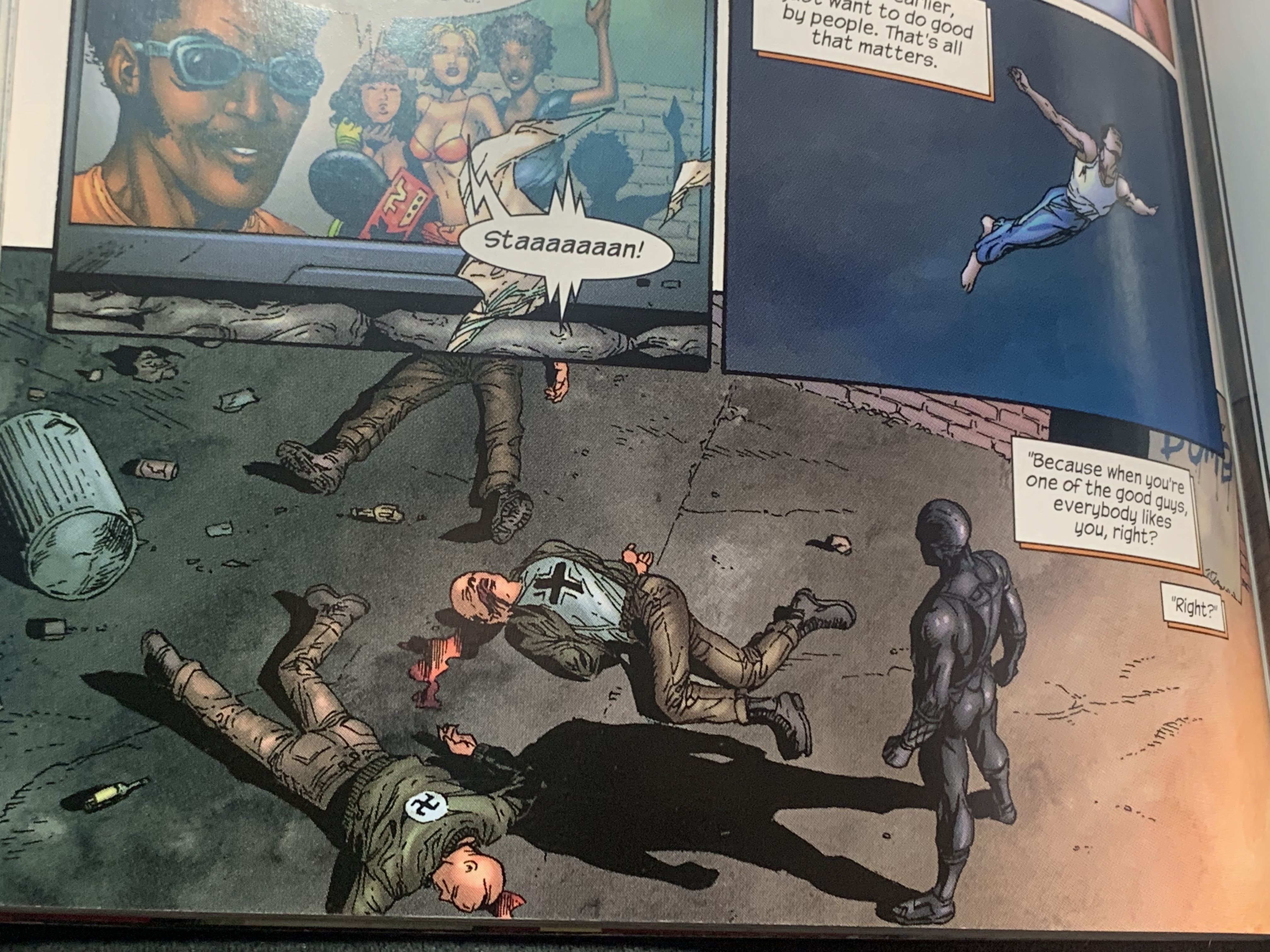
There is also Richmond, who goes by Nighthawk. He’s Batman — no superpowers, just money, superior training, and the angst of watching his parents gunned down in front of him. The wrinkle in the Batman analogy is that Richmond is Black and his parents were killed in a hate crime by racists. So, when he’s prowling the night going after criminals, he specifically defends Black people from racists and Nazi scum. Nighthawk is grislier than Batman, too. In one gnarly scene, he rips an assailant’s ears off. When Mark finds out about him, he actually gives Nighthawk a lecture about the virtue of color-blindness and protecting everyone. Where you could see the seed of Mark’s lecture being the flower of his undoing and/or turn to the dark side is when he tells Nighthawk, “Sometimes, I think that only somebody who was truly an alien could solve all the world’s problems. Because only an alien could be objective enough to get the job done.” That’s definitely not Superman thinking! Eek. (Additionally, there is an allusion to a princess warrior type woman who made me think of Wonder Woman. She wasn’t developed further in this first volume, however.)
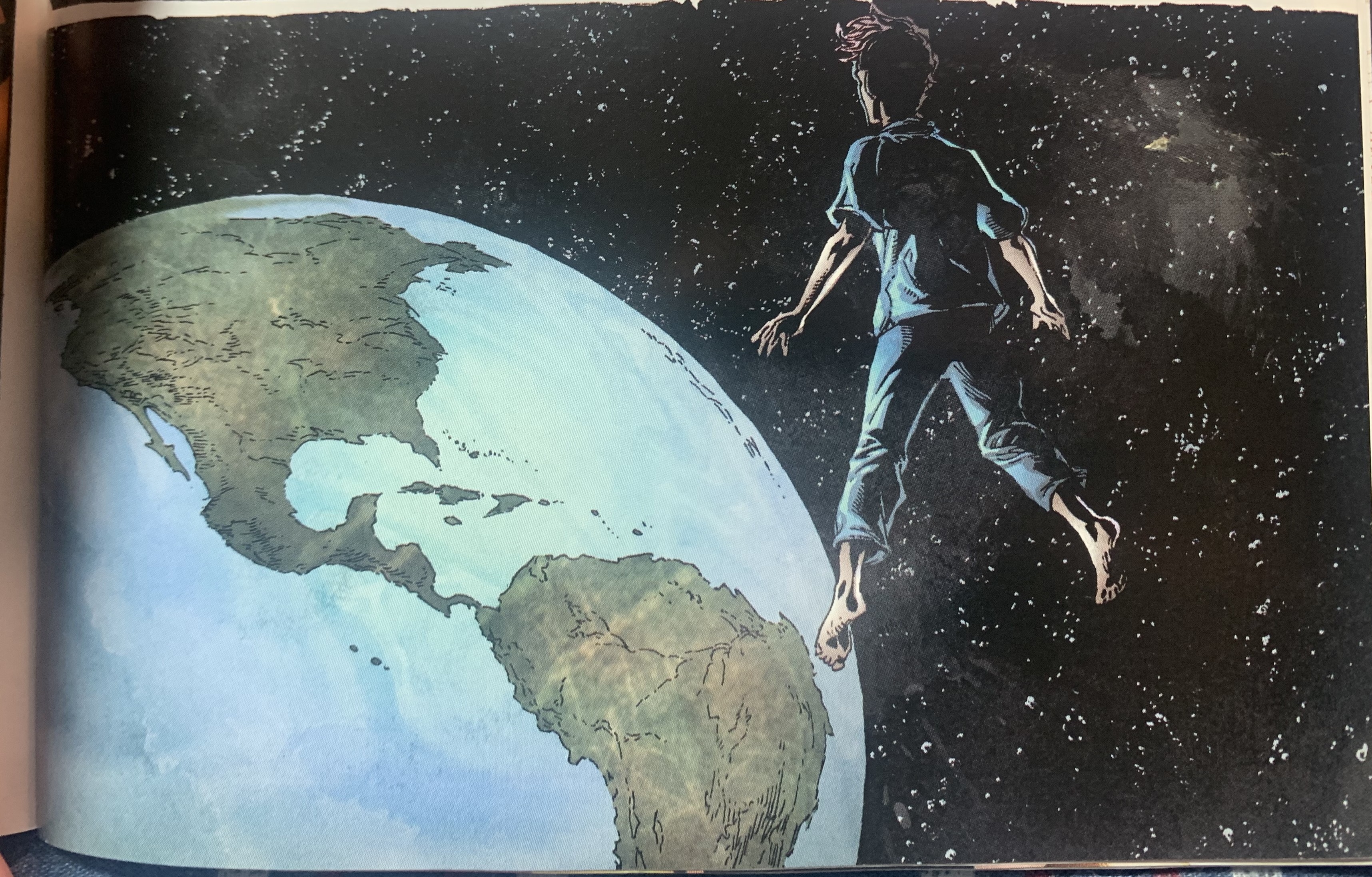
Where this volume leaves us before Volume 2: Powers & Principalities, is the government unsure about Joe, the spaceship-imbued god, and Mark floating in space thinking about his “objective alien” line and putting his entire hand (from his distance in space, it appears so) over the earth. What a striking image that was.
I was quite taken in by the first volume of Supreme Power. Straczynski struck the right balance of homage to and satire of Marvel and DC Comics, and a sense of forlorn and foreboding about what the future holds in a world with “supreme power” beings. Frank and Sibal provided gorgeous imagery and ink to compliment Straczynski’s writing, including Nighthawk’s intimidating costume and the scenes with Joe going godlike. I’m excited to read the next volume!


3 thoughts