
Spoilers!
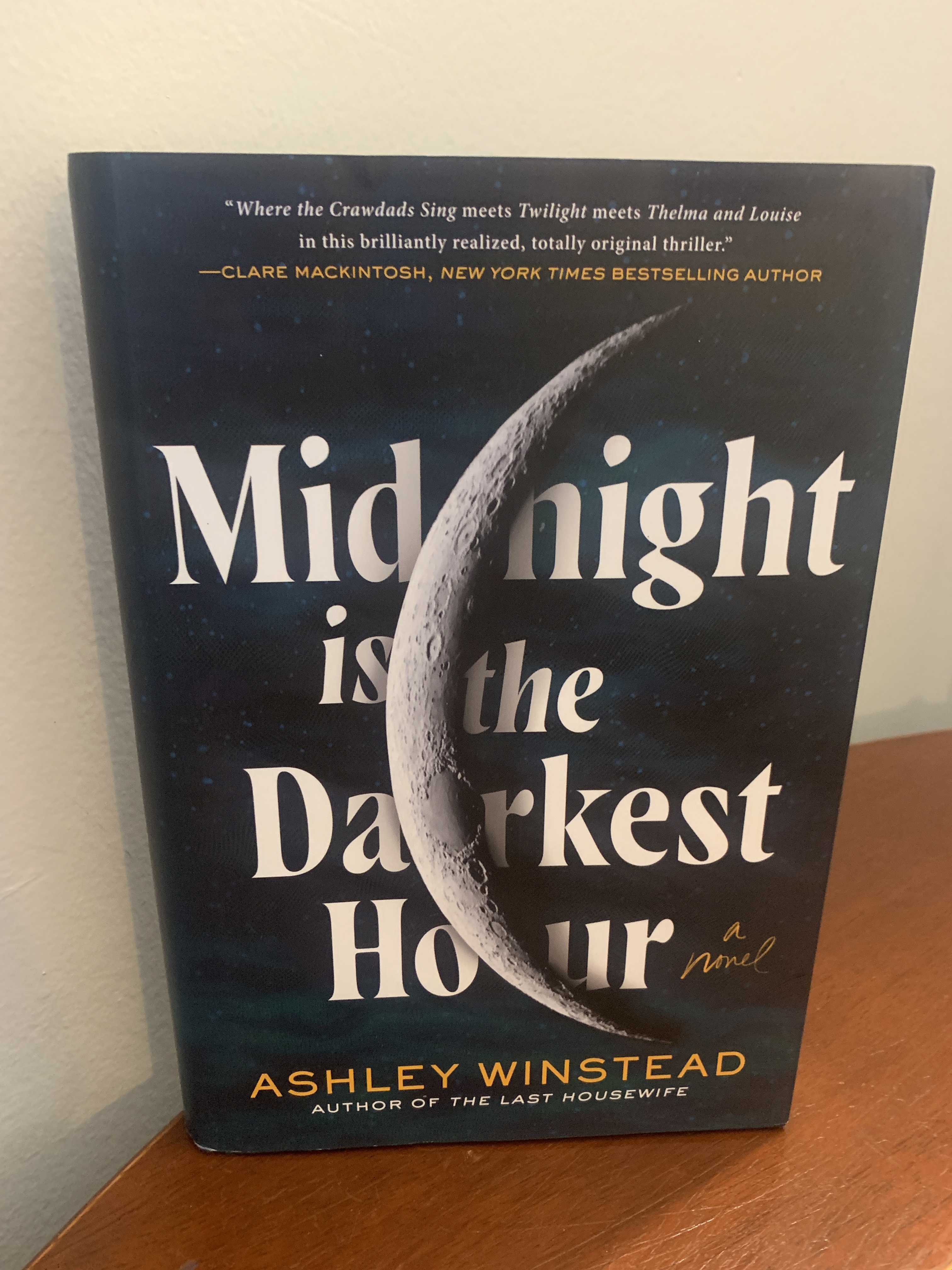
Holy Fire Born Again turned out to be more foreshadowing than I expected in Ashley Winstead’s 2023 book, Midnight is the Darkest Hour. Part religious rebellion, part tantalizing Twilight-inspired true romance, and part Bonnie and Clyde, Winstead’s thrilling book is difficult to put in a convenient genre box, but that makes it all the more compelling as a story, and fitting with our two protagonists, who view the world through an amalgamation of the books they’ve read, including The Count of Monte Cristo, a major throughline of the story. I wasn’t quite sure what to expect going into Winstead’s story, as I go into every story purposefully avoiding the synopsis, but as it unfurled, it quickly became apparent just how different this book was — in a good way.
Ruth Cornier has lived an intentionally sheltered life in Bottom Springs, Louisiana, a swampy region in the Bayou with God-fearing, Bible-thumping small-town folk. Her father is the reverend at the aforementioned Holy Fire Born Again Church, and as such, has all the power in the small town, and of course, at home with his wife and Ruth. Indeed, for any transgression he doesn’t approve of, Ruth’s father beats her with a rattan cane; it’s so normalized, I’m not sure Ruth even recognizes it for abuse. One way he exerts his control is over what Ruth reads. He makes Ruth, a voracious reader, desirous to read beyond what she’s allowed to read, burn Twilight when they discover her possession of it. I would never burn a book, even on threat of punishment from my parents. Oof. But obedience has been grilled into Ruth, not just from a religious perspective, but particularly as a woman within a religious context. Her rebellion is more incremental, like reading Twilight, and then it explodes at the age of 17. Like falling in love itself, it happens slowly and then all at once, to quote John Green’s The Fault in Our Stars, as our two protagonists routinely quote books. At 17, Ruth, again a sheltered reverend’s daughter girl, is doted upon by a man who suddenly starts appearing at the church. Man indeed, as Renard is 24. At first Ruth thinks he’s taking her to the make out spot of the swamp (imagine finding that romantic; all the bugs!), but instead, he takes her to a more secluded part where he tries to take advantage of her. If it wasn’t for the happenstance of Everett, a boy in Ruth’s grade who has been outcasted and who been derisively referred to as the “Devil’s Son” because his father is an alcoholic, Renard would have raped Ruth. As Renard and Everett fight, Ruth hits Renard over the head with a rock. Everett finishes the job, bludgeoning Renard to death. They then decide to hack his body up and deliver it to the swamp’s gators. That escalated quickly meme here. Like, it’s one thing to have killed him in self-defense. It’s a different level of violence to hack a human body to pieces and conceal it.
Since that moment, Everett, or Ever, as Ruth calls him, and Ruth are bound together by their secret, by their shared interests (he’s also a reader), and that sensibility of being outcasts and a little rebellious. The present occurs six years after they fed Renard to the gators. It’s in this present when a human skull, detached from a body with signs of bludgeoning, is found in the swamp. But it’s the local high-powered owner of a fishing company, Fred, not Renard. Still, it makes Everett and Ruth skittish and concerned. Moreover, on a personal level, in the present, we learn that Everett absconded for a summer, leaving Ruth alone, and during that time, she started going out with Barry, a junior deputy with the Sheriff’s Department, ironically enough. She justifies it to Everett when he does return as a way to learn more about the ongoing investigation. That’s the thing, Everett and Ruth are presented as best friends, but from the get-go, there’s an undercurrent of something far more going on than anything resembling a mere friendship. They’re lovers who haven’t had the language or action yet to catch up to what their feelings have already generated.
Soon, we learn that Fred was also bad in that he physically abused his daughter, especially when it’s discovered that she’s pregnant at 15. She’s pressured into an abortion because the far worse sin is to be shunned by the Bottom Springs community. We later learn Ruth’s reverend father helped cover it up, not only because he was pals with Fred, but because the boy on the other end of the situation was Barry. Barry is only trying to marry Ruth to shore up his own power within the community. Luckily, she rejects his marriage proposal. So, what seems like a coincidence perhaps that two men, Renard and Fred, were found dead likely by murder (Renard’s body is also found later, although they still think it’s an accident), it becomes apparent that they aren’t the only ones who have died in the town after whispers of wrongdoing and malignant character defects. A local pedophile, son of a wealthy man who owns the hospital, died in what appeared to be an accident or a suicide. And Everett’s own father died from apparent alcohol poisoning.
What really happened? As I figured, Everett killed the pedophile and was intending to kill the father, too, but he died of old age, but it’s Ruth who killed Everett’s father because not only was he an alcoholic, but he viciously beat Everett.
With these deaths uncovered, this God-fearing town is being whipped up into a frenzy by Ruth’s father and the unyielding gossiping that goes on, as well as the superstitious belief that the culprit is the “Low Man,” a Devil-like figure. That fits right in with the moniker for Everett that he’s the Devil’s Son. Even Ruth is ensnared by this superstition, as well as by her love of Twilight: she confronts Everett with whether he’s the Low Man, a supernatural being similar to Edward from Twilight. No, he’s not, obviously. But that doesn’t stop the town, including the sheriff, from wanting to lynch Everett.
But who, then, is the ultimate “prize” in the town, owed vigilante justice, as Everett sees it? Ruth’s father. He’s the one pulling all the strings, including convincing Everett’s father to brutally beat his mother to death on the guise of her being a “witch.” But also, Ruth’s father is worse still. He knew about the pedophile; indeed, he rescued Ruth from him, but allowed another girl to be victimized. As for all his accrued wealth, it’s from running drugs through a local drug gang. When Ruth confronts him about it, he defends himself by the rationale that the ends justify the means and sometimes, being a vehicle of God is messy work. Ruth confronted him instead of letting Everett kill him because she wanted the opportunity to see if he was redeemable, or if his ego and insatiable need for power was more important to him than her. When he reveals that power matters more than loving Ruth, she allows him to burn in a fire she purposefully set as a threat inside Holy Fire Born Again. In that way, as a baptism by fire, Ruth is born again. She’s made her choice. She is the Bonnie to Everett’s Clyde. Indeed, Everett insinuates that he’s been killing other “bad men” beyond Bottom Springs when he’s disappeared from the town.
In the climatic scene, the police are chasing Ruth and Everett in the latter’s corvette. They’re game plan? Reach Texas, although I’m not sure crossing state lines would have been the salvation they were envisioning. Nonetheless, an approaching bridge separates them from Texas; the sheriff’s office is raising the bridge so it can’t be crossed. Like a game of Driver, they decide to try to ramp the bridge to make it to the other side. The book ends without knowing their fate (and sneakily, too, because the very next page is a teaser of Winstead’s next book, so it made me think there was more of this story left). Of course, Bonnie and Clyde didn’t ride triumphantly off into the sunset; they were killed by police. So, while Ruth and Everett likely succeeded in exposing the truth of her father and the other powerbrokers of Bottom Springs, I’m not sure they lived to see the fruits of it.
Ruth and Everett, like like their inspiration, Bonnie and Clyde, do not represent a healthy relationship. Even if you removed the criminal acts, consider how often they reassure each other that they are only telling the truth now, no more secrets or lies. Then, there’s another secret unearthed or lie to walk back. Consider how unhealthily bereft Ruth was when Everett didn’t return to Bottom Springs one summer. Or consider how Ruth overlayed her fantasies of an Edward-like figure onto Everett. She thought he was supernatural! For Everett’s part, he has a martyrdom-like yearning to protect the “damsel in distress” Ruth, often violently. They’re a codependent relationship, and that’s before they fully lean into being lovers. Then, of course, add in the premeditated murder, scheming, and attempts to throw police off, and they’re not exactly squeaky clean heroes. That all said, that’s what makes them fun characters to read about, and they were up against demonstrably worse people in a town of cruel hypocrites. As Everett remarked, every cruel person they know attended Holy Fire Born Again.
I look forward to reading more of Winstead’s books, which surely continue to defy easy genre identification. I also highly recommend if you also have the hardcover version to read “A Conversation with the Author” at the end. Winstead has thought deeply about this subject of coercive, contradictory systems of control, especially systems that exert control over women, the ways in which women rebel, both “quotidian and bombastic,” and what it all portends for our views on justice, the law, and what’s morally good. She’s quite compelling in how she parses it all, or at least, sought to have the reader parse it all.


