
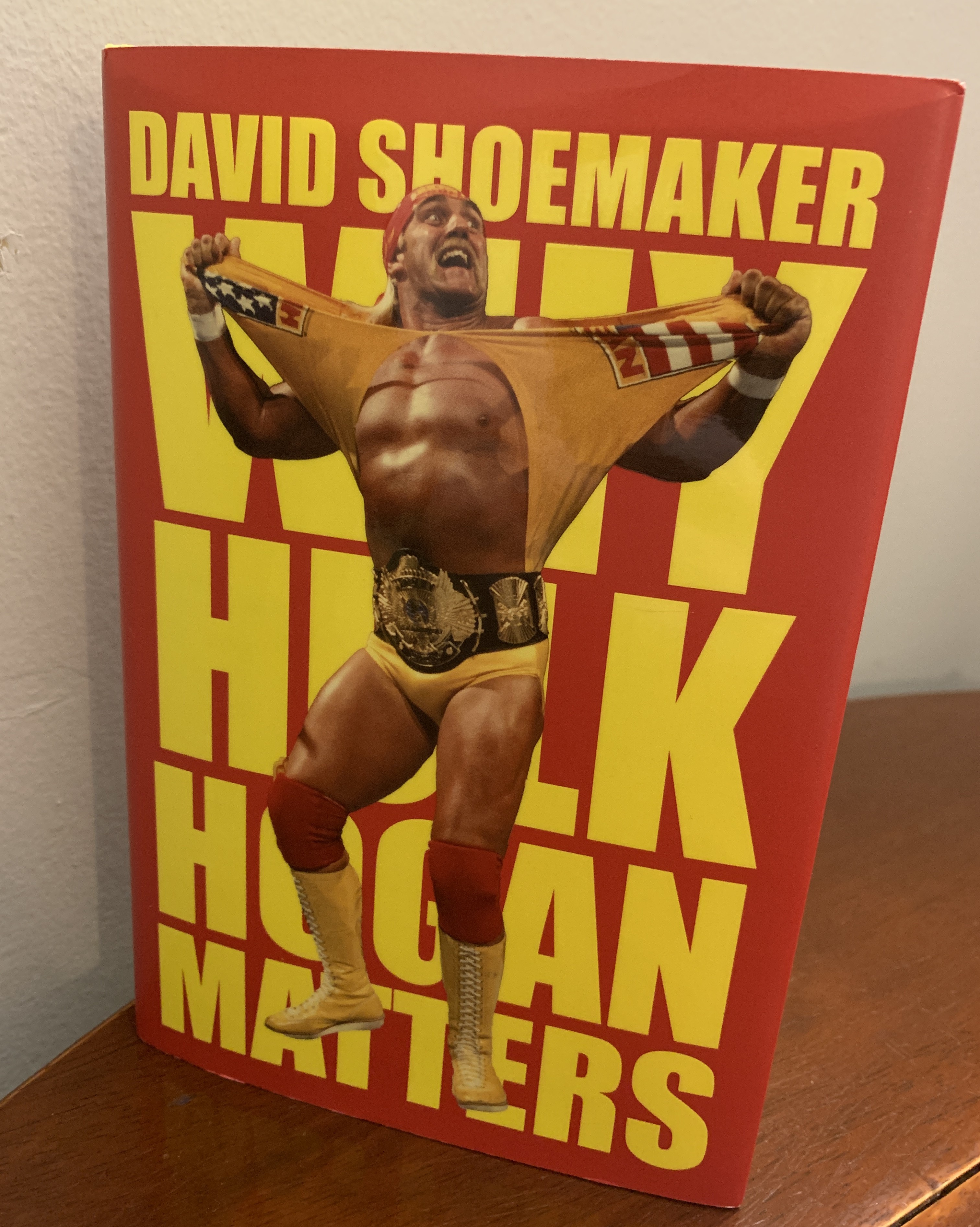
Hulk Hogan still matters, perhaps most powerfully as a cautionary tale about what happens when artifice becomes edifice. With Hulk Hogan, who had the moniker “Immortal,” what became unyielding to the sands of time was his inability to extricate himself from the role he played. Even Terry Bollea (Hogan’s real name), did the “job” (lost) in service to Hogan’s insatiable need for relevance. David Shoemaker is the preeminent writer in wrestling’s squared circle, and his newest book, Why Hulk Hogan Matters, explores the highs and lows of Hogan’s career and post-ring life to argue the titular thesis at each inflection point. Stripped to its essence, Hogan mattered as an idea, both in wrestling and wider American pop culture, until the idea of Hogan ceased to matter anymore. For someone whose lifeforce depended on relevance, it was a death knell before his actual death on July 24, 2025.
Shoemaker is my favorite writer in professional wrestling because he’s a genuinely good, serious writer about an inherently goofy passion of ours. He’s one of those writers I naturally want to quote every other sentence he writes, so I’ll limit myself to a few throughout what follows. It also feels right that Shoemaker wrote this book on Hogan after his death because Shoemaker’s career writing about professional wrestling started through death: chronicling the deaths of wrestlers, including with his first book, 2013’s The Squared Circle: Life, Death, and Professional Wrestling, which I previously reviewed, a broader look at wrestling through the ages and its meaning to wrestling fans. After all, while pro wrestling is inherently goofy — a predetermined theatrical, but athletic, soap opera where we’re all willing, desirous “marks” to the carnival barkers — it still means a lot to those of us who consume it precisely because it makes us feel something. Whether it’s an exercise in real life catharsis or escapism from real life, wrestling provides an outlet, and importantly, because it doesn’t have a traditional “off season,” it’s always there. That is integral to my own love of pro wrestling. Whatever may be going on in my life, I can always count on professional wrestling being there. And whether the reason we buy-in to pro wrestling as willing marks is because of the aspirational (larger-than-life characters akin to superheroes) or living vicariously through heroes more readily accessible (underdogs), wrestling offers a unique blend of storytelling that is part electric where you have to be in the moment to experience it and part bone marrow-deep where it embeds on our memories and reminds us of why we’re fans in the first place. Or as Shoemaker explains wrestling fandom so eloquently, “The most devoted fans were those who could see the strings and still weep when the puppet died.” For many wrestling fans, Hulk Hogan represented the pinnacle of larger-than-life, electric, bone marrow-deep storytelling for decades in professional wrestling, both through his decade run in WWF (now WWE) as its triumphant hero and his shocking reinvention as a cool heel in late ’90s WCW. Which only served to make his downfall, the cautionary tale of his saga, all the more bittersweet for his fans. (I’ve enjoyed Hogan’s big wrestling matches and moments in WWF, while not having seen much of his WCW run, admittedly, but I would not count myself among his fans.)
Hogan’s wrestling career beats are well-trodden territory — but for newer or nonfans: his initial run under Vince McMahon’s father in the then-WWWF; his AWA run, where Hulk Hogan showed what was to come in WWF under McMahon, buoyed by his appearance in Rocky III as Thunderlips; upon returning to WWF, his title win from the Iron Sheik in Madison Square Garden, January 1983; the pinnacle of Hulkamania, slamming André the Giant at WrestleMania III; the Mega Powers exploding at WrestleMania V; the seeming “passing of the torch” to the Ultimate Warrior at WrestleMania VI; overstaying his welcome by WrestleMania IX with Bret Hart; the return of the “red and yellow” but in WCW in the pre-New World Order days; the July 1996 heel turn at Bash in the Beach; the politicking-infused bad booking that culminated the feud with Crow Sting in 1997; Goldberg’s triumphant, if poorly followed through, defeat of Hogan in 1998; the Finger Poke of Doom in 1999; coming back “home” to now-WWE in 2002, with one last nostalgic run with the World Title; and then subsequent returns, including one last nostalgic echo in 2005, and ultimately, a final appearance on WWE’s flagship show, Raw, when it debuted on Netflix in January 6, 2025, where Hogan was booed vociferously by the crowd in what is deemed “go-away heat,” or non-storyline booing — but what makes Shoemaker’s brief overview of those career beats compelling (aside from his aforementioned writing prowess) is the way in which time has allowed for a better rendering of those moments, often more than what conventional wisdom states, and how each beat offers a reason Hogan mattered, according to Shoemaker.
In short, Hogan mattered to pro wrestling in the early 1980s, as a reflection of American culture at the time, to be a vehicle for its cable television-aided expansion from a regional, territorial system into a national and eventually global business. He mattered again in WCW when he finally allowed himself to lean into what people thought Terry Bollea was doing behind-the-scenes anyway (politicking, exerting creative control) and in so doing, changing with the fans’ new appetites and expectations for pro wrestling. He mattered again in his late 2002-2003 run by closing the narrative arc with WWE by returning home and ultimately feuding with Vince McMahon in a worked-shoot way (an intentional blending of real life emotions with storytelling) over who had “authorship” of WWE’s success: Hogan or McMahon. They were both necessary; again, Hogan as the vessel, and McMahon as the vision for what wrestling could be with that vessel, or as Shoemaker referred to him, Hogan was scalable in in a way few wrestlers had ever been and was a “logo that talked.” In other words, at least in the way McMahon envisioned pro wrestling, it wasn’t about moral complexity, but about emotional clarity with contrast, to paraphrase Shoemaker, and that type of clarity with contrast is scalable beyond language and countries, hence making WWE a national and then global brand. It is notable that both Hogan and McMahon would flame out, overstay their welcome, and become enveloped in scandals of their own doing.
Inevitability, Hogan reminds me of another artifact of the 1980s that is somehow still around with us today: Donald Trump. A lot has been made of how much the Trump years have been like pro wrestling, with Trump as showman and people buying in to his schtick (and indeed, Trump was enmeshed with WWE at various points, both in the ’80s and later in 2007, with the “Battle of the Billionaires” opposite McMahon), although like Hogan, eventually the showman buys into the schtick and it becomes reality. Like Trump, though, Hogan was notorious for being a pathological liar, about both big and small matters, and lies when the truth is so obvious. Such lying is particularly odious and bewildering when the truth itself is already significant. As an example with Trump, he won the presidency in 2016 and 2024, but he has to lie and inflate both wins beyond the facts. With Hogan, slamming André the Giant at WrestleMania III is already a substantial moment in the history of professional wrestling (nearly 40 years later, some would say it’s still an unmatched moment), but Hogan has to inflate it in myriad ways (the crowd size, André’s intentions, injuries sustained in the slamming). Also like Trump, who still thinks of himself as an outsider, a non-politician, despite being in his second term as president and presiding as the head of the GOP for a decade, Hogan never saw himself as politicking backstage with creative control because he saw it as common sense. Most incisive for this comparison, Shoemaker writes of Hogan after a bad appearance on Arsenio Hall’s show where he tried to diminish his steroid-taking, “Hogan always seemed less interested in reckoning than in recalibrating the story until it felt survivable.” That would become Hogan’s salient modus operandi when his sex tape was revealed in 2012, which wasn’t even the headline per se, as it was the abhorrently racist remarks he made on the tape. Even then, for Hogan, it was never about apologizing, but rather, trying to survive and outlast the damage (indeed, when Hogan did ultimately return to WWE, as Shoemaker notes, he spoke in front of the locker room, but instead of offering an apology, it became a warning about hidden cameras). Likewise, Trump’s life, especially his political career, has been marked by survivability rather than any iota of reckoning or accountability. Of course, my comparison between Trump and Hogan is more readily obvious to me after Hogan appeared at the Republican National Convention in 2024 in support of Trump, and even in that context, was doing his schtick and bleeding 1980s nostalgia (which is fitting for Trump, who seems permanently stuck in 1980s New York). Shoemaker rightly points out, though, that Hogan again misread the room, as he had with Arsenio Hall’s audience: 1980s Hogan was intentionally ambiguous so he could be a hero for all (scalability!), whereas at the RNC, he chose a side. But even when Hogan ceases to matter, like at the January 6, 2025, episode of Raw, he matters because it’s Hogan not mattering. Such is the paradoxical gravitational pull of Hogan.
While I started this review calling Hogan’s story a cautionary tale, Shoemaker ends his book arguing that is too tidy a takeaway. Shoemaker sees Hogan’s post-wrestling career in particular as more about narcissism and the “awkward sin of insistence.” (Another parallel to Trump, all about excess, narcissism, and an unbearable insistence.) All of which, in my humble opinion, still feels like a cautionary tale: Hogan mattered to pro wrestling at various points in its history until he didn’t matter anymore, at which point, Hogan’s performative excess and insistence ran out of spotlight runway, so much so, that he tied his dwindling relevance to a more polarizing, odious relevance (Trump) in his final years. So, yes, as Shoemaker says, there’s certainly still a “never meet your heroes” element (indeed, Shoemaker, moments before finally interviewing Hogan, ran into the legend in the bathroom attaching his hair extensions underneath his trademark bandana), but by necessity now, we’re back to the 1980s with Hogan, if you’re wrestling fan of his, where one must forget the existence of Terry Bollea and embrace the larger-than-life ambiguity of Hulk Hogan the character. The bittersweet irony is that Bollea probably would have embraced that attitude because for him, Bollea did die in the 1980s.


