
Spoilers!
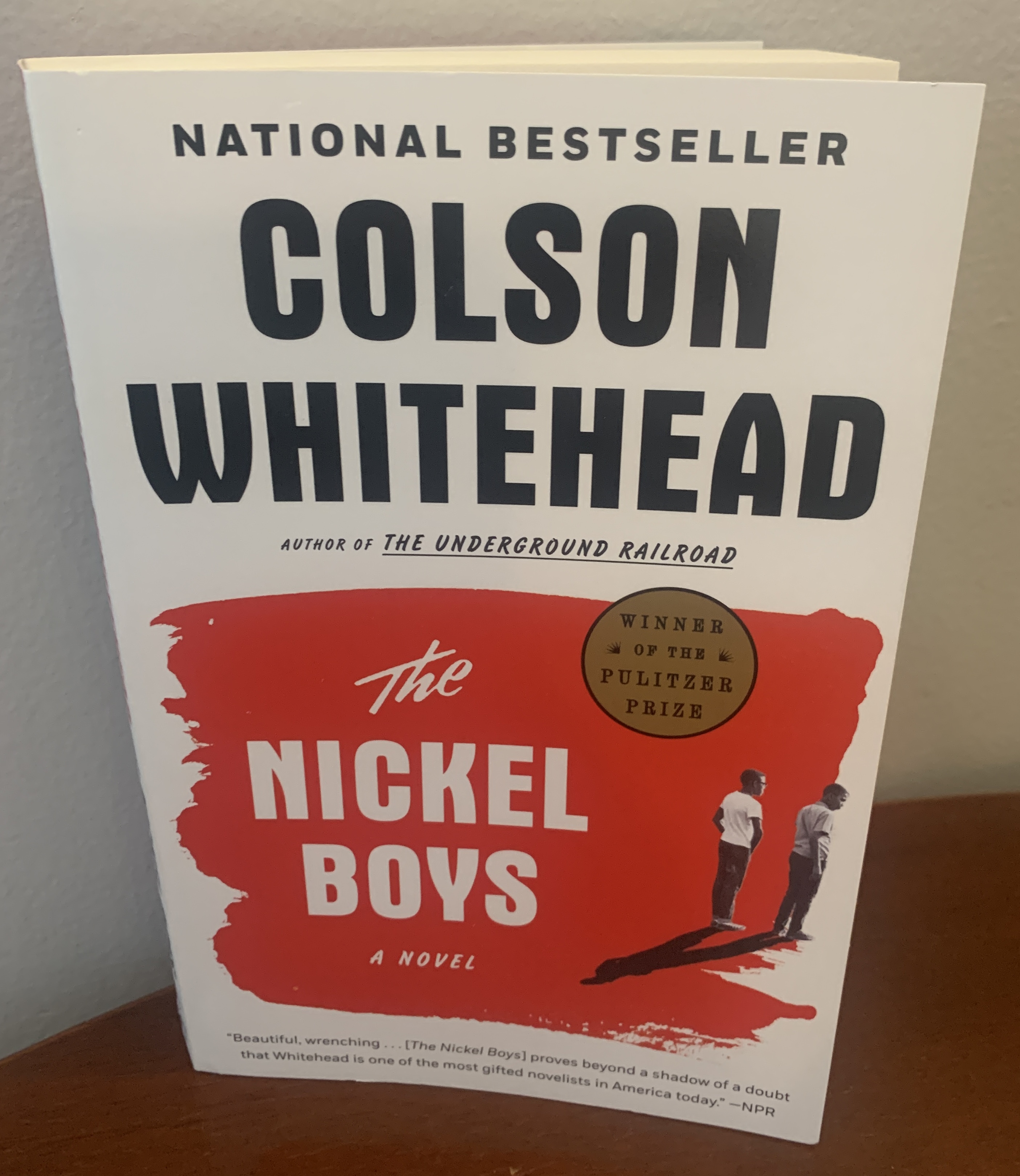
“I am a man.” Unfortunately, despite protestations otherwise, for much of American history, African Americans were not treated with the full dignity afforded them on account of their humanness and their enoughness. Indeed, this sordid history is still within the lifetime of many Americans, wherein full humanness is a relatively modern recognition. Colson Whitehead’s 2019 Pulitzer Prize-winning book, The Nickel Boys, uses a real-life story of an awful Florida “reform” school to elucidate what it means to be defiant against injustice and the exceedingly unbearable cost of that defiance. An extraordinary book from an extraordinary author, The Nickel Boys had one of the most jaw-dropping endings I can recall reading in quite some time. I was floored and deeply moved. Even writing my recollection of it brings forth goosebumps. Whitehead, in my experience reading this, The Underground Railroad, and Zone One, is a master craftsman at being economical with his potent words; there’s no wasted flourishes here. It’s gut punches, story, and characters that become entrenched in the reader’s brain. Everyone especially owes it to themselves to read The Nickel Boys. You won’t soon forget Elwood and Turner.
Elwood is a young Black boy growing up in Tallahassee, Florida, who was orphaned by his parents (they went off to California), and is being raised by his industrious grandmother, Harriet. Her industriousness has influenced Elwood, as has her playing one of Martin Luther King Jr.’s speeches recorded on a LP. Elwood doesn’t know if he can live up to the loftiness of King’s ideal: not even just to turn the other cheek in the face of injustice and racial discrimination, but to love the perpetrator of that injustice and discrimination in spite of their offenses. To carry the weight of it all. To persist. And yet, he will try throughout the book. In addition to being industrious about his job at the local drugstore, he’s also industrious about his learning, hence engaging with MLK, but also educationally otherwise; he wins what he thinks is a full set of encyclopedias at his previous dishwashing job, only to realize he’s been made a mark and he only has a fragment of them. (Being a mark will be a persistent them, including with Harriet, who gets taken in by a seemingly do-gooder white lawyer from Atlanta. But what is a mark if not a hopeful optimist? Someone who believes in the good within people?) Nonetheless, Elwood can learn something from the Ae section and they look nice on their bookshelf. This yearning for learning sets Elwood apart from his peers, who are often illiterate or only interested in horseplay, if they’re in school at all. Which is why Elwood even dares to dream about college and studying literature.
On his way to college, Elwood hitches a ride with a random stranger, a Black man. They are promptly pulled over by a racist cop who arrests Elwood for stealing the vehicle. Instead of going to a juvenile prison, Elwood is sent where all wayward boys — white, Black, and Latino — are sent in Florida: the Nickel Academy.
The Nickel Academy, established at the start of the 20th century, takes in boys for minor infractions, made up infractions, like Elwood’s, and orphans with nowhere else to go so they become wards of the state. Ostensibly, a great deal of money flows into the Academy because a great deal of money is also flowing out of the Academy via the Nickel Boys being put to work on the printing press and the brickmaking. Instead of using that money coming in to feed the boys well and maintain the property, the leadership at the Academy siphon off the money to enrich themselves and give the boys literal scraps in exchange.
At the Academy, the boys are split between those on the white side and those on the Black side, with one Latino floating in between because he confuses leadership. On its own, what I’ve described would be hellish. Imagine being erroneously sent to such a place or sent to such a place for relatively minor infractions. But in addition to those facts, the Nickel Academy features leadership and housefathers who are violently racist, and viciously whip the boys at the “White House,” a dilapidated shed behind the Academy. Some of the housefathers are also sexual predators, who abuse the boys. And then, if a boy has gone afoul of the “rules,” they are taken out back, shackled, and left for dead. They’re buried in Boot Hill cemetery in an unmarked grave with nobody to care or account for how they ended up there. That is what Elwood, who shouldn’t even be there, is up against.
Fortunately for Elwood’s sake, at least to some extent, he has Turner, who is back at Nickel Academy for the second time, to help him inasmuch as he can, and some of the other boys. For his part, Elwood figures he’ll keep his head down and make it through this ordeal and on to college — ostensibly you can “graduate” from the Academy once you move up to “Ace” or you can get demerits and a whipping at the White House. But he can’t help himself; he’s not a bystander. He’s not someone who can stay quiet and out of the fray. When he sees older boys seemingly bullying a younger boy, Elwood tries to intervene only to be sucker punched. One of the racist housefathers of the Academy don’t investigate further; they instead brutally whip Elwood like they do everyone else involved. Elwood figures they ultimately gave him more lashings because he was deemed “uppity” for trying to learn more than what the teachers were trying to teach him. Everyone, including the teachers, are skating by from one state inspection to the next; they only “care” when it’s inspection time.
Elwood’s assessment is that there are four ways to escape Nickel: 1.) serve your time, whatever that duration ends up being (could be six months, could be two years), or you could age out; 2.) the courts might intervene, which is about as likely as an asteroid hitting the Nickel Academy; 3.) you die; or 4.) you escape. Then, Elmwood devises a fifth option: get rid of Nickel, the asteroid option, if you will. Given his admiration of MLK, it’s not altogether surprising that Elwood chooses this option, whereby he chronicles the abuses ongoing at Nickel, as well as the financial fraud, and delivers it to one of the state inspectors during one of their “surprise” (an inside man usually warns the Academy leadership ahead of time) inspections. The thinking being, if only the state knows, then surely they’ll put a stop to what Nickel is doing. The brilliance of Whitehead’s depiction of the state inspectors when they do come is that each state inspector reminds Elwood of someone who evinces the unreality of America at that time: someone reminiscent of JFK (the promise of the era prior to his assassination); Jackie Gleason of The Honeymooners; and Mayberry (the latter two the epitome of that myopic 1950s and 1960s white American culture).
At this point, it should be noted that Whitehead flashes forward in his book to where Elwood has survived his Nickel ordeal and is in New York City during the 1960s. He’s even on the cusp of, and eventually does, starting his own moving company appropriately named Ace Moving. That fast-forwarding goes even further into the 1980s and then around 2014, with Elwood now married and considering returning to Tallahassee as news of the Nickel Academy’s buried bodies comes to light.
What does it mean, though, to be a man in an unjust time? What is one to do? Bear it and survive? Resist and bear the punishment? Resist and die? As an adult, Elwood runs into an old Nickel Boy named Chickie Pete and they get a drink together. Elwood muses about whether Chickie Pete could have played his trumpet professionally, if things had been different. If they hadn’t been ruined by “that place.” He continues, “All those lost geniuses — sure not all of them were geniuses, Chickie Pete for example was not solving special relativity — but they had been denied even the simple pleasure of being ordinary. Hobbled and handicapped before the race even began, never figuring out how to be normal.” That’s one of the greatest, more difficult to quantify tragedies of America’s history of subjugating Black men and women: what could they have been without such an anvil around their necks? Indeed, as Elwood says, even the opportunity to be ordinary and normal is itself the gift of our humanness and they were denied that, too. But being a man, in King’s estimation as Elwood understood it, goes deeper than merely the ability to live ordinary. It is to “cultivate that pure love for their oppressors, that it might carry them to the other side of the struggle.” Turner analogized Nickel Academy to an obstacle course to navigate in order to survive, whereas Elwood at least agrees with King that the only way through it is through it. He struggles, though, with this idea of loving the oppressor, especially with it no longer an abstraction. He considers King’s quote, “But be ye assured that we will wear you down by our capacity to suffer, and one day we will win our freedom.” Elwood is not so certain about his capacity and perhaps what’s also left unsaid is if “one day” even includes him. Elwood argues that the Nickel boys absolutely existed within the capacity for suffering. “The beatings, the rapes, the unrelenting winnowing of themselves. They endured. But to love those who would have destroyed them? To make that leap?” It’s an impossible things, he concludes.
Perhaps, though, Elwood can beat them on their own playing field, which is to say the documentation of their wrongdoing and hope that white men of good conscience will do something about it. However, when the time comes for Elwood to hand off the letter to “JFK,” Spencer, the superintendent, asks Elwood to deliver an errand to a farmer far away. Thankfully, Turner, who had initial misgivings about Elwood’s plan, decides he’ll deliver the letter to JFK for Elwood.
Somehow, Spencer and the other housefathers learn about the letter handed off to JFK, and knowing that only Elwood could have written it, they send him to solitary confinement, itself a brutal, inhuman punishment. To paraphrase Elwood, the worst that can happen to a man in solitary confinement has already happened: to wake up. Turner again comes to the rescue, thanks to his ability to relatively freely roam the campus unlike other students. He frees Elwood and has a plan in place to escape, utilizing the various stops they had visited as part of “community service” (which really meant siphoning off the money and goods they received from the state) to take what they needed to effectuate their escape. Instead, sadly, the housefathers, including one of the white men who seemed friendly to them, of course, catch up, shotguns in hand. Elwood and Turner run for their lives and as they approach a fence, Turner is able to scale it, but Elwood is shot dead. What?! Again, goosebumps. I thought Elwood survived; we’d been reading about him in the flash-forwards, with his wife and moving company! Turns out, when Turner survived that initial capture, he fled to New York City and took Elwood’s name as his own. Even his wife didn’t know his real name, Jack Turner, until he told her in 2014.
So permeating is the injustice and the trauma of the Nickel Academy that Turner fears even returning there with other survivors, lest he be arrested — 40-some years later! — for escaping. But he goes back because all the survivors are speaking for the white boys and it’s time someone, like him, spoke for the Black boys. The book ends with him eating at the place that used to be a hotel where Elwood worked as a boy (unbeknownst to Turner’s memory).
What an astonishing, heart-wrenching story, which come to find out, is based on a true story that inspired Whitehead’s book, the Arthur G. Dozier School for Boys in Marianna, Florida, a “reform” school like Nickel Academy, that existed from 1900 until, shockingly, 2011. So far, at least 81 bodies have been identified, along with hundreds of known survivors of abuse.
In the end then, what does it mean to be a man against such odds? What did it mean for Elwood, who didn’t even survive the ordeal? It’s difficult, of course, to speak for Elwood, but I think Turner likes to imagine that Elwood would be proud of what Turner had become: normal, ordinary. He had the opportunity to live a normal life. To start a business. To get married. To just freakin’ live. Yes, he still had to do it under a lie, because history is not so long ago, but all the same. Elwood represents a more optimistic, persistently stubborn version of the story, embodied by King, and like King, he died prematurely, violently, murderously, whereas Turner represents a more cynical view, that the world is hell and there ain’t no changing it, only surviving it. What does it mean to be a man? Perhaps Whitehead is telling us to be a man is to hold both worldviews within our complex brains and only when the abstract becomes real do we learn what we’re made of and which direction we’ll go.


