
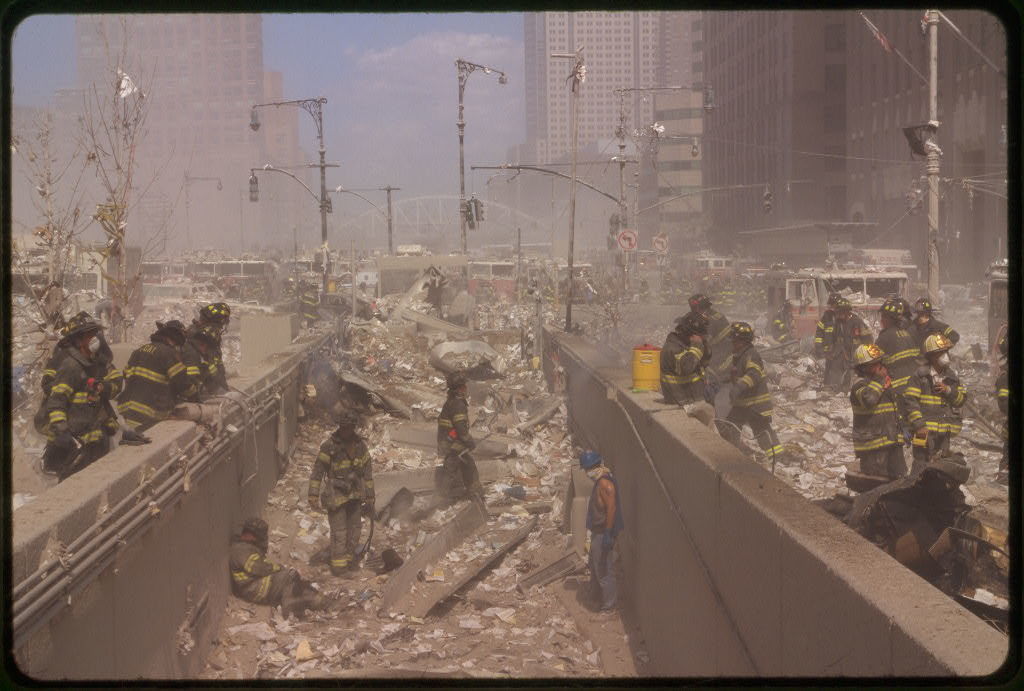
On the 25th anniversary of 9/11, as many others have done, I’ve been reflecting, reading, and viewing a lot about that day. It’s hard to imagine that it’s been so long because in many respects, that day feels close at hand. More difficult to imagine is that nearly 100 million Americans have been born since that day and thus, have no memory of it. It’s become history. Far from never forgetting, we need to actually tell the story.
To that end, at least as it regards my own memory of that day, I was in my sixth grade history class; Ms. Hamilton’s class specifically (and I always have remembered that she had a daughter named Paris since that name stood out to me as so unique when I was a child), when our math teacher came into the room to tell her to turn on the TV. No, it wasn’t one of those TVs they rolled in (although we had those, too), but a TV protruding from the wall. I remember her shocked gasp because at that time, the second plane hit. Then we went to English class — it’s interesting I remember Mrs. Hamilton’s name, but the math and English teachers’ names are just out of reach — and she tried to get us to do work. It might have even been a quiz. But nobody could focus. My next memory is coming home and the neighborhood kids gathering on the playground between the houses of my two neighbors in our cul-de-sac, where we, as sixth and seventh graders, discussed the news. We didn’t know anything or understand it, obviously, and I don’t recall what exactly what was said; I only remember being in that circle. Then, it was dinnertime, and I distinctly remember being annoyed that it was still on the TV, and asking my mom why everyone was watching it all these hours later. I had no sense of the attack, of course, or the obsessive nature of why everyone remained glued to their TVs, or the chaotic, disorienting feeling that more attacks could be coming. (I don’t remember my mom’s response.)
But more importantly in terms of telling the story, I spent most of Friday and some of Saturday morning reading and watching various personal stories that better tell the story of 9/11 than those aforementioned 100 million Americans will get from a textbook per se. Of course, I’d also highly recommend Lawrence Wright’s 2006 book, The Looming Tower: Al-Qaeda and The Road to 9/11, I finished the day before and reviewed. A note about the below recommendations: some of these articles appear behind paywalls, but hopefully you have an opportunity to engage with these remarkable stories at some point.
There are generally speaking, in my humble estimation, three definitive longform articles about 9/11 that are a must-read (in no particular order):
“The Falling Man” by Tom Junod, published in Esquire magazine.
“The Real Heroes Are Dead” by James Stewart, published in The New Yorker.
Honorable mention to:
“What Bobby McIlvaine Left Behind” by Jennifer Senior in The Atlantic.
I’m going to include the link in the headline and a little excerpt I found compelling and/or my own (very brief) commentary. What I read/watched on Friday/Saturday:
“They cleaned up ground zero. Now many are hiding from ICE” by Jasmine Garsd, published in NPR.
“I am scared. We are all scared”, says Lucelly, the woman who took her lunch breaks in the rubble of ground zero. “My daughter lives in New Jersey, and I don’t even go visit her, because I am scared of immigration. It is a new pain on top of an old one.”
“At some point you were closer to the last time than you were to the first time, and you didn’t even know it. You didn’t know that each time you passed the threshold you were saying goodbye.”
Well-worth watching the full clip. (The Glenn Beck chalkboard really took me back.) It’s difficult to put into words how nuts it is that a Republican Senator is a 9/11 truther. Tell that to a Republican Senator 15 years ago and it wouldn’t even compute.
“The cloud of Sept. 11 grew darker when Joe, who had helped with recovery efforts after the towers came down, developed esophageal cancer — an illness that has been linked to exposure to toxins at the World Trade Center site.”
I’m glad Jake kept going when suicide initially seemed like an appealing option to him.
“… a department that originally was created to look externally, identifying threats and stopping plots before they could enter the U.S., has instead become increasingly focused on policing U.S. residents.”
DHS has overstayed its welcome, to say the very least.
“A Letter to Myself on 9/11” by Mark Hertling, published in The Bulwark.
“Humility will be one of the most important qualities in leadership and strategy. The stronger you become, the more important it will be to recognize what you don’t know.”
“‘The sirens are going, the lights are going, and there are firefighters pulling on their equipment, getting ready to go save lives, waving out the back door to me,’ he recalled. All 11 of those firefighters on Rescue One had less than two hours to live.”
“What we forget when we remember 9/11” by Stephanie A. Martin in The Conversation.
“When an event once remembered in minute detail becomes a date others know only from history, the passage of one’s own life becomes newly visible.“
“Men offered the shirts off their backs to cover the children. Remarkably, they covered more than 3 miles in search of shelter and safety, getting as far away as they could from what we later came to call ground zero.”
A remarkable story of two women getting their daycare kids out of danger.
“My dad thinks sharing his story might help us be more open with each other. He’s also hoping it will help others who hear or read his story open up to their loved ones too.”
“At the FBI, more than 400 people have 9/11-related illnesses and at least 33 have died from 9/11-related cancers, according to the bureau.”
“The Lost Journalistic World of 9/11” by Matthew Cooper, published in Washington Monthly.
“The terrorists maimed our cathedrals, as she wrote in Time. But two decades later, we’ve done a pretty good job of defacing our institutions all by ourselves.”
“A Quarter Century of Panic” by Tom Nichols, published in The Atlantic.
“The same threats that existed before 2001 remain with us, even though American leaders stopped paying attention to them for too long because of the inherently doomed attempt to reduce the threat of terrorism to zero.”
“Al’s 19-year-old son Josh had just woken up at his mom’s house in New Mexico. He saw the plane hit the tower on live TV. He didn’t realize he was watching his dad.”
Sad story that kept unfurling in unfortunate ways years after that fateful day.
Incredible story of survival, perseverance, service, and inspiration.
Fascinating to look at, and quite surprising to me that the Burger King is still there.
“On Being a 9/11 Kid” by Cat Brennan, published in “The Dispatch”.
“How many of my classmates had a parent’s death detailed and photographed in their textbook?”
Sobering, smart reflection.
“The Painter on the Street” by Ottessa Moshfegh, published in GQ magazine.
“All I felt I could do was stay alive until the darkness passed. I was twenty years old. In hindsight, my mom was probably visiting me in New York that day to check on me. At the time, I figured she just wanted a daylong vacation and a new Chinatown watch.”
Such a great read.
“Where is it written that life will be so accommodating?”
An intriguing, if rather thankless, side of 9/11 I didn’t previously know about.
“The Man in the Red Bandanna” published by ESPN.
13-minutes well-worth watching. Such a damn hero.
“9/11 and the Digital Media Era” by David Friend, published in Vanity Fair magazine.
“With social media, we elevate the exhibitionist and the voyeur. With streaming services and YouTube and 24/7 content, we can binge our days silly. In a way, we risk becoming a culture of viewers instead of doers, a society of spectators.”
“The powers previous presidents amassed are now being turned against us. We’re here now because we were too arrogant, or naïve, to think that was possible. We’re here because we thought the Oval Office was too revered and stately … to be co-opted by authoritarianism.”
Myriad takeaways, but most provocatively from him: any honest assessment 25 years on from 9/11 must conclude that we’ve lost. Our allies. Our way. Our freedoms.
“The Man Who Refused to Sit on the Sidelines” by Sally Jenkins, published in The Atlantic.
“He’d tell his sons not to be bystanders. ‘Don’t sit on the sidelines. Make things happen. Do things.’”
Staggeringly beautiful. Kevin was a hero, and his two sons took up his mantle.
“The Untold Pre-History of 9/11” by Chris Naylor, published in the National Interest.
“And if the job seems too big and too demanding, I can only suggest that we would do well to think of the consequences and alternatives.”
Fascinating piece.
I could have listened to Blight and Graff talk all day about America and historical events.
A gripping story about the search for a disposable camera from within the twin towers on 9/11, with a heck of a twist involving former FBI agent Sachtleben with a very different set of photos.
“I worry that the powerful counterterrorism instruments will be used in ways that infringe on civil liberties even as major threats go unaddressed.”
Ben Chevat, the group’s executive director, said the documents showed that the city knew about the toxic chemicals’ danger, “even as city officials continued messaging to the public that the air was ‘safe and acceptable.’”
If there’s not one on here that you would highly recommend, please share it with me.


