
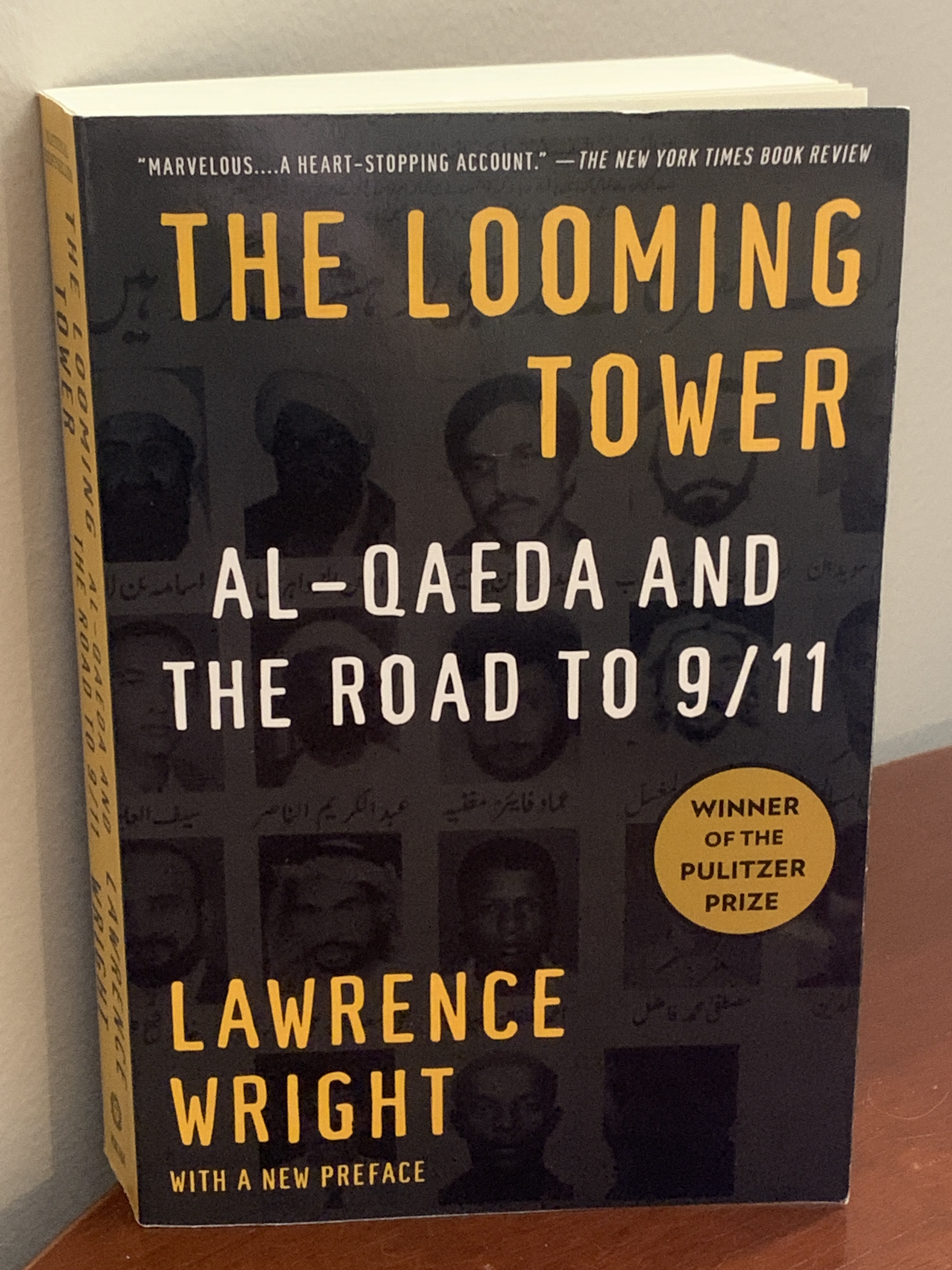
On the eve of the 25th anniversary of 9/11 as I write this, it’s natural to wonder if that tragic day was avoidable. Obviously, and most importantly, it was avoidable if radicalized, delusional, and fanatical men like Osama bin Laden and the 19 hijackers didn’t orchestrate and perpetrate it. If bin Laden instead stayed the son of a celebrated construction worker in Saudi Arabia, and if the 19 hijackers, not rendered terrorists by way of poverty or illiteracy, but something more insidious — a misguided need for belonging and purpose —, found their purpose through something positive. But we also have to wonder if American intelligence agencies, chief among them the Federal Bureau of Investigation, the Central Intelligence Agency, the National Security Agency, that we pour billions of dollars into annually to ostensibly protect Americans, could have prevented bin Laden and the hijackers from executing on their violent vision for that day. Reading journalist Lawrence Wright’s 2006 Pulitzer Prize-winning book, The Looming Tower: Al-Qaeda and the Road to 9/11, one is left with the sad conclusion that 9/11 could have been prevented, if only the alphabet soup of U.S. agencies worked better together and took more seriously the intent of those who wished to do us harm. Admittedly, it feels too neat, too retroactively reassuring to conclude as much. Such is the complexity of world historic events and the helpful benefit of hindsight. And yet, as one walks this road with Wright, the red flags proliferate, and tragically, are missed. As we remember the 2,977 victims from that day, including about 9,677 deaths from 9/11-related illnesses thereafter, every American owes it to themselves to understand why 9/11 happened — what motivated bin Laden, al-Qaeda, and the 19 hijackers — and the ways in which our own government failed to protect us. Wright’s book is surprisingly accessibly as an invaluable artifact to this end, and because of that, informative, but also deeply heartbreaking and maddening.
By 2001, al-Qaeda consisted of 300-400 men, who had declared their loyalty to bin Laden and the cause of jihad: waging holy war against the United States and modernity itself, with the stated goal of achieving a pure Islamic State. About 30,000 to 40,000 affiliated fighters from numerous countries in the world shared in that mission, a mission with its seeds dating back to the 1940s shortly after WWII and with the creation of Israel. 9/11 was the culmination of bin Laden’s efforts to drag the U.S. into the land where empires go to die, Afghanistan, and subsequently, fall as the Soviet Union had (there were prior attacks with this same aim). But as alluded to, to better understand 9/11, the road begins with Sayyid Qutb in 1948 America. An Egyptian author and intellectual, Qutb was traveling throughout America, first seeing our big cities before settling in Greeley, Colorado, where he came away with the impression that despite the proliferation of churches he saw, materialism was the real American god. Indeed, amid the onset of the Cold War, framed as communism vs. capitalism, Qutb saw the real war as between Islam and materialism, or modernity. Modernity includes secularism, rationality, democracy, individualism, mixing of the sexes, tolerance, and yes, materialism. To be clear, Qutb, and later bin Laden, had no real prescription for what the government under Sharia or Islamic law would look like. It was an end of itself. They weren’t concerned about governing beyond establishing and governing the purity of Islam as they interpreted it. Qutb framed this project as a duty, saying, “Only by restoring Islam to the center of their lives … could Muslims hops to recapture their rightful place as the dominant culture in the world.” He took up common cause back in Egypt with the Muslim Brothers (or Muslim Brotherhood), a radical group intent on overthrowing Egypt’s first native leader, Abdel Nasser. That initiated the perpetual action-reaction between the radical elements and the Egyptian government: the former attacks (or attempts), and the latter reacts disproportionately, seemingly imprisoning, torturing, and executing scores of individuals who may not have been affiliated with the causal event. While Qutb would be hanged in 1966 for his efforts, others would take on the mantle, such as Ayman al-Zawahiri.
Zawahiri was only 15 when he first started planning to overthrow the Egyptian government. In fact, he rejected the Muslim Brotherhood for compromising too much, another theme we would see in terms of creeping radicalism. He started his own group, al-Jihad. That group would later merge with al-Qaeda for financial reasons (bin Laden as the financier), and introduced the idea of suicide bombings to the group (the actual concept of suicide bombings predates the group, with Hezbollah and Hamas). Even though suicide is expressly forbidden under any scholarly reading of the Quran, Zawahiri twisted it to be acceptable if the act was aimed at perceived infidels. Before he was executed, Qutb was tortured in prison. Zawahiri would also be imprisoned at one point, and also tortured by the Egyptians. As such, Wright said, “One line of thinking proposes that America’s tragedy on September 11 was born in the prisons of Egypt.” Wright continues that torture created an appetite for revenge in Qutb and his acolytes, like Zawahiri. Why blame the West, though, and not just the Egyptian government? The West were the enablers of the regime, and worse still, it’s the West and its ever-encroaching modernity that has corrupted and humiliated Islamic society. To the latter, the very essence of torture is humiliation, which are the seeds of anger and revenge in the tortured. Wright provides a specific example of how awful the Egyptian government could be. When a plot headed by Zawahiri, with the help of the Sudanese government, was uncovered to assassinate Egyptian President Hosni Mubarak in 1995, Mubarak’s regime responded with a major crackdown across the country. They then lured 13-year-old Ahmed, the son of a known jihadist, into a home with juice and videos, only to drug and sodomize him, which they took photos of and threatened to show his father if he didn’t help them. They then forced him to recruit another child, Mus’ab, who was also the son of another jihadist, this one the treasurer of al-Qaeda. He was also humiliated and abused with drugs and sodomizing. Egyptian agents then sent the boys to kill Zawahiri. But of course, he’s no angel either. He captured both boys, stripped them naked to prove they had achieved puberty, forced them to confess to what happened to them on videotape, and then videotaped their executions, too.
Bin Laden’s family was originally from Yemen, but came to the Kingdom of Saudi Arabia, a country run and influenced by the Wahhabi sect of Islam, which sees no difference between religion and government. His father, Mohammed, had 54 children with 22 wives; Osama was the 17th son (he followed in his father’s footsteps with four wives and 17 children). The father, largely illiterate and unschooled, became a successful, wealthy construction worker, who helped develop much of the nascent KSA, engendering close ties to the royal House of Saud. Incidentally, Mohammed died in a plane crash. One interesting counterfactual is to wonder what KSA would look like today if King Faisal wasn’t murdered in 1975. Not that KSA under his rule was a bastion of modernity and progressive values, but he did make attempts to modernize the country, lessen the power of the Islamic clergy, and end slavery. Nonetheless, between his assassination and the 1979 takeover of the Grand Mosque in Mecca by Islamist militants, the royals felt too threatened by such elements and KSA became even more conservative in its approach, i.e. enabling more influence to be exerted by the religious establishment, an establishment they needed to retake the Grand Mosque of Mecca from the Islamic radicals. Understanding the power dynamics in KSA is crucial to understanding the environment in which bin Laden comes out of, and would ultimately be a key motivating factor in his desire to attack America.
Another important inflection point in 1979 was the Soviet Union’s invasion of Afghanistan, pitting the communist droves against the mujahideen, the Afghan fighters. Sheik Abdullah Azzam, who inspired bin Laden, praised the Afghan mujahideen, and tried to adopt their struggle and adapt it to his: this was not just a fight in service to one’s country, but a fight in service to Islam writ large. Indeed, Azzam issued a fatwa, or ruling on a point of Islamic law (as he interpreted it), that jihad in Afghanistan was obligatory for every able-bodied Muslim. Given that it was the Cold War, the U.S. was involved, funneling money and arms to the mujahideen, alongside the Saudis, through an intermediary (the Pakistani ISI, its intelligence service). But for the most part, it’s worth noting that the Arab fighters who came to Afghanistan trying to co-opt the struggle, as it were, were largely ineffective in countering the Soviets. Their “success” was more PR than it was the reality on the ground. Bin Laden himself crossed over into Afghanistan, settling high in the mountains to finance the mujahideen. In this way, Wright said bin Laden eclipsed his mentor, Azzam, and became the “chief private financier of the jihad.” That impression would stick for many years thereafter, even when bin Laden was destitute and disconnected, no longer able to bankroll the effort. These militants who came from various countries in response to Azzam’s fatwa and bin Laden’s bankrolling is what would constitute al-Qaeda when it was formed years later. Azzam believed war was against nonbelievers, though, not necessarily wayward Muslims, and as such, opposed killing innocent civilians; still, he believed in restoring the Islamic State though the old Muslim empire. He just needed a vanguard as its base, or qaeda. In August 1988, al-Qaeda was born, although Wright said it was secretly established a few months prior.
Originally established ostensibly in the mold of the mujahideen, defending Muslim lands when they threatened, al-Qaeda would expressly become a global terrorist organization justifying offensive attacks against civilians, including Muslims seen as apostate. One must find it darkly amusing that bin Laden brought his father’s construction business bureaucratic structure and mindset to al-Qaeda. Most of the leadership council were Egyptians, including Zawahiri, but also had members from Algeria, Libya, and Oman. They opened an office in Peshawar, Pakistan, and created a constitution and bylaws. New recruits signed an oath to bin Laden, as I mentioned at the top, and swore themselves to secrecy. Here’s where the darkly amusing part comes in: single members earned a $1,000 month salary (married members received $1,500), and everyone received an annual round-trip ticket home each year, with a month of vacation, a health-care plan, and if you changed your mind about jihad, a buyout option of $2,400 (although I’m skeptical they would have been allowed to merely “go on their way” after the buyout). Like his father before him, by 1989, bin Laden was the equivalent of a celebrity in KSA, which was uncommon outside the royals. He was worth about $7 million.
The next inflection point came with Saddam Hussein’s invasion of Kuwait, which the Saudis feared was the first step into attempting to control their oil fields. They begged the United States to protect their country. American forces for the first time touched down in KSA, holy land, and then obviously, with the first Gulf War, went on to wage war against Saddam. Ostensibly, American forces stationing in KSA was to last the duration of the war, but it persisted. This would be one of those major sticking points for bin Laden: seeking to remove America from its place in the holy land. By this point, though, bin laden was wooed, as it were, by the new military leader of Sudan, Omar al-Bashir, who effectuated a coup of the Sudanese government in 1989. Like his father before him, al-Bashir saw bin Laden as someone capable of financing and building his country.
After pressure from the Egyptians, the Saudis finally revoked bin Laden’s citizenship in 1994 for being too outspoken against the Kingdom and for his militancy, of course. Even his family turned their back on him, cutting off his Saudi allowance. This is when bin Laden’s ability to finance terrorism dries up. Wright said some see this as another inflection point, the last one, to full radicalization. Even Sudan eventually kicked bin laden out two years later in 1996 because they didn’t want America to consider Sudan a state-sponsor of terrorism. Back to the mountains bin Laden went, where Wright thinks he enjoyed such destitute living anyway. At least, it fit with the PR image bin Laden put further, but in reality, even in the mountains, the al-Qaeda operation was more “modern” than we would imagine. He used a satellite phone, after all.
So, what’s going on in America? With the fall of the Soviet Union, Wright said, “America was the only power capable of blocking the restoration of the ancient Islamic caliphate, and it would have to be confronted and defeated.” However, in the 1980s and 1990s, most people in America, including the FBI and CIA, had not heard of bin Laden or his group, nor did they have many staff on hand who could even translate Arabic. It doesn’t seem like the initial attack on the World Trade Center in 1993 put Islamic terror more at the forefront either. Zawahiri came to California shortly after the 1993 bombing to “tap the rich American vein for al-Jihad,” with the help of his guide, Ali Abdelsoud Mohammed. A former member of the Egyptian military, Zawahiri tasked Mohammed with infiltrating American intelligence. He later joined the U.S. Army, openly Muslim, which Wright said was the secret to Mohammed’s double identity: he never hid his beliefs. For American soldiers deploying to the Middle East, Mohammed helped orient them to Middle East politics and culture, while also “slipping maps and training manuals off base to downsize and copy at Kinko’s.” These he used to write a multivolume terrorist training guide that became al-Qaeda’s playbook. After the U.S. Army, he settled in the Silicon Valley with his wife. In 1993, he was still trying to penetrate American intelligence, and he spoke to counterintelligence specialists with the Department of Defense, where he specifically showed them mujahideen training camps in Afghanistan and mentioned bin Laden, as well as making a reference to al-Qaeda. It still would take three more years before “anyone else in American intelligence would hear of al-Qaeda.” Since al-Jihad had not yet merged with al-Qaeda, Wright reasons that Zawahiri was willing to sell out bin Laden in order to gain access to American intelligence to benefit his organization. Regardless, he concludes, “If the FBI and the Department of Defense’s counterintelligence team had responded to Mohammed’s overture, they would have had a very dangerous, formidably skilled double agent on their hands.” The report was filed with the FBI and forgotten. And later, when the FBI sought more documents, the Department of Defense said they had been lost.
John O’Neill was the FBI’s chief of the counterterrorism unit, nicknamed the Prince of Darkness because he struck quite the image as the person hellbent on tracking down terrorists, like bin Laden, while presenting himself as polished and dapper with his suits and fancy shoes. His first official day on the job, two years after the ’93 WTC bombing, he coordinated the rendition (kidnapping and relocation) of the bomber, Ramzi Youssuf. O’Neill also led the Middle East squad in the NYC field office known as I-49. O’Neill’s counterpart was Dan Coleman, who was assigned to Alec Station in Virginia, a standalone unit within the CIA, and “labored alone” on the bin Laden case. Michael Scheuer, a CIA analyst, was O’Neill’s other counterpart, who detested him, but regardless, was also later sidelined on the bin Laden case as O’Neill would be. O’Neill and Scheuer butting heads was a microcosm of the turf war and friction between the FBI and the CIA that would be the central fact for why 9/11 wasn’t prevented, if it could have been. The CIA simply didn’t share pivotal intelligence with the FBI, and the FBI likewise, didn’t want to share what it knew, either. The former worried that any intelligence could compromise their sources and relationships with foreign services, and the latter saw any intelligence as potential evidence that couldn’t be compromised.
After the vacuum left in the wake of the Soviet invasion of Afghanistan and the resulting civil war between the warlords, the Pakistani ISI and Saudis were back at it funneling money and weapons into the country, but this time to a group known as the Taliban, who they thought were the best option to restore order. Oops. Around the same time in 1996, bin Laden declared war on the United States. Again, he mythologized himself as this primitive person (purity of Islam) up against the evil empire of the U.S., the goliath, but he wasn’t primitive by any stretch, nor was al-Qaeda. The son of a construction magnate, Wright said bin Laden built his cave in Afghanistan with heavy machinery, outfitted with computers and advanced communications devices. But it was this primitive stance that was “appealingly potent, especially to people who had been let down by modernity.” Wright continues, “… the mind that understood such symbolism, and how it could be manipulated, was sophisticated and modern in the extreme.” A reflection of this sophistication was the coordinated 1998 American embassy bombings in Nairobi and Tanzania, the first real attributable attacks to al-Qaeda, again intended to draw the U.S. into a war in Afghanistan. Wright addresses a question we might have, though: Would 9/11 have been possible without bin Laden to steer it? Wright doesn’t think so. Yes, the conflict between the West and segments of the Arab Muslim world had bubbled up long before bin Laden, but al-Qaeda depended on bin Laden’s vision of an international jihad corps when most previous movements were focused nationally, like in Egypt or on Israel. “It was bin Laden’s tenacity that made him deaf to the moral quarrels that attended the murder of so many and indifferent to the repeated failures that would have destroyed most men’s dreams,” Wright said. Which makes the siloed, lackadaisical response to him on the American side all the more damning and frustrating.
Khaled Sheik Mohammed, uncle to Yousef, was the mastermind behind 9/11, intent upon hijacking planes and finally taking down the World Trade Center. He proposed the idea sometime around 1996, envisioning a wave of hijacked planes in the East Coast and then in the West Coast. In the spring of 1999, bin Laden greenlit Mohammed’s plan. The goal wasn’t only symbolic damage; bin Laden had dreams of grandeur, imagining the attack could actually bring down the U.S. Bin Laden later decided that the attack on the West Coast could wait. Two of the men originally chosen were Nawaf al-Hazmi and his friend, Khaled al-Mihdhar, both rich Saudi kids. Wright said the movements of these two men offered the most realistic hope for American intelligence to uncover the 9/11 conspiracy. In addition to these two, there was Abu Bara and Khallad (the name he took on). It should be noted that al-Hazmi, Khaled, and Khallad all fought with the Taliban against Ahmed Shah Massoud’s Northern Alliance (Massoud would be assassinated two days before 9/11). Khallad would go on to be the mastermind behind the USS Cole bombing on October 12, 2000. Mihdhar, Hazmi, and others met in Kuala Lumpur, Malaysia. The fact of the meeting was picked up by the NSA. They didn’t pursue the matter further, but the CIA already had the names Mihdhar and Hazmi, as Prince Turki of KSA had alerted his American colleagues that they were members of al-Qaeda. The CIA broke into Mihdhar’s room when he was on his way to Malaysia to take photos of his passport, faxing it to Alec Station. That passport indicated Mihdhar had a multi-entry America visa set to expire in April. While the CIA said the FBI had this information, they did not. By this point, Scheuer was sidelined at Alec Station, and this pivotal Malaysia meeting wasn’t wiretapped, so, no further information was revealed about the plots of the USS Cole and 9/11 attacks. The Saudis sent the FBI their own cable about Mihdhar’s American visa, which an FBI agent, Doug Miller, read and asked permission to advise the FBI further on (he needed permission to transmit that information from the CIA, where it originated at Alec Station to another intelligence organization, the FBI). He was told it was not a matter for the FBI. No follow-up occurred. Three months after this meeting, the CIA learned Hazmi flew to Los Angeles on January 15, 2000. Wright said if they had checked the flight manifest, they would have seen Mihdhar with him. Regardless, they never notified the FBI or the State Department that at least one known al-Qaeda operative was in the country. (Some theorized that the CIA withheld this information in the hopes of turning Mihdhar and Hazmi down the road.) Hazmi and Mihdhar would be on American Airlines Flight 77, which was crashed into the Pentagon. The bitter irony is that one year before 9/11, New York’s Joint Terrorism Task Force, a coalition of the FBI, CIA, NYPD, the Port Authority, and others, celebrated its 20th anniversary in the Windows on the World banquet room atop the North Tower. Mary Jo White, the U.S. Attorney for the Southern District of New York, praised the team for their “close-to-perfect record of successful investigations and convictions.”
In one of bin Laden’s speeches, he tried to rally the 9/11 hijackers, pushing the point of humiliation by saying, “It becomes clear to us that shying away from the fight, combined with the love of earthly existences that fills the hearts of many of us, is the source of this misery, this humiliation, and this contempt.” The 9/11 hijackers were well-educated, otherwise had skills, and lived comfortably in the West, and yet, Wright says, bin Laden’s words reached into their hearts and resonated with their sense of shame. Bin Laden then quoted the fourth sura of the Quran, which he repeated three times, “Wherever you are, death will find you, even in the looming tower.”
O’Neill on 9/11 was retired from the FBI, and was less than three weeks into his new job at the World Trade Center. He wouldn’t survive the attack. More bitter irony. But for all his flaws as a man (he was a philander), he was a hero on that day, and as Wright estimated, our best chance at preventing 9/11.
In the Quran, it is said that the taking of a single human life destroys a universe. As the dead from 9/11 testify to (Wright has a beautiful quote about the “universal parliament” of the victims, ranging from 62 countries and every ethnic group and religion in the world), “Al-Qaeda had aimed its attacks at America, but it struck all of humanity.”
The Looming Tower is a story where we know the ending, tragically and sadly. And indeed, that it was also the beginning of a post-9/11 world, the War on Terror, bin Laden’s wish of an American war in Afghanistan, and on the domestic front, draconian civil rights violations of ordinary Americans in the name of that War on Terror. There is so much more one can say about how the U.S. tragically squandered the good will of the world after 9/11 with its invasion of Iraq, among other actions, and the botched initial attempt to get bin Laden at Tora Bora. But that’s a story for another day. Wright’s story is about how vital it is that we understand the road to 9/11, what radicalized the hearts of men to commit atrocious acts, and the fundamental systemic flaws that prevented good men from stopping it. I would have liked a postscript from Wright evaluating the ways in which the FBI, CIA, and NSA addressed their failures to prevent 9/11, and what that looked like (notwithstanding the creation of the Department of Homeland Security). Otherwise, I can’t recommend Wright’s book enough. The Looming Tower is one of the best nonfiction books I’ve ever read, clearly deserving of its Pulitzer Prize.


One thought